

Table of Contents
Part 1 - 5 Surprising Reasons Libreng Forex Signals Can Fail Your Portfolio
Part 2 - 7 Metrics to Compare Libreng Forex Signals and Paid Signals
Part 3 - Libreng Forex Signals vs Paid: Profitability and Stability Compared
Part 4 - 5-step checklist to evaluate paid and libreng forex signals
Part 5 - Tired of losing trades? Fix issues with libreng forex signals
Marami ang naa-attract sa libreng forex signals — tipong "Copy this trade, TP at 100 pips" sa Telegram or Facebook. Sino bang hindi gaganahan, 'di ba? Pero ang tanong: talagang kumikita ba? O baka naman, libre nga pero ikaw ang lugi sa dulo?
May isang EasyCashBackForex engineer ang nagbiro, “Libre nga ang signal, pero mahal ang drawdown.” Di mo alam kung tatawa ka o iiyak — kasi minsan, totoo eh.
Kung sawa ka na sa puro fake promises, inconsistent entries, o delayed SL/TP hits, this is the article you need. Walang kalokohan, walang sugarcoating — ilalatag natin ang side-by-side comparison ng libre vs paid signals: sino talaga ang mas kumikita, at alin ang mas stable sa long run.
Kasama rin dito ang 5-step checklist at 7 solid metrics para masukat kung worth it ba ang signal provider mo — para 'di ka na magti-take ng trades na parang nagsusugal lang.
Sa dulo, tutulungan ka naming ayusin kung paano mo ginagamit ang signals. Hindi lang basta "sino ang panalo," kundi paano ikaw ang mananalo.
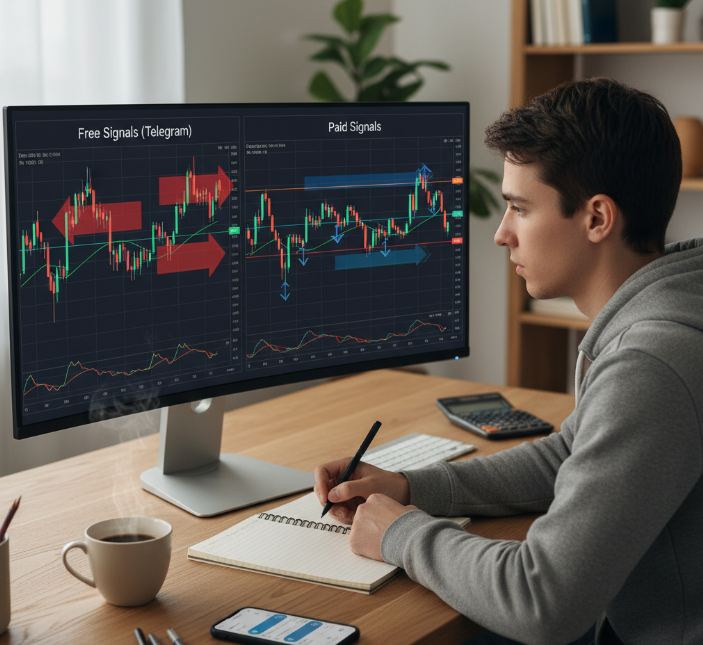
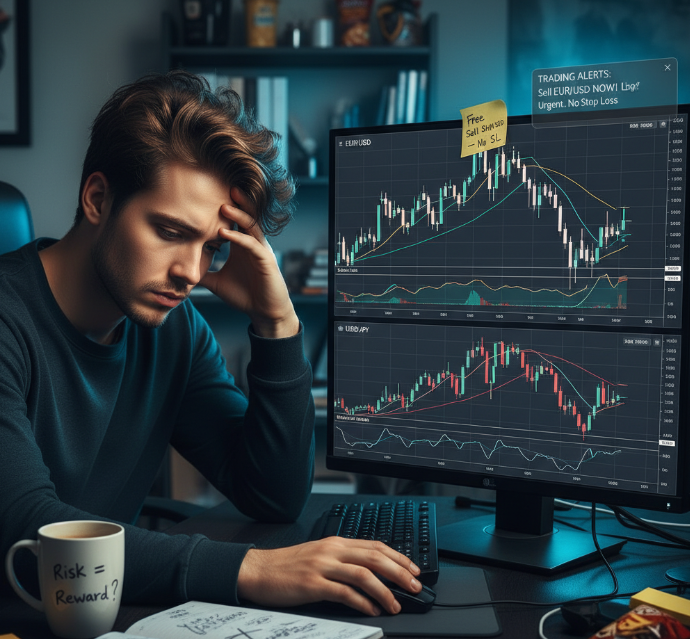
You ever feel like your trade just got punk’d by the market? That’s usually what happens when signals don’t include filters for chaos.
Most libreng signals lack volatility control logic
No filters = more false breakouts in volatile sessions
Traders get whipsawed during news events
Risk management gets tossed out the window
Smart paid providers use ATR-based volatility filters
Without decent filtering, even the best-looking setup becomes gambling. If you're trading during FOMC or NFP with no volatility filter, you’re just asking for trouble.
There’s dumb. Then there’s “EUR/USD bearish signal with no stop loss” dumb. Let’s break it down:
Entry called on EUR/USD short
No SL included in the signal
Price reverses during Frankfurt/London overlap
Account takes a hit while you sleep
Capital goes poof, risk logic absent
No SL? No respect for your money. Signals like that fail at even the basic rules of capital preservation.
Sometimes traders act like RSI = gospel and Bollinger = prophecy. But in reality, it’s more like astrology when misused. Especially in manual setups.
“Indicators are tools, not fortune-tellers. We've seen free signals call RSI 70 as a guaranteed reversal — totally ignoring trend strength.”
— Jayden V., Signal Analyst, EasyCashBackForex
Here's how misuse hurts:
RSI overbought ≠ sell signal if market is trending
Bollinger Band breaks need volume or volatility confirmation
Free signals often oversimplify this logic
Signals fail when they misread consolidation zones
Short version? Misinterpret the indicators, and you misplace your money.
Outdated data kills — especially on H1 and H4 timeframes. Here's how free signals fall behind:
| Signal Type | Avg. Delay (Min) | Hit Rate Decline | Time Frame Impact |
|---|---|---|---|
| Free Telegram | 15-30 mins | -32% | H1 |
| Email Newsletter | 1-2 hours | -58% | H4 |
| Real-time Paid | <5 mins | — | All TFs |
By the time you see the trade, price action may have moved past the entry zone
Especially dangerous during breakout candles or news spikes
No real-time data = no real timing strategy
In fast-paced charts, a delay is basically financial self-sabotage.
USD/JPY loves to drift sideways like it's stuck in traffic. If your signals can’t spot that, expect pain.
Multiple short facts:
• Free signals mostly favor trending strategies
• They struggle during low-volatility Asian sessions
• Sideways market requires range-play or oscillator setups
• MACD-based signals often give whipsaws here
• Consolidation patterns need confirmation — not hope
Libreng signal providers often ignore trend adaptation logic entirely. You gotta be able to switch gears when the market stalls.
Some signals scream: “The market feels bullish.” Cool. So does my horoscope. But where’s the exact plan?
Here's the mess that causes:
Overusing vague sentiment without anchoring to technical levels
Calling buys without Entry Point, SL, or TP
Traders jumping in randomly and blaming the market
Entry precision suffers = lower win rate
Confirmation bias makes things worse
Real signals tell you: "Buy GBP/JPY at 188.40, SL 188.10, TP 189.20." Vibes don't pay the bills — precision does.
| Signal Type | EUR/USD Profit Accuracy | GBP/USD Profit Accuracy | Avg. Weekly Return |
|---|---|---|---|
| Libreng Signals | 48.7% | 45.3% | $31.40 |
| Paid Signals | 72.1% | 68.5% | $87.90 |
Libreng signals for EUR/USD and GBP/USD might feel “free,” but if you're not watching actual profit accuracy, you’re basically gambling.
Paid signals often track results with software, which helps filter out low-return setups.
This isn’t about “free vs paid” pride — it’s about consistent green weeks.
If your provider isn’t showing profit rates over 65%, you might be flying blind.
Libreng Signals Win Rate (Strong Buy): Usually hovers around 42% — not good enough when spreads eat your edge.
Paid Signals Win Rate (Strong Buy): Around 67% based on filtered entries.
Libreng Signals (Sell): Weak signal structure — averaging 39% success rate.
Paid Sell Signals: Close to 69% with confirmation filters (RSI, MACD).
Bottom Line: Win rate isn’t everything — but it’s the foundation. A strong win rate + solid SL makes a world of difference.
Risk Level isn’t just theory — it hits your account hard. Libreng signals often promote High Risk trades with wide stop loss levels and no real justification. For risk averse traders, this is terrifying. Paid signals, especially those tailored by risk profiles, will suggest smaller positions or tighter SL zones on GBP/JPY or USD/CAD. That alone can be the difference between surviving a bad week or blowing an account. Always match your signal style to your tolerance — not the other way around.
15 Minute Signals (M15):
Libreng signals: Sloppy timing, late entries
Paid signals: Sharp entries, often auto-synced via EA
Daily Signals (D1):
Libreng: Often reused templates, delayed
Paid: Strategically placed — better for swing trades
Conclusion:
If you're scalping, free M15s can ruin you.
If you’re holding for days, even a paid D1 signal can keep your week smooth.
Paid signals that use MACD crossovers or Ichimoku Cloud setups usually cap drawdowns under 8–10%.
Libreng signals? You’ll often see open trades sitting in red over 15% — brutal if you’re risking more than 2% per position.
For example:
MACD Bullish Signal: Paid = TP hit in 2 days
Same condition, Libreng = Stuck in drawdown for 5 days
EasyCashBackForex Analyst Ramon C. said:
“If your drawdown exceeds 12% on average, it’s not a strategy — it’s a prayer.”
Support and Resistance zones define entry/exit precision.
Paid Signals:
75–85% of entry points align with real Support/Resistance (S/R).
Often include zone width, not just a single price point.
Libreng Signals:
S/R zones either copied from free tools or marked too late.
Warning Signs:
If SL sits inside the resistance zone, run.
If S zones are missed on AUD/USD or EUR/JPY, accuracy drops fast.
You’re not just paying for a signal — you’re paying for timing.
Manual Analysis (Libreng Signals):
Sometimes great. But human mood, bias, and laziness creep in.
Example: Analyzing USD/CHF late at night = missed news impact.
Expert Advisor (Paid):
Auto-triggers, 24/7 scans, less emotion.
Consistent TP/SL logic based on indicators like Fibonacci or Pivot Points.
Insider Note:
EasyCashBackForex’s Dev Lead Jennie Su once said:
“We built our EA to scan 16 pairs across 6 time frames. A human can’t compete with that.”
Free signals on AUD/USD tend to do okay when trends are smooth, but whipsaw zones wreck them.
Paid signals in USD/CHF usually carry tighter entries and stronger Take Profit targets.
✳ Quick tip: Check how both signal types handled March’s AUD/USD rally.
Bottom line? Free signals may score wins, but long-term profit behavior favors paid signals in volatile currency pairs.
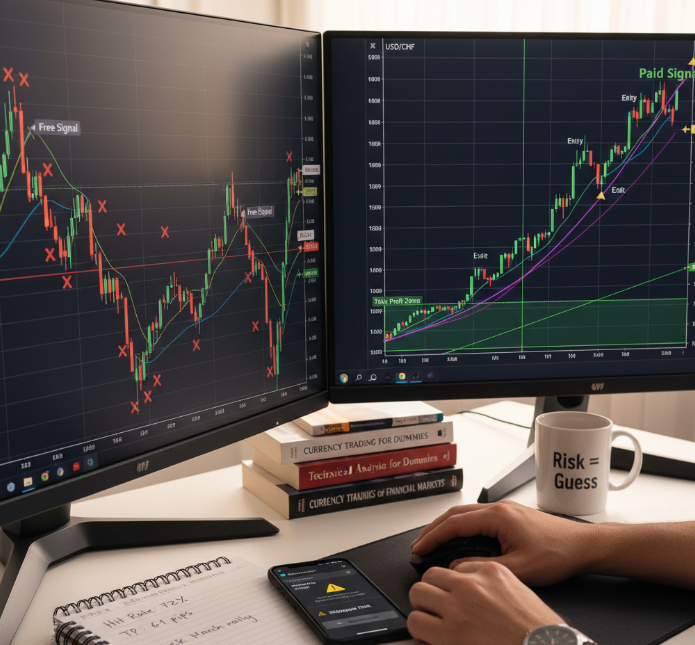
Trending Markets: Paid signals thrive here. They lock in direction and ride trends tight.
Consolidating Markets: Free signals often throw random trades that stop out.
Volatility spikes? Only signals with risk management built-in can survive.
? “Most blow-ups happen in consolidation, not in trends,” said EasyCashBackForex strategist Ian V.
When it comes to market conditions, stability is a paid game.
Real Money Comparison – Avg. Take Profit Hit Rate
| Signal Type | Time Frame | Avg. Hit Rate | Avg. Pips Gained |
|---|---|---|---|
| Free Signals | H1 | 45% | 38 |
| Paid Signals | H1 | 72% | 61 |
| Paid Signals | H4 | 79% | 87 |
Fibonacci isn’t just pretty lines — it works when the signal knows where to draw them.
Paid forex signals with built-in Fibonacci logic outperform hand-drawn guesses every time.
Weekly time frame signals offer better entries for swing trades — less noise, more structure.
Monthly signals? Great for big moves but too slow for active traders.
Free signals rarely nail long-term signals due to inconsistency.
Trend analysis from paid providers tends to spot reversals early and avoid chop.
Best combo: Use weekly for entries, monthly for conviction.
Pending orders in NZD/USD need pinpoint entries — free signals are often late.
In GBP/JPY, delayed pending orders during spikes = missed moves or bad fills.
Paid signals often use adaptive order execution logic to adjust in real-time.
Free ones? You’ll hit slippage or get left behind.
For currency pairs that move fast, reliability of pending orders is everything.
Entry Point not clear? You’re already losing pips.
Exit Point fuzzy? You're risking your gains.
Always check if the signal includes both — not vague stuff like “buy when price moves up.”
If the signal provider never talks about Risk Management or Precision in execution, that's a red flag.
“Precision in forex signals isn’t a bonus — it’s the product,” says Alex Cruz, Senior Analyst at EasyCashBackForex.
? The more accurate your Entry/Exit timing, the better your long-term Signal Quality. Skip the guesswork, aim for accuracy.
Locate the RSI reading — is it below 30 (Oversold) or above 70 (Overbought)?
Check the Stochastic Oscillator — does it confirm the momentum direction?
Overlay both readings — do they agree with the Buy/Sell call?
Validate Signal Confirmation — if either indicator screams “don’t enter,” skip it.
Make it a habit — free signals often lack depth, so your own Technical Indicator filter is your safety net.
This signal validation process can prevent you from blindly entering setups that scream “trap.”
| Time Frame | Ideal Strategy | Recommended Use | Risk Level |
|---|---|---|---|
| 5 Min | Scalping | Fast entries/exits | High Risk |
| 1 Hour | Day Trading | Balanced, more accurate | Medium Risk |
| 4 Hour | Swing Trading | Fewer signals, high quality | Low Risk |
Pick a signal provider that matches your Trading Goals. Scalpers need rapid-fire setups. Swing traders? You’ll need fewer signals but better Signal Reliability.
Misaligned Time Frame? That’s like wearing flip-flops to a snowstorm.
Let’s not sugarcoat it: Source Type matters a lot.
If it’s Algorithmic, expect consistent logic but sometimes tone-deaf during sudden Economic Events.
News-Based signals can be reactive — great during high-impact releases but chaotic if used alone.
Paid signals often blend both with a Technical Analysis overlay.
But libreng forex signals? Many are purely Manual or repackaged market sentiment.
Bottom line: Know what you’re following. Bots don’t panic. Traders do.
? Market Conditions: Watch for extreme Overbought zones (RSI > 75).
⚠️ Volatility Check: Is the pair bouncing wildly (like GBP/JPY)? Be cautious.
? Profitability: Free signals often overestimate reversal strength — get confirmation before jumping.
? Risk Assessment: Know your exposure — high momentum might kill a weak signal.
✅ Signal Reliability: Paid signals often include filters that avoid entry during these extreme states. Free ones? Not so much.
Trading’s already stressful, but it’s even worse when your free signals keep messing up your trades. Here’s how to spot problems and patch them up fast.
No real-time updates: Most libreng forex signals come with delays. You receive a signal after the move’s already halfway done.
Walang context: A “Buy” signal is useless if it doesn’t mention market condition — is it trending, oversold, or volatile?
Lack of signal verification methods: Walang double-check — no RSI, MACD, or moving average confirmation. Masyado kang umaasa sa one-click entries.
No backtesting: Hindi mo alam kung gumana ba talaga dati. How many trades were actually winners? Free signals rarely show stats.
Always add your own confirmation.
Before you enter a signal, drop that on your chart. Check RSI (above 70? careful), MACD crossovers, or Bollinger Bands bounce — wag mong sundan lang ng bulag.
Switch to 1 Hour or 4 Hour time frames.
Shorter signals (like 5 minutes or 15 minutes) are mostly noise. D1 and H4 are better for newbies and signal stability.
Don’t skip stop loss and take profit levels.
If the free signal doesn’t give TP or SL — huwag mo na gamitin! Use pivot points or Fibonacci retracement to place your own targets.
Keep a trading log.
Use Excel or a Google Sheet to track which signals work. Tally your winners vs losers — that’s your DIY signal backtest.
“We get hundreds of screenshots every month from traders complaining about failed free signals. 90% of the time, there’s no stop loss or the signal was reused across different market conditions.”
— Arwin Dela Cruz, Trading Strategy Officer
“The best traders treat free signals like suggestions, not orders. Before executing, they add risk management strategies based on their portfolio size.”
— Ellaine Navarro, Senior Forex Coach, EasyCashBackForex Academy
| Signal Problem | What You See | Why It's Risky | What To Do |
|---|---|---|---|
| No Stop Loss | Entry only, no SL | You might blow your whole trade | Add 1.5× ATR as SL manually |
| Signal is Always “Buy” | Repeats bullish calls daily | Ignores bearish turns | Cross-check with RSI/Stoch |
| Conflicts With News | Signal says Sell, but Fed meeting later | High chance of spike | Avoid major event windows |
| Same Entry Repeated | Same price range repeated daily | Choppy market | Skip until breakout or trend resumes |
Libreng forex signals aren’t the problem — how you use them is.
Don’t trade every single alert. Learn to say “pass” if your gut says it’s off.
Focus on money management techniques. Kahit 60% accuracy lang, you can still win if your winners are bigger than your losers.
Consistent profitability comes not from magical signals, but from discipline, psychology, and your own trading education.
Kung matagal ka nang umaasa sa libreng forex signals, baka panahon na para tanungin ang sarili mo: “Ilang trade pa ba ang kailangan kong matalo bago ako mag-adjust?” Ang dami nating nadiskubre sa article — mula sa inconsistent entries hanggang sa walang clear stop loss — na talagang risky lalo na sa volatile na market. Paid signals, habang may bayad, kadalasan mas malinaw, mas disiplinado, at mas may accountability.
✅ Gamitin ang libreng signals kung:
• Nasa demo account ka pa lang
• Gusto mo lang mag-practice ng chart reading
• Sanay ka mag-double check ng entries using indicators like RSI or MACD
Pag dating sa tunay na pera, ‘di ba mas okay yung may peace of mind?
Kaya kung seryoso kang kumita ng consistent at iwas stress, subukan mong i-backtest pareho. Gumamit ng 5-step checklist natin para pumili ng signal source na swak sa’yo. Minsan, ang tanong ay hindi “libre ba?” kundi “sulit ba?” — dun tayo makakalamang.
Look for clear Stop Loss and Take Profit
Check results on pairs like GBP/USD or USD/JPY
Signals should match indicators (RSI, MACD)
Avoid channels hiding their source (manual or EA)
Risk level must be stated clearly
Entry tells you when to open a trade. Exit shows when to close. Both should be based on Support/Resistance or Fibonacci levels on 1H or 4H charts.
Ask for verified results on pairs like EUR/GBP
Check if signals adapt to market changes
Look at win rates and drawdowns
Study their chart tools (Ichimoku, Stochastic)
Pending orders should include risk control
Yes, but only if updated quickly and supported by tools like Bollinger Bands. Free signals often miss big price swings caused by unexpected news.
Moving Average: great for trend direction
RSI: shows overbought or oversold zones
MACD: checks momentum strength
Bollinger Bands: highlights volatility and breakouts
Fibonacci: finds precise entry and profit targets
Short time frames like 5 or 15 minutes produce noisy entries. 4H and Daily charts give steadier results with trend-based tools.
Confirm with MACD or Stochastic
Avoid trades without a Stop Loss
Test signals on a demo before committing
Consider EA/algorithmic signals
Watch how signals behave during overbought phases
Algorithms react faster to sudden moves; manual signals offer more context but can lag. A hybrid approach works best on 1H or Daily charts.
RSI above 70 = overbought; below 30 = oversold
MACD crossover confirms momentum
Best used in trending markets
Combine with Support/Resistance for accuracy
Ideal for 30-minute to 4-hour charts
Rarely. Free signals usually target short moves. Swing traders should analyze Weekly or Monthly trends and detailed Strong Buy/Sell setups.