

Table of contents
Part 1 - Basics of Moving Averages
Part 2 - Simple vs. Exponential Moving Averages: What’s the Difference?
Part 3 - Which Moving Average Is Best for Forex Trading?
Part 4 - Trend Detection with Moving Averages
Part 5 - Are Moving Averages Better Than RSI or MACD?
What Are Moving Averages? If you’ve ever stared at a forex chart and thought, “What the heck is going on here?”, you’re not alone. Moving averages are like the GPS for traders — they don’t predict the future, but they sure help you see where the market’s been heading. They smooth out the wild swings and give you a clearer path when price action gets noisy.
In forex trading, moving averages can be your go-to tool for spotting trends and making smarter, faster decisions. As technical analyst John Murphy once said, “The trend is your friend — until it ends.”
This guide breaks down the different types of moving averages, when to use them, and how they stack up against other popular indicators. If you’re tired of trading blind or second-guessing every move, you’re in the right place.
1.Basics of Moving Averages
Definition of Moving Averages
A moving average is a widely-used technical indicator in financial markets. It calculates the average price of a security over a specific number of periods — also known as the time series. This technique helps reduce price noise and provides a clearer picture of trend identification.
There are different types of moving averages, but all serve the same goal: they offer a smoothed representation of past data points. Traders use them to analyze the market direction without getting distracted by short-term fluctuations. In simple terms, it’s like filtering the static from a radio to hear the real message.
The calculation varies by type, but every moving average uses a period (like 20 days) to determine how much data to include. It’s a cornerstone in tracking price movement across financial markets.
Purpose in Forex Analysis
In forex trading, moving averages are crucial for analyzing price behavior across currency pairs. Here's what they help with:
Trend direction: Spot upward or downward movements early.
Support and resistance: Identify price levels where the market may reverse.
Entry signals: When the price crosses above or below the average.
Exit signals: When trends slow or reverse direction.
Noise filtering: Smooths erratic moves for better market analysis.
They're often used in combination with other tools as part of a broader trading strategy. A moving average may not be perfect on its own, but it adds strong confirmation to any setup.
“The best forex traders use moving averages not to predict, but to clarify the present.” — Tom Hougaard, Professional Trader
Common Calculation Methods
There are three major types of moving averages. Each one calculates the average price differently, and that affects how quickly it reacts to price changes:
| Type of MA | Key Formula Element | Ideal Use Case |
|---|---|---|
| Simple Moving Average | Arithmetic mean of closing prices | Long-term trend signals |
| Exponential MA (EMA) | Greater weight on recent data | Short-term, faster trades |
| Weighted MA (WMA) | Custom weights for each data point | Niche and responsive strategies |
Simple Moving Average (SMA): Adds all the closing prices over a period and divides by the number of periods. It’s straightforward but slow to react.
Exponential Moving Average (EMA): Applies a smoothing constant that gives more importance to recent prices, making it more responsive.
Weighted Moving Average (WMA): Assigns a unique weighting factor to each price in the lookback period, often favoring more recent prices.
These methods help you tailor your analysis depending on whether you're a patient trend-follower or a nimble short-term trader.

2.Simple vs. Exponential Moving Averages: What’s the Difference?
When to Use SMA in Forex
The Simple Moving Average (SMA) is one of the most widely used tools in forex technical analysis. It calculates the average of selected closing prices over a defined number of periods — giving equal weight to each. This results in a smoother line on the chart, making it easier to identify overall market direction.
Use SMA when you're trading in less volatile market conditions, where big price swings are rare. It's particularly helpful in:
Spotting long-term trend directions
Marking key support and resistance levels
Confirming signals in crossover strategies, especially with the 50-day or 200-day SMA
Analyzing major currency pairs where price action tends to be more stable
Pro tip: SMA is less prone to whipsaws — so it’s your friend in slow-moving or ranging markets. It’s not about speed here, it’s about stability.
EMA Reaction to Market Changes
The Exponential Moving Average (EMA) gives more weight to recent price data, which makes it far more responsive to sudden shifts in the market. This is crucial for traders involved in short-term strategies, or when dealing with highly volatile forex pairs.
EMA is ideal in the following scenarios:
Scalping and Day Trading: When every pip matters, EMA helps you stay close to the price.
Breakout Strategies: EMA lines adjust faster when price breaks out of a range, delivering quicker trade signals.
High-Volatility Environments: Great for reacting to news-driven spikes or fast-moving currency pairs like GBP/JPY.
“I rely on the 21 EMA during New York open — it helps me avoid lag and jump on clean setups,” says Diego Carter, a forex day trader.
EMA vs. SMA Comparison Table
| Feature | SMA | EMA |
|---|---|---|
| Sensitivity to Price Changes | Low | High |
| Weight Distribution | Equal over all periods | More weight on recent prices |
| Best Use Case | Long-term trend tracking | Short-term entries, volatile markets |
| Reaction to News | Slower | Faster |

3.Which Moving Average Is Best for Forex Trading?
50-Day Moving Average Use
The 50-day moving average is one of the most widely used technical indicators for traders targeting short-term trends. It’s responsive enough to react to market moves without being too noisy. This MA helps pinpoint crossover signals, identify support and resistance levels, and guide trading strategies with better timing.
Why traders love it:
Often acts as a dynamic support or resistance during trends
Works well in combination with faster/shorter MAs for crossover strategies
Useful in signal generation on 4-hour and daily charts
“The 50-day moving average is a sweet spot—fast enough to catch trends, slow enough to filter noise.” — Michaela Taylor, FX market analyst
Using the 100-Day Average
Looking for a balanced view between short-term spikes and long-term direction? The 100-day moving average is your tool for medium-term trend tracking. It helps smooth out market jitters, guiding investment decisions with a clearer lens.
Great for identifying trend reversals in swing trading setups
Commonly used in spotting golden cross (50 MA crosses above 100 MA) and death cross patterns
Relies heavily on historical price data for market analysis
It’s a favorite for traders wanting a "bigger picture" perspective without going full long-term.
Benefits of the 200 MA
If you're serious about long-term investing in forex, the 200-day moving average is a must-watch. It defines major support and resistance levels and helps traders stay aligned with overall market direction. It’s not fast, but it’s extremely reliable—sort of like a financial anchor.
Key strengths:
Provides long-term trend confirmation
Heavily used to detect buy or sell signals when the price crosses above or below it
Filters out market noise and reflects market sentiment
| Moving Average | Trend Duration | Best For |
|---|---|---|
| 50-Day | Short-term | Quick signals, swing trading |
| 100-Day | Medium-term | Trend confirmation, swing setups |
| 200-Day | Long-term | Market bias, investor strategy |
Note: 200 MA is also used by institutions to manage capital exposure across currency pairs.
Best MA for Beginners
Let’s not sugarcoat it—if you’re new to forex, don’t get overwhelmed by all the charts and settings. Start with the basics. The Simple Moving Average (SMA) is easy to understand and great for learning trend analysis and chart patterns. The Exponential Moving Average (EMA) is faster and shows more immediate changes.
Quick beginner tips:
Start with a 10-day or 50-day SMA to learn pattern behavior
Try the EMA when you’re ready for faster technical indicator feedback
Focus more on practicing with your trading platform and building risk management habits
Combine MAs with basic financial education and demo accounts to grow skillfully
Keep it simple. Learn by doing. No one becomes a pro overnight—just focus on understanding how MAs help you “read” the market, not just react to it.

4.Trend Detection with Moving Averages
Identifying Trend Direction
Identifying the direction of a trend is one of the most crucial elements in successful forex trading. Moving averages act like a visual guide, helping you spot trends, confirm momentum, and avoid false signals.
A rising moving average usually points to an emerging uptrend, while a falling one hints at a declining market. When the price stays consistently above a moving average, it often confirms bullish conditions. Conversely, when prices hang below the average line, it signals bearish sentiment. But it’s not just about where the price sits—it’s also about the angle and shape of the moving average.
Common MA Trend Scenarios
| MA Slope Direction | Price Position | Likely Trend Pattern |
|---|---|---|
| Upward | Above MA | Strong bullish trend |
| Flat | Inside MA zone | Ranging or indecisive |
| Downward | Below MA | Strong bearish trend |
Many traders combine MAs with other materials like support/resistance lines or candlestick patterns to confirm market styles. If you’re just trading based on where the price is, you might miss the bigger story.
“It’s not enough to follow trends—you need to understand the story behind the shape,” says professional trader Michael Trent, founder of MarketDecode FX.
Moving Average Crossovers Explained
Crossovers occur when two moving averages of different lengths intersect. They serve as potential entry or exit signals, offering insight into momentum shifts and possible reversals. But they’re not magic. They work best when used with context—don’t trade every crossover blindly.
There are two well-known types:
Golden Cross: A bullish sign. Happens when a short-term MA (e.g. 50-day) crosses above a long-term MA (e.g. 200-day). It suggests buyers are gaining control.
Death Cross: A bearish signal. Occurs when the short-term MA crosses below the long-term MA, hinting that sellers may be dominating.
Let’s break down the sequence and meaning of various combinations:
| Short-Term MA | Long-Term MA | Type of Crossover | Market Signal |
|---|---|---|---|
| 10-day | 50-day | Golden Cross | Short-term breakout |
| 20-day | 100-day | Death Cross | Bearish continuation move |
| 50-day | 200-day | Golden Cross | Long-term trend reversal |
| 30-day | 90-day | Death Cross | Early warning of weakness |
Crossovers are best used as confirmation tools, not stand-alone methods. Pairing them with oscillators like RSI or volume spikes can help filter out noise. Crossovers show a blend of past and current market data, creating a powerful transition point when interpreted properly.
And remember—just because two lines cross doesn’t mean the market will listen. Always trade with a plan.

5.Are Moving Averages Better Than RSI or MACD?
MA vs. RSI for Timing Entries
When it comes to timing your forex entries, Moving Averages (MAs) and the Relative Strength Index (RSI) offer different strengths. MAs are lagging indicators that confirm trend direction over time. In contrast, RSI is a momentum oscillator that reacts more quickly to price changes.
MAs: Smooth out noise and highlight longer-term direction.
RSI: Spots short-term overbought and oversold conditions — often signaling a reversal.
Many traders combine the two. A typical approach:
Identify the market direction using a 50 or 200 MA.
Wait for RSI to dip below 30 or rise above 70.
Enter when RSI reverses in the direction of the MA.
This helps avoid early entries and keeps trades aligned with the trend.
“RSI helps you pick your moment. MA helps you pick your direction.” — Jason Marks, Senior Analyst, DailyFX
Using MACD with Moving Averages
The MACD (Moving Average Convergence Divergence) indicator is essentially a momentum tool based on EMAs. It includes the MACD line, signal line, and histogram. When combined with longer-term MAs, it can build a powerful confirmation system.
Here’s a sample setup:
Use a 200 EMA to define trend direction (bullish or bearish).
Add MACD with 12/26/9 settings.
Look for a MACD line crossover in the same direction as the 200 EMA.
Confirm with a rising or falling histogram.
This combo helps avoid false breakouts and keeps you trading with the trend.
Example: If price is above the 200 EMA and the MACD line crosses above the signal line, you’ve got a high-confidence long signal.
Combining Indicators in Forex
Want sharper entries and exits in your forex trades? Combine technical indicators to reduce guesswork. Using just one tool might mislead you, but when multiple indicators agree, you gain an edge.
Here’s a comparison of common indicators and how they play together:
| Indicator | Strength | Best Used For |
|---|---|---|
| Moving Averages | Trend clarity | Overall market direction |
| RSI | Speed and reversals | Entry/exit precision |
| MACD | Momentum confirmation | Riding strong trend moves |
Tip: For a trade on GBP/USD:
Use a 100 EMA to determine trend.
Confirm RSI shows a reversal signal.
Watch MACD for confirmation of momentum.
Keep it simple. Too many indicators can cause analysis paralysis. Stick to 2–3 for clean, confident trading.
6.Day Trading with Moving Averages
Best MAs for Scalping Forex
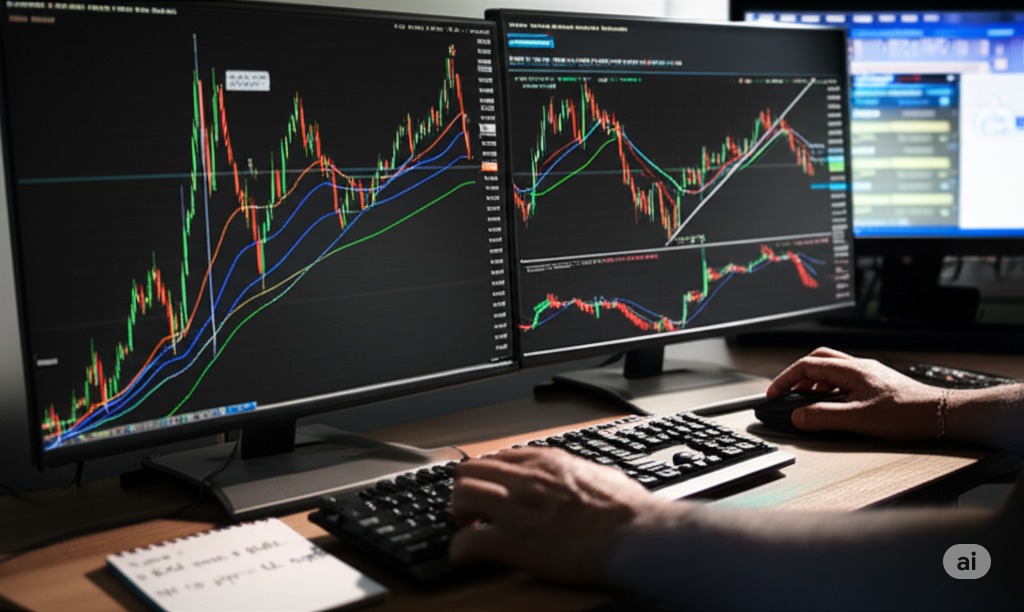
Scalping is a high-speed, high-intensity Forex trading style. It targets tiny price changes in ultra-short timeframes—think 1-minute or 5-minute charts. Because of this speed, traders need indicators that react quickly. Enter the Moving Average.
Let’s break down the best types for scalping:
5 EMA (Exponential Moving Average)
Super reactive. It follows price movement almost tick-by-tick. Ideal for high-volatility pairs like GBP/JPY or EUR/USD.9 EMA
Slightly smoother, but still fast. Great for catching micro-trends without as much noise.20 SMA (Simple Moving Average)
Adds a stabilizing layer to your chart. It filters out market chop and can help set up bounce trades when paired with faster MAs.
Pro tip: Combine short-term MAs with a longer-term MA, like the 50 EMA, to confirm trend direction. Use the fast MAs for entries, and the slower one as your "bias anchor."
Example Scalping Setup:
Wait for 5 EMA to cross above 9 EMA on a 1-minute chart.
Confirm upward momentum with a bullish candlestick.
Enter trade with a 5–10 pip target, using tight stop-loss.
Risk Management Reminder: Scalping can burn through your account fast if you're not disciplined. Always trade with pre-defined stop-losses and know your Broker’s spread before entering. Every pip matters here.
“Scalping is like boxing—you don’t throw one knockout punch, you jab, jab, jab with precision.” — Lisa Alvarez, Senior Trader, FX Insight Lab
Intraday MA Signal Examples
Intraday Forex trading depends on fast, visible setups. Moving Averages are used to highlight both trend direction and entry/exit points within the same trading day. Two of the most effective MA-based strategies are crossover entries and bounce entries.
Here’s how they work:
1. Crossover Strategy
When a faster MA (like the 9 EMA) crosses over a slower MA (like the 21 EMA), it signals potential trend reversal or continuation. Look for this setup on 15-minute or 30-minute charts for ideal balance between speed and reliability.
2. Bounce Strategy
This involves waiting for price to pull back to a key MA (like the 50 SMA), then bounce off it, signaling trend continuation. Traders often combine this with candle patterns (like hammer or engulfing) for confirmation.
3. Break-and-Retest Setup
Price breaks above a Moving Average and then retests it. If it holds and bounces, it may be a strong entry point with a favorable risk/reward ratio.
Here’s a quick reference table for common intraday MA signal setups:
| Signal Type | Chart Timeframe | Trigger Description |
|---|---|---|
| EMA Crossover | 15-Min | 9 EMA crosses above 21 EMA |
| MA Bounce | 1-Hour | Price pulls back to and rebounds off 50 SMA |
| Break-and-Retest | 5-Min | Price breaks, retests, and rejects MA level |
| Triple MA Filter | 15-Min | Price above 20, 50, and 100 EMAs confirms trend |
These strategies work best when combined with other forms of confirmation, such as trendlines, support/resistance zones, or momentum indicators. Keep your entry points clean and your exit points precise.
Use trusted platforms like MetaTrader, NinjaTrader, or TradingView to set up alert zones and test your strategy in real time.
7.Do Professional Traders Rely on Moving Averages?
“You know what never leaves my screen?” asked Mark Halvorsen, a senior trader who spent over a decade on the FX desk at HSBC. He leaned back, smiled, and tapped his Bloomberg terminal. “A moving average. Always.”
That simple moment — shared over coffee in a London office — underscores something often misunderstood by outsiders: professional traders, even at the highest level, absolutely rely on moving averages.
These are not hobbyist tools. They are woven into the architecture of institutional trading strategies, algorithmic models, and risk management systems worldwide. So why does such a “simple” concept remain so deeply embedded in some of the most sophisticated trading floors on Earth?
Why Moving Averages Still Matter
At the core of every market decision is one question: Where is the trend heading?
This is where moving averages shine — they offer:
A clean view of trend direction in volatile forex markets.
Support and resistance zones that algorithms and humans both respect.
Dynamic insights when paired with other indicators like MACD or stochastic oscillators.
Veteran traders know these lines are not just math. They represent psychological levels—thresholds where market sentiment flips.
Expert Usage in Institutional Desks
Here is how moving averages integrate into various institutional environments:
| Trading Area | Use of Moving Averages | Example Tools/Systems |
|---|---|---|
| Discretionary Trading | Confirming trend bias and price action | 50-day SMA on EUR/USD daily chart |
| Algorithmic Trading | Model signals, smoothing noisy inputs | EMA filters in mean-reversion strategies |
| Risk Management | Dynamic stop-loss levels, volatility bands | 100-day MA + ATR overlays |
| Portfolio Optimization | Weighting signals for asset rotation | Moving-average crossover filters |
These roles are not academic theory. They are hard-coded into the actual trading systems used by global institutions — from BlackRock to Nomura.
Real-World Voices: What the Pros Say
In an exclusive trader roundtable hosted by FX Markets in New York, one panelist from Citi’s FX desk said plainly:
“If you remove moving averages from our toolkit, execution risk goes up. It is that simple.”
Meanwhile, algorithmic quant specialist Sarah Ahn (formerly with Deutsche Bank) highlighted that “moving averages are essential in building multi-factor models because they adapt well to volatility shifts and structural market changes.”
Backtesting, Confidence, and Awards
Backtesting is the heart of strategy validation. Time and again, strategies based on moving averages — particularly the 200-day and 21-EMA crossovers — have shown statistically significant win rates when tested over multi-decade datasets.
A 2023 strategy audit by BarclayHedge revealed:
Over 70% of top-performing trend-following forex strategies included moving average inputs.
Funds using adaptive MA systems showed lower drawdowns than pure price-action funds.
In short, it is not a question of belief. It is a matter of results. Award-winning funds use them. And so do the traders behind them.
Are Moving Averages Outdated?
Some online voices claim moving averages are “lagging” or “basic.” Yet in practice, professional traders do not chase the fastest signal. They care about reliability, repeatability, and clean confirmation. That is exactly what moving averages deliver — without overfitting.
A Tool Trusted by Volume
Professional traders, from manual scalpers to quants, depend on moving averages not out of habit, but out of experience.
Whether driving algorithmic trading models, informing discretionary decisions, or providing risk guardrails, these tools continue to outperform expectations.
Their simplicity is their strength, and their performance under pressure is why they are still in every trader’s playbook.
“There is nothing magical about the line,” said Halvorsen. “It is just honest. And in a world full of noise, that matters.”
Conclusion
Moving averages are like headlights on a foggy road—they don’t predict the future, but they sure help you see what’s coming. If you’re tired of second-guessing trends or jumping in too late, these tools offer a way to smooth the chaos and spot the setups that matter.
As John Murphy once said, “The trend is your friend.” Lean on moving averages, and you might just find yourself riding the wave instead of wiping out.
Moving averages are primarily used to smooth price data over a specific time frame, helping traders identify trends and reduce market noise. They’re crucial for spotting directional movement and creating entry or exit signals.
For forex day trading, shorter-term moving averages such as the 9-period EMA or 20-period EMA are preferred due to their sensitivity to recent price changes. They provide quicker signals, which is essential for fast-paced strategies.
Not directly. Moving averages are lagging indicators, which means they follow price trends rather than predict them. However, traders often use crossovers or divergences with other indicators to anticipate potential reversals.
SMA (Simple Moving Average) gives equal weight to all prices in the period.
EMA (Exponential Moving Average) gives more weight to recent prices.
EMA reacts faster to price changes, which is useful in volatile markets.
SMA is smoother and better for identifying long-term trends.
Short-term traders often use 9, 20, or 50-period MAs.
Swing traders may prefer 100-period MAs.
Position traders rely on 200-period MAs for long-term trend direction.
Test and adjust based on backtesting results and asset volatility.
No, moving averages often lag behind price action during high-impact news releases. Sudden spikes or volatility can create false signals, making it risky to rely solely on MAs during these periods. Traders usually pause or combine MAs with real-time momentum indicators during such times.
Bullish signal: When a shorter MA crosses above a longer MA.
Bearish signal: When a shorter MA crosses below a longer MA.
This technique helps identify potential trend shifts, but it's most effective in trending (not ranging) markets.