

? Great—but don’t get caught off guard by sneaky charges. In “AvaTrade Canada Fees Explained:Spreads, Swap Rates, Hidden Costs,” we break down the real costs behind each trade. Because let’s be honest—what’s the point of a winning trade if half your profit disappears in fees?
Picture this: You make a clean trade, only to realize the spread, a quiet , and a surprise inactivity charge just ate your lunch. As one Canadian trader on Reddit put it, “The platform’s solid—but you better know what’s under the hood before revving the engine.”

This guide gives you the full picture—spreads, overnight charges, and those fine-print fees no one talks about. Let’s clear the fog and help you trade smart, not sorry.
Understanding Canada’s spreads is key to managing your trading costs. Let’s break down what spreads are, how they’re structured, and why they fluctuate.
EUR/USD spread at AvaTrade Canada
The pair is one of the most traded at AvaTrade Canada, and the spread typically starts from 0.9 pips. This means the difference between the bid price and the ask price is 0.00009 in value — the pip value being crucial for calculating costs.
Tight spreads = lower trading cost
AvaTrade uses a
Suitable for high-volume EUR/USD scalping
Fixed vs variable spread structures
Choosing between a fixed spread and a variable spread is like picking between a set menu and a buffet — each has its perks, depending on market mood.
Fixed spreads stay constant, ideal for low-volatility periods
Variable spreads shift with liquidity and price fluctuations
Brokers may widen spreads during high market volatility
Variable spreads can be cheaper in stable markets
Tip: Day traders often prefer variable spreads for flexibility, while news traders lean toward fixed spreads to dodge sudden spikes.
How market conditions affect spreads
When market conditions change, spreads widen — sometimes unexpectedly.
High volatility (e.g. after a central bank rate hike) = spread increases
Low liquidity, such as during holidays or after-hours, means wider spreads
Economic news releases can cause erratic spread spikes
Higher trading volume can reduce spreads if liquidity increases
Spreads are a reflection of supply and demand — more buyers and sellers usually mean tighter spreads.
“Spreads are the silent killer of profits if you ignore them.” — Max W., Forex Trading Analyst at FXStreet
Are Swap Fees Charged Daily at AvaTrade?
Swap fees at AvaTrade may seem small, but they add up fast. Let’s break down when and how they apply across assets.
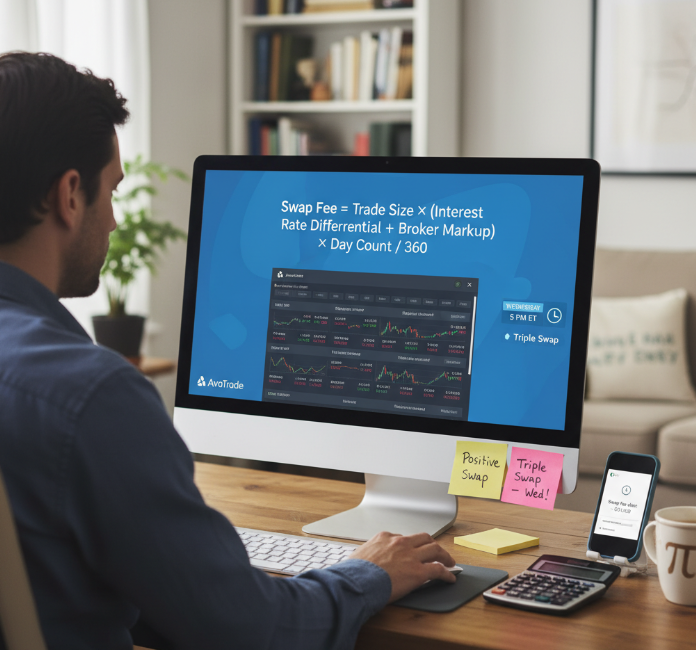
1. Swap fee calculation method
Swap fees at AvaTrade are calculated based on interest rate differentials between the base and the quote currency in a trading pair. These fees apply when holding overnight positions, and differ for long vs. short trades.
Formula (simplified): Swap Fee = Trade Size × (Interest Rate Differential ± Broker Markup) × Day Count / 360
AvaTrade adjusts rates daily, and they vary per instrument.
2. Weekend rollover and triple swaps
At AvaTrade, weekend rollovers are baked into Wednesday night’s swap. That means if you’re holding a position past 5 PM ET Wednesday, you’ll get hit with triple swaps — to cover Friday, Saturday, and Sunday. See AvaTrade’s own guidance on .
Forex pairs: Triple swaps apply Wednesdays.
Stock CFDs: These may apply on Fridays, depending on the asset.
Pro tip: Newbies often get blindsided midweek. Set alerts!
3. Positive vs negative swap rates
Swap rates can be your friend or foe. If the interest rate differential is in your favor, you might earn a positive swap on overnight holdings — nice! But most traders end up paying a negative swap.
Let’s simplify:
Long EUR/USD → Pay swap if EUR has lower rates
Short AUD/JPY → Might earn swap if AUD > JPY
Carry traders use this to their advantage, but only when currency pairs align right.
“Knowing your swap direction can make or break your weekly profit.” — Lucas Berger, FX Analyst, FinTech Weekly
4. Swap fees on cryptocurrencies
Crypto traders at AvaTrade — heads up! While you’re not trading actual cryptocurrencies (they’re CFDs), you’re still subject to overnight funding costs.
These swap fees are generally higher than forex due to insane volatility and speculative holding periods. Quick facts:
Fees charged daily at 22:00 GMT
Higher leverage = higher funding cost
Weekend = triple swap, just like forex
Hidden Fees at AvaTrade
Hidden fees can sneak up on traders. This section exposes lesser-known charges you might face with AvaTrade Canada.
1. Inactivity and account maintenance fees
Update for Canada (Friedberg Direct): AvaTrade’s Canadian entity (Friedberg Direct) applies different inactivity rules than the global site. According to the Canadian Help Centre, if an account has been inactive for 2 consecutive months and equity is below the account-currency equivalent of $2,000, a $10 monthly inactivity fee is charged going forward. Separately, AvaTrade’s global fees page notes a $50 inactivity fee after 3 months of non-use (varies by base currency). Check which policy applies to your specific account before assuming amounts. — See: Canadian FAQ on and the global .
? Pro Tip: Set a calendar reminder to make at least one small trade every 60–90 days (and keep equity above the threshold) to avoid being charged.
“Retail traders often overlook dormant fees—don’t let your account bleed while you're on vacation.” — Daryl Hunt, Forex Strategist
2. Withdrawal and funding method charges
Yep, moving your money in or out of AvaTrade isn’t always free — and it depends on how you do it: timelines vary by method per AvaTrade’s Help Centre and Friedberg pages:
Credit/Debit Card withdrawals: up to 5 business days
E-wallets: up to 1 business day
Wire/E-wire: up to ~3–10 business days depending on the bank/intermediaries — See AvaTrade’s withdrawal pages for specifics: and Friedberg Direct , plus detailed .
| Deposit Method | Typical Fee | Processing Time |
|---|---|---|
| Bank Transfer | $25–$50 | 3–7 days |
| E-wallet | ~2% | 1–2 days |
| Credit Card | Free | 3–5 days |
Tip: Check AvaTrade Canada's specific fee schedule and your payment provider’s terms before moving funds — third-party bank/intermediary charges aren’t always front and center.
AvaTrade vs Other Brokers in Canada
When I sat down recently with Lara Bennett, who has been trading forex and CFDs in Toronto for over three years, she offered this candid observation: “I like AvaTrade for simplicity, but when I switched a portion of my account to Interactive Brokers I noticed the cost gap.” That comment sets the tone for what follows – a side-by-side look at how AvaTrade stacks up in Canada against major competitors across key dimensions: commissions/point spreads, trading platforms, regulation, asset classes.
Regulation and Trust
Lara emphasised that the first question for any Canadian trader is: “Is the broker properly regulated and safe to use?”
AvaTrade is regulated in Canada under the registration frameworks required for forex/CFD brokers (via the ).
Interactive Brokers is a global powerhouse with multiple Tier-1 licences and strong transparency, making it appealing for experienced traders seeking deep markets.
Questrade is Canadian-based, well suited for local investors and holds registration for stocks/ETFs and also offers forex/CFDs through subsidiaries.
TD Direct Investing carries the backing of a major Canadian bank and solid investor-protection credentials, though its strength lies in stock/ETF trading rather than high-volume forex/CFD.
FOREX.com is recognised globally for its regulatory coverage and infrastructure; in Canada its regulatory status is sound.
OANDA has built a strong reputation over many years, and Canadian reviews highlight its trustworthiness.
CMC Markets is highly trusted globally and holds Canadian regulatory credentials; review sites show it offers very competitive fees.
In short: if you prioritise the strongest global regulatory footprint and the highest transparency, Interactive Brokers and CMC Markets stand out. If you favour a Canadian-local brand and a more straightforward trader experience, Questrade or TD may appeal. AvaTrade and the others provide a middle ground.
Commissions, Spreads and Trading Costs
Cost is always in focus for traders. Lara pulled up her broker cost sheet and noted key differences:
AvaTrade uses a (for many instruments) and advertises spreads from about 0.9 pips on EUR/USD for some accounts.
Interactive Brokers offers very tight spreads plus commissions; for active traders the model can deliver lowest total cost per trade. (Industry reviews show IB’s average cost on major forex pairs is significantly lower than many brokers.)
Questrade delivers excellent cost for stocks/ETFs in Canada but for forex/CFDs the spreads and implicit fees are wider compared to dedicated forex brokers.
TD Direct Investing – the model is more traditional (fixed commission on stocks etc) and less optimised for ultra-low-spread forex/CFD trading.
FOREX.com – reviewers highlight that while it excels in platform and regulation, fee levels for some products are above the absolute lowest tier.
OANDA – noted for transparent fees, with strong trust scores (93/99) in reviews; though depending on account type costs vary.
CMC Markets – reviews indicate “low trading fees (such as spreads and commissions)” for FX/CFDs and very competitive spreads in many asset classes.
Here is a simplified cost comparison snapshot:
| Broker | Strength in Costs | Trade-type Ideal |
|---|---|---|
| AvaTrade | Straightforward spread-only model | Medium-frequency FX/CFD |
| Interactive Brokers | Very low cost for high volume trading | Professional/high-volume |
| Questrade | Great for Canadian stocks/ETFs; moderate for FX/CFD | Canadian investor |
| TD Direct Investing | Strong for stocks/long-term holds | Buy-and-hold investors |
| FOREX.com | Good all-rounder; slightly higher cost | Dedicated FX traders |
| OANDA | Trusted brand with decent cost | FX traders seeking reliability |
| CMC Markets | Low spreads + broad product range | Diversified traders |
Trading Platform, Asset Classes and Experience
Lara noted: “I switched brokers just to test the difference in platform and available assets.” Her experience included:
AvaTrade offers & plus a proprietary platform and copy-trading features. That makes it appealing if you are comfortable with standard FX/CFD workflows.
Interactive Brokers supports an unusually wide asset set: stocks, options, futures, forex, crypto etc. Its desktop platform is complex but powerful.
Questrade offers easy-to-use platforms for Canadian stocks/ETFs, with forex/CFD features added later. The “Canadian feel” is strong.
TD Direct Investing integrates banking + investing, offering convenience for Canadians whose main focus is shares/funds rather than frequent trading.
FOREX.com offers multiple platforms including its own Advanced Trading, TradingView integration, MetaTrader variants.
OANDA’s platform is praised for reliability though some reports mention execution delays in certain conditions.
CMC Markets has a “Next Generation” platform which reviewers say is highly customisable and supports 330+ currency pairs, 10 000+ stock CFDs etc.
If your strategy involves multi-asset portfolios, algorithmic trading or global markets, Interactive Brokers and CMC Markets may serve better. If you prefer ease and local convenience in Canada, Questrade or TD may appeal more than the more specialist FX/CFD brokers.
Which Broker for Which Trader in Canada?
Putting it all together, Lara offered this practical guideline:
If you are a professional trader or high-volume trader seeking the absolute lowest cost and global access → Interactive Brokers.
If your primary focus is forex/CFD trading, and you want a trusted brand with decent cost and platform simplicity → AvaTrade or OANDA or FOREX.com.
If you are a Canadian investor focusing mainly on stocks/ETFs but occasionally on forex/CFDs, and you value Canadian support, seamless banking interface → Questrade or TD Direct Investing.
If you want a diversified multi-asset approach with high quality platform and strong regulatory background → CMC Markets.
In the world of trading platforms in Canada, cost is important but not everything. As Lara said: “Even if you pay a little more per trade, if the platform is slower or the asset set is limited, you lose more than you save.” The aim is to match your trading style, frequency, asset classes, and comfort with complexity to the broker’s strengths in regulation, cost, platform and service. AvaTrade has its merits especially for FX/CFD traders seeking simplicity; but if you compare cost, platform reach and breadth of assets, you may find stronger fits in the other brokers discussed.
How to Avoid Swap and Hidden Charges
Reducing unnecessary trading costs starts with smart account choices and good timing. Here’s how to dodge AvaTrade's hidden and swap-related fees.
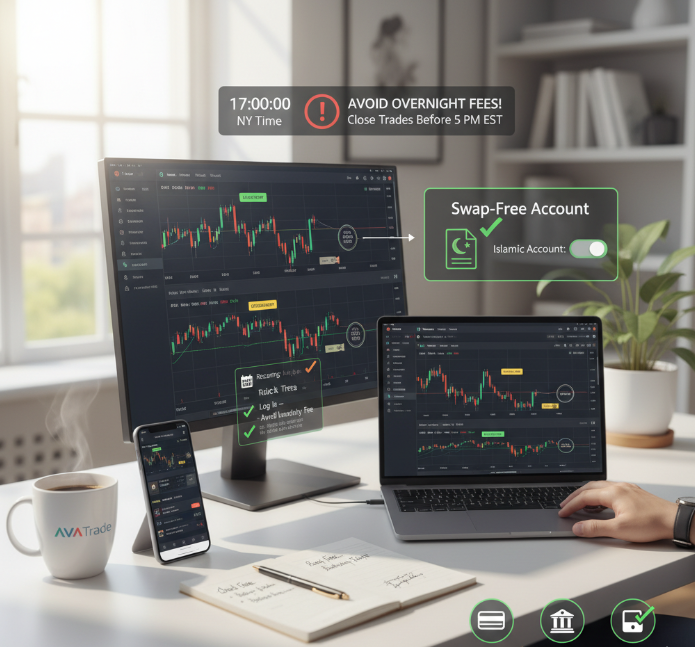
Using swap-free (Islamic) accounts
Swap-free accounts, often referred to as Islamic accounts, are designed to comply with Sharia law by eliminating interest charges on overnight positions. AvaTrade offers this account type, helping traders avoid rollover fees entirely (see ; note some swap-free accounts may incur charges after several days per Help Centre).
These accounts are ideal for long-term trades where swap charges would normally pile up. Keep in mind, AvaTrade may charge a flat admin fee after a few days, so weigh the costs!
Timing trades to avoid rollovers
Know when the market rolls over – typically at 5 p.m. New York time.
Avoid holding trades overnight, especially on Wednesdays when apply.
Use shorter trade durations during active trading sessions to close before rollover kicks in.
Staying ahead of overnight fees can save you a decent chunk over time. Time your exits like a pro, and AvaTrade won't nick you with rollover charges!
Choosing low-swap currency pairs
Some currency pairs naturally have lower swap rates due to narrow interest rate differentials. If you’re planning to hold positions longer:
✅ Stick to major pairs like EUR/USD or USD/JPY.
❌ Avoid exotic pairs with high carry trade exposure.
⚙️ Use AvaTrade’s trading conditions for guidance before entering trades.
Pro tip: Low-swap pairs aren’t just cheaper — they’re often more stable too.
Avoiding inactivity and dormant charges
As noted above for Canada, inactivity fees are triggered by periods of non-use and account equity thresholds (see ). Set reminders and keep the account active to avoid deductions.
To avoid this:
Log in at least once every 2–3 months
Place occasional small trades
Set calendar reminders to stay active
Even if you’re on a break, don’t let your account go dormant — AvaTrade won't hesitate to charge you!
Funding methods with zero processing fees
Did you know some deposit methods sneak in surprise fees? Here’s how to avoid them:
| Method | Deposit Fee | Withdrawal Fee |
|---|---|---|
| Credit Cards | $0 | $0 |
| Bank Transfer | May Vary | Depends on bank |
| E-Wallets | $0 | $0 |
Use your method of choice, but verify timelines and any third-party costs on AvaTrade’s pages.
Conclusion
Spreads look decent on paper, but once those swap fees and hidden charges sneak in, things can add up faster than a Tim’s drive-thru line on a Monday morning. It’s not just about what you see — it’s about what you don’t.
As the saying goes, “The devil’s in the details.” The folks at DailyForex even noted AvaTrade’s average forex cost tends to land higher than advertised during active hours.
If you're trading casually or scalping short-term, AvaTrade might hit the sweet spot. Just don’t forget to double-check the fine print — no one likes surprise fees nibbling away at profits. And if you use MT4/MT5, you can always compare conditions while routing your analysis through or chart views, and browse AvaTrade’s Canadian pages to confirm specific terms that apply to Friedberg Direct accounts.
References
Our Fees & Charges – AvaTrade —
Are there costs or fees incurred when trading CFDs? (triple swaps) —
Forex – Financial Instruments Index —
Islamic Trading Account – Friedberg Direct —
What is inactivity fee? – Friedberg Direct (Canada) —
Withdrawals & Deposits – AvaTrade —
Withdrawals & Deposits – Friedberg Direct (Canada) —
How long do withdrawals take? – Help Centre —
AvaTrade Canada – Regulated broker (Friedberg Direct) —
CMC Markets Canada – Review (BrokerChooser) — https://brokerchooser.com/broker-reviews/cmc-markets-review/cmc-markets-canada
OANDA – Broker page (TradingView) — https://www.tradingview.com/broker/OANDA/
FOREX.com Canada – Review (Forex Québec) —
Faq
A spread is the difference between the buy (ask) and sell (bid) price of a trading instrument.
It's essentially the broker's cut — how they make money when you open a position.At AvaTrade, spreads can be:
Fixed (stay the same) or variable (change with market conditions)
As low as 0.9 pips for major pairs like EUR/USD
Built into the price (no separate commission)
Yes.
Weekend positions incur triple swap charges, usually applied on Wednesdays. This accounts for the fact that forex markets close over the weekend, but interest still accrues.
Yes — for the most part.
AvaTrade uses a spread-only model, meaning:You don’t pay traditional per-trade commissions.
The cost is embedded in the spread.
Exceptions may apply to CFDs like stocks where different rules can apply.
AvaTrade charges a fee if your account remains idle for a long time. Here's how it breaks down:
€50 (CAD equivalent) after 3 months of no activity
An additional €100 administrative fee may be charged after 12 months
These fees are deducted directly from your balance
You can avoid them by logging in and making a small trade
Yes.
Muslim traders who follow Sharia law can request a swap-free account, which avoids overnight interest. These accounts are available upon request and usually require account verification and approval.
Great question — and something savvy traders always look into. You can:
Choose major pairs with tight spreads
Avoid holding positions overnight to dodge swap fees
Fund your account with fee-free payment methods
Monitor for promotions or reduced spread campaigns
Not really — but they do exist depending on the method:
Always check if your bank or e-wallet also charges fees on the receiving end.
Credit/Debit Cards – Usually free
Bank Transfers – May involve third-party banking fees
E-wallets – Typically fast and low-cost
Yes — and they often sneak up on new traders. While AvaTrade is generally transparent, here’s what to watch for:
These costs may not be obvious at first but can impact your long-term returns if you're not paying attention.
Inactivity fees
Withdrawal processing charges
Wider spreads during volatility
Slippage in fast-moving markets