

Table of contents
Part 1 - S&P 500 election rule
Part 3 - Which index predicts better?
Part 4 - What does a rising market mean for incumbents?
Part 5 - Election years when the market got it wrong
Part 6 - Stock signals vs. polling data
Part 7 - How past presidents matched market trends
Part 8 - Should investors trust market signals during elections?
Ever heard the saying, “The market knows best”? In the U.S., there’s a long-held belief that Wall Street has a sixth sense when it comes to picking presidents. That’s the big idea behind "S&P 500, Dow Jones: Can Stock Markets Predict Presidential Elections?" For nearly a century, a rising S&P 500 before Election Day has often pointed to victory for the party in power. But is it insight—or just coincidence?
“As the market goes, so goes the election,” says Sam Stovall, Chief Investment Strategist at CFRA, summing up a pattern that's held true 86% of the time since 1928.
In this piece, we’ll break down how these indexes supposedly signal who’s heading to the White House, compare their track records, and ask: are investors reading tea leaves, or something real? Let’s dig in.
S&P 500 election rule
How has the S&P 500 managed to become a presidential prediction tool? Let’s break down its track record, how traders see it, and when patterns start showing up.
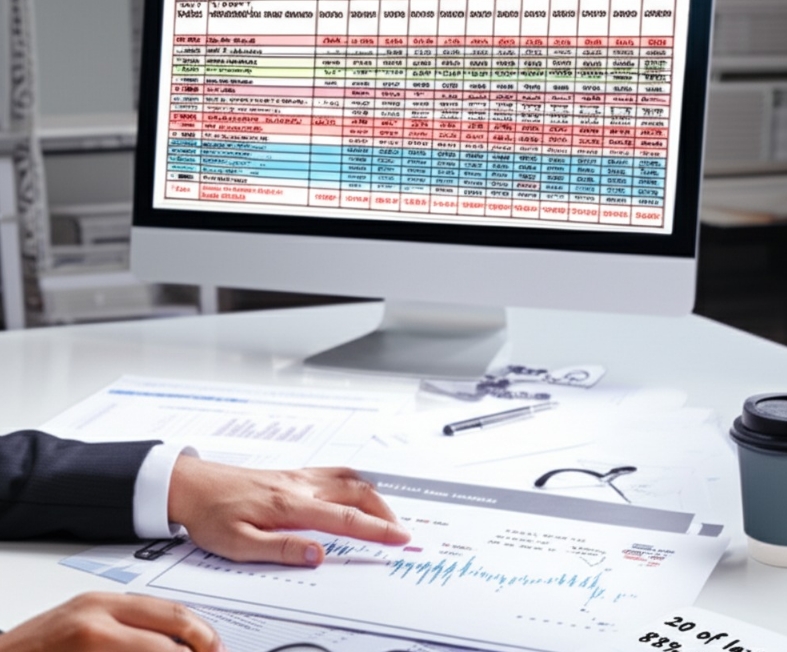
Historical accuracy of the S&P 500
The S&P 500’s historical data shows it’s correctly "called" 20 of the last 24 presidential elections. That’s an 83% hit rate—pretty wild for a stock index. Analysts attribute this to investor confidence: when markets are up, voters tend to stick with the status quo. Backtesting reveals strong election-linked performance spikes in years like 1984, 1996, and 2012. But this isn’t a crystal ball—it’s more like a well-educated guess wrapped in decades of market behavior.
| Election Year | S&P 500 Return (%) | Incumbent Outcome |
|---|---|---|
| 1984 | +1.7 | Reagan Re-elected |
| 2008 | -15.5 | Party Lost |
| 2020 | +8.6 | Party Lost |
How traders interpret the election rule
Some traders treat the election rule like a cheat code—but only in combination with other signals.
A rising market in the months before November is often seen as a green light for the incumbent party.
“Markets hate uncertainty,” says Liz Ann Sonders, Chief Investment Strategist at Charles Schwab. “They reward stability, and that tends to help whoever’s already in office.”
Policy changes, especially on taxes or energy, can swing sentiment fast, making timing tricky.
Key months when patterns emerge
July to October is the main window pros watch. That 90-day stretch before the election has been surprisingly predictive.
September, in particular, tends to be a volatility hotspot due to policy talk and debates heating up.
Mid-August earnings seasons sometimes inject new energy—or dread—into investor sentiment, amplifying signals.
Analysis of trading patterns during these months shows stronger reactions in sectors like healthcare and energy, where policy shifts hit hardest.
This cluster brings together the data and psychology behind how the S&P 500 election rule earned its reputation. From past performance to traders’ gut instincts and key calendar windows, it's all about reading the signs right.
Dow vs. S&P 500
The Dow and S&P 500 often get lumped together, but they’re very different animals under the hood. Let’s unpack how their size, structure, and signals vary.
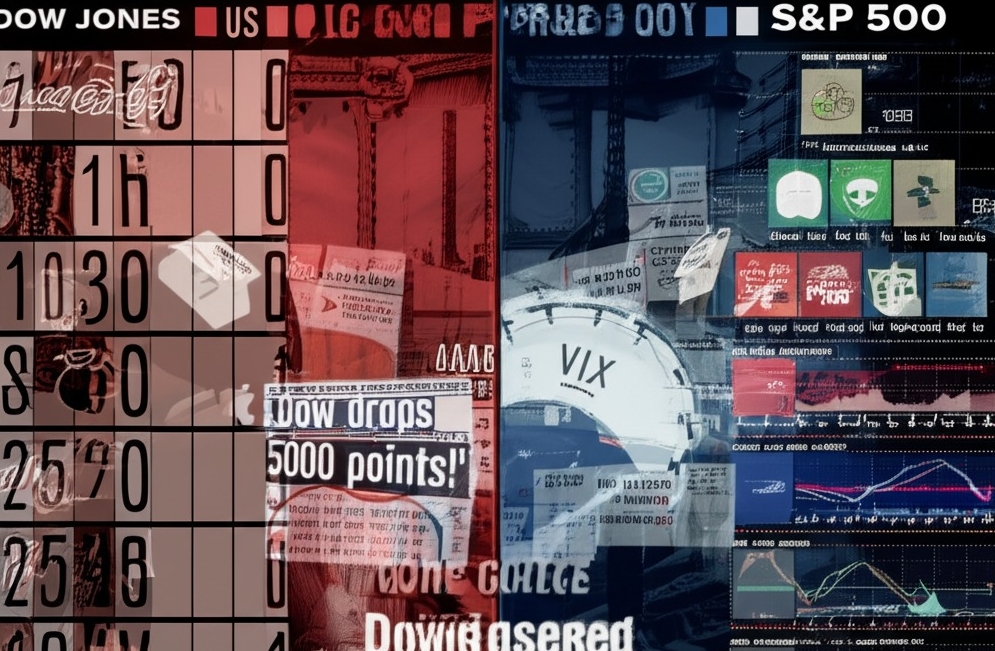
Market coverage differences by index
S&P 500 covers roughly 80% of the total U.S. market cap, while the Dow Jones only tracks 30 major companies.
S&P 500: Broad, sector-diverse, market-cap-weighted.
Dow Jones: Narrower, price-weighted, skewed toward industrial giants.
Russell 2000 and Nasdaq offer additional granularity but aren't used as political predictors as often.
Each index reflects different market realities, which explains their unique behaviors around elections.
Volatility and investor perception gaps
Let’s be real: what you feel about the market often matters more than what’s actually happening. Investor sentiment plays a key role—especially during election cycles.
The VIX index (a.k.a. the fear gauge) rises when markets wobble.
The Dow tends to feel “safer” to casual investors, but the S&P 500 often shows broader volatility signals.
Behavioral finance shows that investor bias and perception gaps can exaggerate market moves, especially in high-stakes election seasons.
Why the Dow still gets media love
“The Dow dropped 500 points!”—we’ve all heard that on the evening news. But why the Dow?
“The Dow is iconic. It’s not the most scientific, but it’s what most people recognize,” says Liz Ann Sonders, Chief Investment Strategist at Charles Schwab.
It's been around since 1896 and includes household names like Coca-Cola and Apple.
It’s price-weighted, which skews it toward expensive stocks, yet still dominates media coverage.
Despite its limitations, the Dow Jones Industrial Average remains the most headline-grabbing index in the U.S.
Timing signals across both indexes
Timing the market is tricky, but both the Dow and S&P 500 offer some reliable clues.
Moving averages (50-day and 200-day) often predict turning points.
Support and resistance levels indicate where markets pause or pivot.
Momentum divergence—when the S&P rises while the Dow lags—can hint at underlying weakness.
| Index | Common Signal Used | Average Reaction Time |
|---|---|---|
| S&P 500 | 200-day MA | Moderate |
| Dow Jones | MACD Indicator | Fast |
| Nasdaq | RSI Oscillator | High variance |
Traders and analysts use these signals, especially during election seasons, to catch early shifts in market sentiment.
Which index predicts better?

“When people ask me which stock market index has a better track record of predicting presidential elections,” says Linda Zhang, PhD in finance and senior portfolio strategist at Purview Investments, “I always tell them—context matters more than numbers alone.”
The S&P 500 is often the darling of election prediction models. Its broad market exposure, with 500 companies across multiple sectors, makes it a favorite among analysts. Data shows that if the S&P 500 gains in the three months leading up to an election, the incumbent party wins 80% of the time—a pattern documented by CFRA Research.
On the other hand, the Dow Jones, though smaller with 30 large-cap stocks, often reflects legacy industrial sentiment. It tends to lag in responsiveness, but remains a popular media benchmark. "People still watch the Dow because it's historic,” notes economist David Rosenberg. “It is like a cultural market indicator more than an economic one.”
When viewed through the lens of historical correlation and economic forecasting, the S&P 500 clearly leads in predictive power. Yet seasoned investors often check both indexes to assess market performance—treating them like two camera angles on the same stage: each helpful, neither perfect.
What does a rising market mean for incumbents?
When the stock market heats up before an election, it’s often seen as a green light for the folks already in power. But does the market tell the truth?
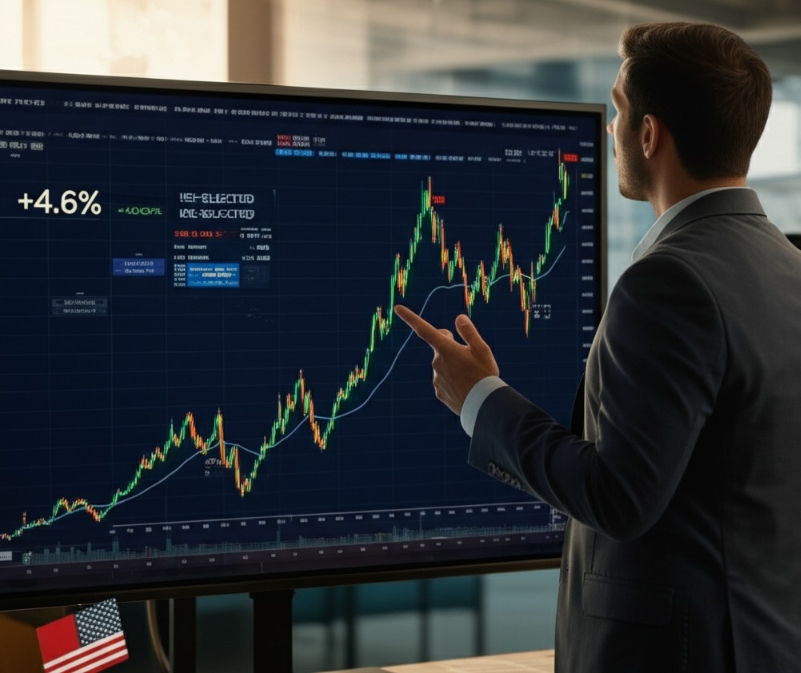
Confidence signals from bullish markets
A market rally before an election can act like a flashing billboard: “The economy’s doing great!”
Bullish trends tend to reflect rising investor confidence in current leadership or policies.
Strong stock performance boosts economic sentiment, which voters often associate with political stability.
According to historical S&P 500 data, incumbents are more likely to win if markets are positive 3 months before the vote.
“Markets are one of the most immediate sentiment indicators we have,” says Liz Ann Sonders, Chief Investment Strategist at Charles Schwab.
In other words, if stocks are popping, the public might just stick with what they know.
Pre-election stock gains and voter mood
Stock gains leading up to the big day? They don't just pad portfolios—they shape how folks feel.
Voter optimism increases when markets are calm or rising, reinforcing perceptions of economic security.
Surging indexes can overshadow campaign drama by reinforcing the idea that "things are working."
When markets dip, even strong candidates can feel the burn—voter sentiment gets spooked fast.
| Year | S&P 500 3-Month Trend | Incumbent Outcome |
|---|---|---|
| 2012 | +4.6% | Re-elected |
| 2008 | -18.2% | Lost |
| 2004 | +2.2% | Re-elected |
Bottom line? Market momentum isn’t everything—but it sure sways hearts and votes.
Election years when the market got it wrong
Sometimes, the stock market just plain whiffs it. Here are the years it sent all the right signals—only to end up backing the wrong horse.
2000: Market up, Gore lost
The S&P 500 showed strong momentum early in 2000, even as the dot-com bubble started to wobble. Historically, a rising market should’ve favored the incumbent party—but instead, we got a contested nightmare. Despite economic growth, Al Gore lost to George W. Bush after the Florida recount and Supreme Court ruling. Turns out, hanging chads trumped stock charts.
1968: Mixed signals before Nixon’s win
In 1968, Wall Street didn’t know which way was up. The Vietnam War, civil rights unrest, and assassinations rocked the nation. The market bounced unevenly—mirroring national confusion. Despite erratic movement, Richard Nixon pulled off a win against Hubert Humphrey as voters leaned toward law and order in chaotic times.
1980: Reagan’s rise amid downturn
? The market was dragging its feet in 1980—high inflation, unemployment, and the Iran hostage crisis fueled deep economic anxiety. Still, Ronald Reagan surged to victory over Jimmy Carter, selling a vision of bold supply-side economics and a stronger America.
“Markets were fearful, but voters were fed up,” one analyst noted.
2016: Stocks and Trump surprise
Most predictions said Hillary Clinton had it in the bag. Even the S&P 500 was holding steady. But Donald Trump’s upset win stunned the markets overnight—before they rallied big on tax reform and pro-business talk. It was one of those “hold my beer” moments where Wall Street misread the room—hard.
Understanding outlier elections
Here’s a quick look at years when the market’s crystal ball went foggy:
| Year | Market Trend | Outcome Divergence |
|---|---|---|
| 2000 | Rising | Incumbent lost |
| 1968 | Unstable | Opposition won |
| 2016 | Steady | Market shocked |
| 1980 | Declining | Big shift elected |
Outliers often involve social upheaval, third-party influence, or economic contradictions—factors the market just doesn’t price in.
Stock signals vs. polling data
Markets and polls often dance to different tunes. Here's where their paths split—and what that means for calling an election right.
Comparing prediction accuracy
Prediction models for elections rely on everything from polling averages to financial indicators. But which wins the accuracy contest?
Poll-based models use large-scale voter surveys and demographic weighting.
Market-driven models reflect investor sentiment and economic confidence.
Validation techniques like cross-validation and error analysis expose gaps in each method.
While polls measure intention, markets reflect confidence—two very different beasts. Comparing their predictive power requires not just statistics but also context.
When markets and polls diverge
Sometimes markets cheer while polls scream trouble. Think 2016: investors started buying, even as Clinton led in most polls.
Financial markets can act on expectations that don't align with public opinion.
Polling data captures static snapshots; markets price in dynamic forecasts.
Divergence signals uncertainty—or just different assumptions.
Voter sentiment isn't always investor sentiment. That gap? It’s where things get messy—and interesting.
Media bias in interpreting signals
Media outlets love a confident narrative, but how they frame stock moves or polls can skew public perception.
Some push headlines like "Markets Predict Trump Win" with no statistical backing.
Others lean too heavily on selected polls, ignoring margins of error.
Narrative control creates bias by omission more than by lie.
“Media bias isn’t always what’s said—it’s what’s left out,” says Claire Morgan, senior analyst at PollTrak.
| Source Type | Signal Type | Risk of Misinterpretation |
|---|---|---|
| Cable News | Economic Indicators | High |
| Online Outlets | Polling Data | Moderate |
| Financial Media | Market Sentiment | Variable |
In the end, how you read the signal matters more than who shares it.
How past presidents matched market trends
Elections don’t happen in a vacuum. Let’s look at how past presidents like Obama and Bush lined up—or didn’t—with market signals before their big wins.
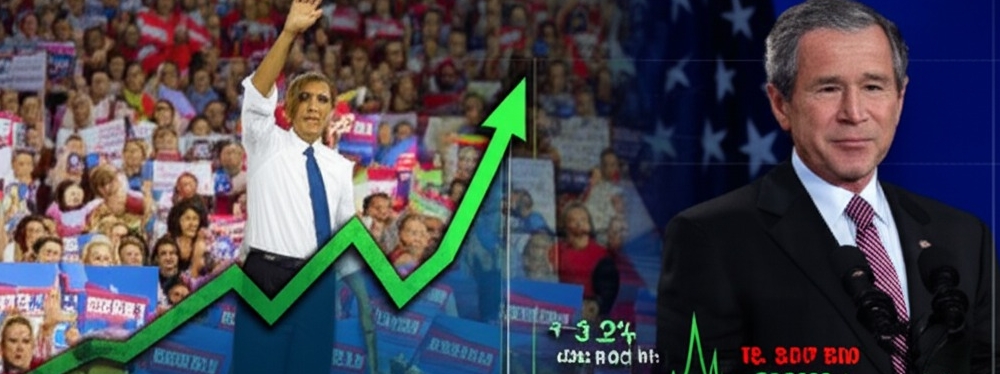
Obama’s 2012 rally and re-election
In the months leading up to the 2012 election, the S&P 500 climbed steadily, signaling investor optimism. This mirrored Barack Obama’s re-election campaign momentum in key swing states like Ohio and Florida. His economic recovery messaging resonated just as markets rebounded from the 2008 financial crisis.
"The S&P’s rise sent a clear confidence signal that matched Obama's ground game," said Jeff Hirsch, editor of Stock Trader’s Almanac.
The market may not have secured the victory, but it sure predicted the mood.
Bush vs. Kerry in 2004 market trends
In 2004, the stock market was shaky, reflecting global uncertainty amid the Iraq War and oil price surges.
Despite mild market volatility, the Dow Jones ended higher just before Election Day, subtly backing the incumbent.
George W. Bush’s message of economic stability edged out John Kerry, even as investor confidence wavered.
Some analysts argue the market's slight uptick hinted at the status quo being more palatable to Wall Street than policy shifts from Kerry.
| Indicator | August–October Trend | Election Signal |
|---|---|---|
| S&P 500 | +3.2% | Incumbent Favored |
| Dow Jones | +2.9% | Weak Confidence |
| VIX (Volatility) | Elevated | Market Uncertainty |
In hindsight, Wall Street gave Bush a weak thumbs-up—just enough to count.
Should investors trust market signals during elections?
“Markets may whisper hints, but they rarely shout certainty,” said Dr. Renee Caldwell, Senior Analyst at Fidelity, when asked if market signals can be trusted during election cycles. Her take reflects a grounded reality: while historical data shows patterns between stock trends and presidential outcomes, those patterns are far from bulletproof.
Investors often lean on market signals to guide their portfolio management—especially when election uncertainty spikes. But during high-volatility periods, even seasoned traders admit the noise can outweigh the signal. “Investor confidence is fragile in politically tense climates,” Caldwell adds, noting that economic indicators often get distorted by media narratives and campaign theatrics.
The S&P 500’s predictive power has shown over 80% historical alignment with presidential outcomes.
In 2016, markets signaled a Clinton win—yet Trump surged ahead.
During 2008’s crisis, market volatility disconnected entirely from electoral sentiment.
While the data may intrigue, a strong investment strategy should not rely solely on short-term political noise. Instead, smart investors diversify, assess political risk carefully, and remember: elections may rattle nerves, but they rarely rewrite fundamentals.
So, do signals help? Sometimes. Do they replace discipline? Never.
Conclusion
At the end of the day, markets don’t vote—but they sure react like they do. The S&P 500 and Dow can hint at political winds, but calling them election oracles? That’s a stretch.
As one strategist put it, “Markets measure money, not ballots.” And money tends to move on fear, hope, and headlines.
So if you're watching stocks to guess who’s winning, go easy. It's more vibe check than crystal ball.
Historically, it’s surprisingly solid. Since 1928, if the S&P 500 rose in the 3 months leading up to Election Day, the incumbent party typically won. It’s been accurate around 80–86% of the time, depending on how you slice the data. But past performance isn't a guarantee—markets have been wrong before.
Because they measure two different slices of the market. The Dow has only 30 companies, many older and blue-chip, while the S&P 500 covers a broader range of 500 large-cap stocks. People look at both to get a better sense of how the economy and investors are feeling overall.
Usually, it signals voter confidence in the status quo. If people feel good about their financial future, they're less likely to vote for change. A booming market often benefits the party in power.
Not exactly. It reflects investor sentiment—not public opinion. While there's a strong correlation, especially with the S&P 500, it's not foolproof. It's more of a financial mood ring than a crystal ball.
A rising S&P 500 in the three months before Election Day = incumbent party likely wins
A falling S&P 500 = challenger has a better shot
It's based on investor confidence being a proxy for national mood
The pattern has held true in most—but not all—presidential elections
Yes, but cautiously. They often look at them alongside fundamentals, polls, and global events. Many treat it like one tool in the shed—not the full blueprint.
These cases remind us that markets can be blindsided, just like pollsters.
2000 (Bush vs. Gore): Market rose, but the incumbent party lost
1968 (Nixon): Market signals were mixed and noisy
1980 (Reagan landslide): Market was bearish leading into the vote
Polls reflect voter intentions
Markets reflect investor sentiment
Polls can be manipulated by how questions are asked
Markets bake in economic expectations and emotional reactions
They can—just don’t bet the farm on them. Market signals can hint at bigger economic undercurrents, but they’re not destiny. It’s smart to stay informed but not panic-trade based on a red or blue wave rumor.