


Ever fumbled through a trade only to realize your forex trading calculation was off by just a hair—and that tiny slip cost you big? Yeah, it’s like misjudging the last step on the stairs: small error, loud fall. The math behind margin, pip values, and risk sizing isn’t some Wall Street wizardry—it’s stuff you need in your back pocket before clicking “buy” or “sell.”
Back when I started trading currencies from my tiny Brooklyn apartment (yes, next to the radiator that hissed like a snake), I thought more trades meant more wins. Wrong. What I needed wasn't guts—it was clarity around lot sizes and how fast a blown margin could drain my account faster than spilled coffee on tax day.
“More than 65% of retail traders lose money due to poor position sizing and misunderstood risk exposure,” according to data from the European Securities and Markets Authority (ESMA). That stat alone should make anyone pause mid-trade.
You’re not here for fluff—you want answers that don’t talk down to you. So buckle in as we break down this crucial trio—margin calls, pip math, position sizing—and show you how smart traders keep their cool while others panic-click out of losing trades.
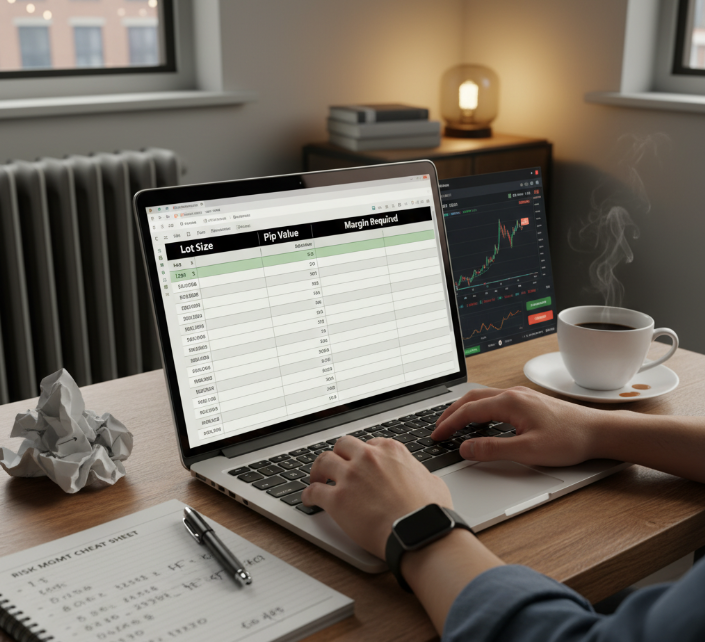
Understanding Forex Trading Calculation Principles
The Role of Currency Pairs in Trading Calculations
Currency pairs are the bread and butter of every forex trading calculation. Each pair—like EUR/USD or USD/JPY—tells a story about two economies. The quote currency sets the tone for your profit/loss, while the base currency determines how much of your account balance is at stake.
EUR/USD = 1.1000 means €1 costs $1.10
If you’re buying, you want that rate to rise
If selling, you’re hoping it drops
The way these pairs move affects your trading capital, especially when calculating position size and potential risk. So yeah, picking the right pair isn’t just about trend; it’s also about how each tick impacts your bottom line.
How Technical Indicators Influence Margin and Leverage Options
Technical indicators aren’t just pretty lines—they shape real decisions around margin requirements and how much exposure you’re taking on with each trade.
RSI overbought? You might reduce position size
MACD crossover? Time to reassess your leverage ratio
Bollinger Bands widening? Expect volatility—and adjust your risk management
These tools help traders gauge market momentum so they don’t end up using too much borrowed money when things get choppy. A smart trader doesn’t just look at charts—they calculate their next move based on what those indicators suggest about price behavior.
Key Fundamental Factors Impacting Forex Calculation Accuracy
Economic data isn’t noise—it’s a compass for accurate forex trading calculation. Central banks set interest rates that directly impact the strength of a currency, which then shifts everything from pip value to required margin levels.
Short-term inflation spikes? That could mess with the strength of the base currency
GDP beats expectations? Expect more movement in major pairs
Rate cuts from central banks? Time to rethink your exposure and tighten up on account equity
All this feeds into how accurately you can plan trades without getting blindsided by surprises that throw off even solid technical setups. The better you understand fundamentals, the sharper your numbers become in real-time trading scenarios.
Calculating Leverage: A Step-by-Step Guide

What Leverage Means: Understanding Its Impact on Margin
Let’s break it down without the fluff—leverage is like borrowing muscle for your trades. It lets you open bigger positions with a smaller chunk of your own capital, but that also means you're walking a tightrope between multiplied gains and equally amplified losses.
You control more with less, but you owe it all if things go south.
Brokers usually offer leverage ratios like 50:1, 100:1, or even 500:1—meaning $100 can control up to $50,000 worth of a currency pair.
The higher the ratio, the smaller your margin requirement—but the risk shoots up too.
A recent report by the Financial Conduct Authority (FCA) noted that a high proportion of retail traders using leverage lose money, underscoring the need for robust risk controls.
Risk Management Techniques When Using High Leverage
Set a strict stop loss every time you enter a trade—no exceptions. One bad move without it can torch your balance.
Use solid position sizing rules; don’t go all-in just because you can afford the margin. Control exposure based on your account's equity.
Stick with a clear-cut risk/reward ratio—aim for at least a 1:2 setup so wins outweigh losses over time.
Trading smart means understanding both the upside and downside of each move within your overall forex trading calculation plan. Don’t just chase profit—preserve your capital too.
Why Margin Matters in Forex Trading Calculations
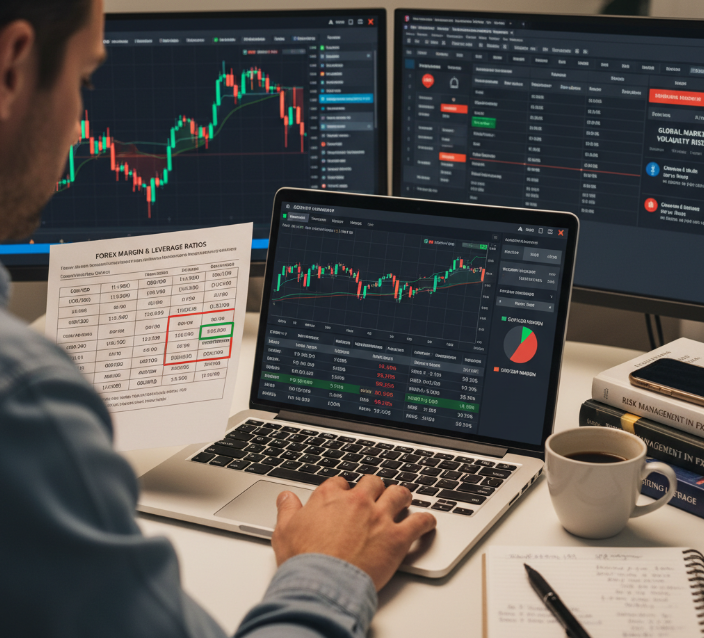
Margin Levels: Comparing Leverage in Different Currency Pairs
Short-term traders often notice that margin levels differ wildly between pairs like USD/JPY and GBP/NZD. That’s not random—it’s baked into the math of margin requirements.
EUR/USD typically has lower margin needs due to high liquidity.
Exotic pairs like USD/TRY demand higher capital, thanks to wild swings.
Brokers adjust based on volatility, historical price behavior, and pair correlation.
For example:
USD/CAD might need just a $500 deposit for a standard lot.
Meanwhile, GBP/ZAR could ask for $2,000+.
This variation directly affects your exposure and trade size. So don’t treat all pairs the same—your margin won’t.
The Connection Between Margin and Position Sizing
Smaller positions mean less required margin, giving you more breathing room.
Overextending with large trades eats up free margin fast.
Smart sizing helps avoid account blowouts during unexpected market turns.
If you're trading EUR/GBP with $10,000 equity at a 50:1 ratio: → A mini lot ($10k position) uses about $200 of your margin. → A standard lot ($100k position) locks up closer to $2,000.
So yeah—position sizing is basically your money management GPS inside the world of forex trading calculation.
Understanding Margin Calls: When They Occur and How to Avoid Them
It happens when your account equity drops below required margin.
Usually kicks in around a maintenance level—say, below 50%.
Your broker may liquidate open positions without asking if you don’t act fast.
Here’s what helps:
Use stop-losses religiously—don’t argue with math.
Don’t max out your available leverage, even if it's tempting.
Always monitor floating losses vs remaining usable funds (free margin).
According to guidance from IG Markets, once your equity falls below the required maintenance margin, positions become at risk of automatic closure.
How Volatility Affects Margin Requirements in Trades
Volatile markets are like caffeine-fueled toddlers—you never quite know what they’ll do next. And brokers hate surprises just as much as traders do.
When things get choppy—think major economic releases or geopolitical flare-ups—brokers hike up their minimum required margin levels as a buffer against chaos-driven price gaps. That means if you're usually putting up $500 for a position during calm times, that same trade might suddenly require double during market spikes.
This is where understanding market rhythm becomes essential in any solid risk management strategy tied into your broader forex trading calculation plan. If volatility is rising but your capital isn’t? Sit it out—or shrink those trades fast before the spread eats you alive.
Calculating Pip Value: A Simple Formula
The Importance of Pip Value in Scalping Strategies
Scalpers live and breathe precision. With trades lasting mere minutes, knowing your pip value isn't optional—it’s a survival skill.
A tiny misjudgment in pip size can flip a winning streak into a losing spiral.
For example, when trading a standard lot, each pip move equals $10—mess that up, and you’re bleeding dollars fast.
Tight stop-losses require pinpoint accuracy; understanding the quote currency impact helps avoid premature exits.
But here’s where it gets spicy—scalping with high-frequency entries means you're making dozens of decisions per hour. If your forex trading calculation is off by just one decimal place, you’re risking way more than intended.
So always lock down your pip math before hitting "Buy." It keeps your risk tight and your profits clean.
How Currency Pair Fluctuations Affect Pip Values
When trading USD/CHF or GBP/JPY, the value per pip changes based on the current exchange rate, not just trade size.
The more volatile the pair, the harder it is to pin down accurate pip worth without live recalculations.
Cross-pairs like EUR/GBP? Trickier still—they often need conversions using both base and quote currencies before finalizing figures.
According to CME Group, changes in implied volatility can materially alter expected price movement ranges—context scalpers often fold into intraday pip targets.
Using Technical Indicators to Refine Your Pip Calculations
Volatility-Based Tools
Bollinger Bands show price deviation levels so you can estimate realistic pip ranges.
ATR (Average True Range) gives insight into average movement size per candle—great for gauging expected pip shifts before entering trades.
Support & Resistance Anchors
Use Fibonacci Retracement levels to align entry points with calculated stop distances.
Helps determine whether a move of X pips is within reason or just wishful thinking based on past data patterns.
Price Action Filters
Combine candle formations with indicator signals to validate if projected pip value aligns with actual momentum.
Especially useful when calculating risk-to-reward ratios using precise position sizes across different currency pairs and lot types like mini lot or micro lot setups.
Bottom line? Smart traders bake indicators right into their daily forex trading calculation routines—not as guesswork but as tactical tools for cleaner execution.
Understanding Margin Call: Risks in Forex Trading
How to Identify Potential Margin Call Triggers
Equity-to-margin ratio drops below safe levels — your account equity can't support open trades anymore. This is the most direct margin call trigger.
A sudden spike in volatility, especially during news events, can cause rapid equity reduction, pushing your margin level into danger.
Oversized positions relative to your account balance increase the risk of hitting a stop-out level.
Holding multiple correlated trades? If one pair tanks, others might follow — compounding losses fast.
Declining free margin due to floating losses leaves little buffer against market swings.
Ignoring broker alerts or failing to top up funds can lead straight to forced liquidation.
Each of these signs ties back into how well you're managing your forex trading calculation — especially position sizing and exposure control.
Strategies for Avoiding Margin Calls in a Bearish Market
Use tight but realistic stop-loss orders. They’re not just safety nets; they’re survival tools that cap damage early.
Scale down your position size so you don’t burn through all your account equity if things go south. Small lots = longer staying power.
Reduce your use of borrowed funds — high leverage ratios might juice returns, but they also amplify pain when prices drop fast.
“Retail traders who reduced their average leverage by even 20% during Q1 2024 saw a 35% lower incidence of margin calls,” according to retail trading behavior observations from IG Group.
Keep an eye on the big picture with economic calendars — bearish turns often start with macro shifts before charts catch up.
And yeah, sometimes sitting out is a strategy too. No trade beats bad trades every time.
If you're using tools like EasyCashBackFx's real-time margin monitor, you'll get early heads-up warnings before things spiral — keeping your forex trading calculation game sharp and proactive.
Calculating Profit Loss Using Pip Values
Real-Life Scenarios: Profit Calculation using EUR/USD Pip Values
A trader buys one standard lot of EUR/USD at an entry price of 1.1000 and exits at 1.1050.
That’s a movement of +50 pips.
With a standard lot, each pip equals $10, so:
Profit = Pip value × Pip movement = $10 × 50 = $500
If the trade had moved against them by the same amount, it’d be a $500 loss.
Now imagine doing this without knowing your position size or how much each pip is worth—yeah, not ideal.
The Effect of Different Orders on Your Profit Calculations
Orders aren’t just buttons—they shape your outcome:
? Market orders execute instantly but can suffer from slippage during volatile moments. That means your actual exit price might differ from what you expected.
? Limit orders, on the flip side, give you price control but no guarantee they’ll trigger—so missed opportunity risk exists.
? And then there are stop orders, which protect you with a preset stop loss, but they can also get hit prematurely in choppy markets.
Bottom line? The type of order influences both execution and eventual profit/loss accuracy in every live trade scenario.
Understanding Risk-Reward Ratios When Calculating Profit Loss
| Trade Setup | Risk ($) | Reward ($) | R:R Ratio |
|---|---|---|---|
| Trade A | $50 | $150 | 1:3 |
| Trade B | $100 | $200 | 1:2 |
| Trade C | $75 | $225 | 1:3 |
| Trade D | $60 | $90 | 1.5:1 |
How Economic Indicators, like Employment Reports, Influence Profit Calculations
Shortly after the U.S. Non-Farm Payrolls report dropped in early May, EUR/USD surged by nearly +80 pips within minutes—thanks to weaker-than-expected job growth numbers released by BLS.
According to Bloomberg, election cycles and key data releases can drive bouts of FX volatility.
So what does that mean for your profit?
If you're long on EUR/USD with solid timing and correct lot size, those +80 pips could translate into hundreds—or thousands—of dollars depending on your setup.
But if you're caught off guard? Slippage might widen spreads and wreck even well-planned trades during high-impact news events.
Always factor economic reports into your strategy when doing any kind of serious forex trading calculation, especially when working out potential gains or losses tied to fast-moving markets powered by real-world data releases.
And hey, if all this feels overwhelming? forex cashback makes it easier by refunding part of your spread costs—even when the market goes sideways.
References
ESMA – “ESMA agrees to prohibit binary options and restrict CFDs to protect retail investors” – https://www.esma.europa.eu/press-news/esma-news/esma-agrees-prohibit-binary-options-and-restrict-cfds-protect-retail-investors
ESMA (press release PDF) – “Product intervention measures relating to CFDs and binary options” – https://www.esma.europa.eu/sites/default/files/library/esma71-98-128_press_release_product_intervention.pdf
Central Bank of Ireland – “Central Bank CFD Intervention Measure” (evidence on retail losses) – https://www.centralbank.ie/docs/default-source/regulation/industry-market-sectors/investment-firms/mifid-firms/regulatory-requirements-and-guidance/central-bank-cfd-intervention-measure.pdf
FCA – “Continuing concerns about problem firms in the CFD sector” – https://www.fca.org.uk/news/press-releases/fca-highlights-continuing-concerns-about-problem-firms-cfd-sector
IG – “What is margin call?” – https://www.ig.com/en/help-and-support/cfds/margin/what-is-margin-call
IG – “What is a margin call and how do you avoid it?” – https://www.ig.com/au/risk-management/what-is-margin-call
CME Group – “Implied Volatility: a real-world example” – https://www.cmegroup.com/education/articles-and-reports/implied-volatility.html
CME Group – “FX Options Vol Converter” – https://www.cmegroup.com/education/courses/tools-for-option-analysis/fx-options-vol-converter.html
U.S. Bureau of Labor Statistics – “Employment Situation Summary” – https://www.bls.gov/news.release/empsit.nr0.htm
Bloomberg – “US election risks are starting to show up in foreign-exchange markets” – https://www.bloomberg.com/news/articles/2024-05-07/us-election-risks-are-starting-to-show-up-in-foreign-exchange-markets
Forex Trading Calculation FAQ
How do currency pairs influence trade accuracy?
The heartbeat of forex trading calculation lies in the currency pair you choose. Major pairs like EUR/USD offer tighter spreads and higher liquidity, while volatile crosses such as GBP/JPY experience sharp price swings.
Liquidity differences also affect execution—market orders may fill instantly on liquid pairs but experience slippage on exotic or thinly traded crosses.
What role does leverage play in margin requirements?
Leverage allows traders to control large positions with smaller capital, but it also magnifies risk. Higher leverage lowers margin requirements, leaving less room for adverse price movement.
1:10 leverage: Higher margin, lower risk exposure
1:50 leverage: Lower margin, higher risk of margin calls
A sudden move against your position—especially on volatile pairs—can trigger a margin call if risk is not managed properly.
Which technical indicators sharpen trading calculations?
MACD: Identifies momentum shifts for trend-following entries
RSI & Stochastic Oscillator: Highlight overbought and oversold zones
Bollinger Bands: Measure volatility and breakout potential
Fibonacci Retracement: Maps support and resistance levels
Why is pip value critical for scalping strategies?
Scalping relies on capturing small price movements. When profits depend on just one or two pips, accurate pip value calculation is essential.
Correct pip values ensure precise take-profit targets and allow trailing stops to protect gains during rapid market fluctuations.
How do economic reports affect profit and loss calculations?
Economic data can dramatically alter market direction. Employment reports, GDP releases, inflation figures, and interest rate decisions often cause sharp volatility.
Central bank announcements can instantly reverse trends or push markets into consolidation, making risk management crucial during news events.