

Forex Trading isn’t a casino spin; it’s a speed game where hesitation costs real money.
Volatility hits, headlines shake rates, and only sharp systems keep cool heads above water.
The Bank for International Settlements reports foreign exchange remains the world’s largest traded market, dominated by electronic platforms.
Quick Answers: Forex Trading Fundamentals
Prioritize low-latency execution through co-location and optimized connectivity to capture fleeting arbitrage opportunities.
Quick Answers: Forex Trading Fundamentals
Leverage real-time data feeds and sentiment analysis to anticipate central bank moves and volatility spikes.
Quick Answers: Forex Trading Fundamentals
Establish robust risk controls—VaR models, margin limits, and counterparty thresholds—to safeguard capital under high leverage.
Quick Answers: Forex Trading Fundamentals
Automate surveillance and compliance processes (MiFID II, AML) within execution platforms for audit trails and regulatory reporting.
Shocking Revelation: $2.4M In 28 Minutes Explained
Forex Trading moves fast, but this case was lightning in a bottle. In under half an hour, sharp minds in the currency market turned micro gaps into serious money. Here’s how Forex Trading at scale really works.
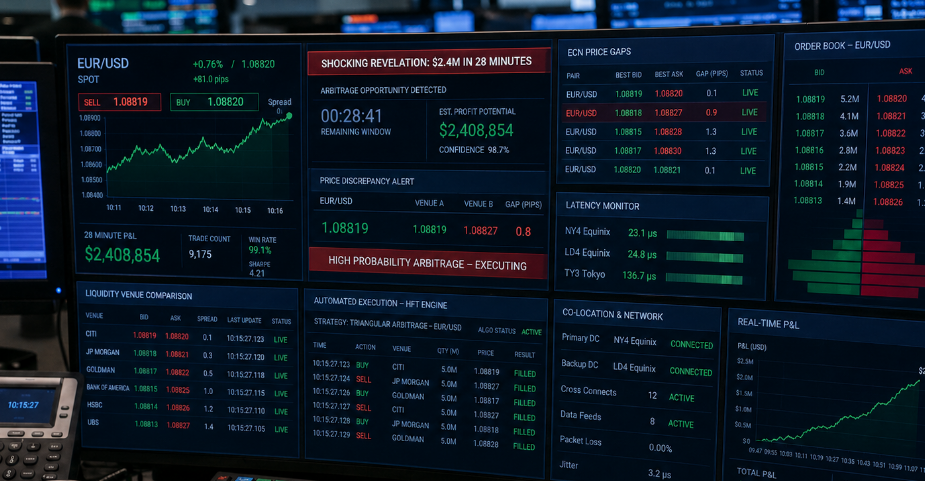
Algorithmic Arbitrage on EUR/USD Spot Contracts
At the core of this Forex Trading event sat a tightly coded Algorithmic trading engine focused on a single Currency pair: EUR/USD within the global Spot market.
Strategy Architecture
1.1 Detection Layer1.2 Execution LayerTriggered Automated execution orders.
Synced buy/sell tickets across venues.
Scanned multiple ECNs for Price discrepancy in the same Financial instrument.
Flagged temporary Market inefficiency in milliseconds.
Arbitrage Logic
Buy lower on one venue.
Sell higher on another.
Lock spread before convergence.
| Venue | Bid (EUR/USD) | Ask (EUR/USD) |
|---|---|---|
| ECN A | 1.08420 | 1.08422 |
| ECN B | 1.08425 | 1.08427 |
| Bank Pool | 1.08418 | 1.08423 |
That 0.3–0.5 pip gap, repeated thousands of times in Forex trading, stacked up fast.
How Proprietary Trading Firms Exploited Real-Time Data
This wasn’t random luck. It was structured Proprietary trading backed by deep Market data feeds.
Data Intake
1.1 Real-time information from order books.1.2 Macro releases parsed in microseconds.Decision Engine
Pattern recognition through rapid Data analysis.
Built-in Information advantage over slower desks.
Execution Edge
Refined Exploitation technique aligned with High-frequency trading logic.
In modern Forex Trading, speed isn’t nice to have. It’s oxygen. Smart traders using EasyCashBackFx can at least recover part of their trading costs through forex cashback while staying active in the foreign exchange market.
Role of Low-Latency Connectivity and Tier 1 Banks
Big gains demand serious pipes.
Infrastructure Stack
1.1 Co-location for ultra Low latency.1.2 Direct fiber Network connectivity to liquidity hubs.1.3 Optimized Data transmission paths.Banking Relationships
Access to a Financial institution within the top Banking sector tier.
Prime broker lines improving Market access.
Speed Economics
Infrastructure advantage reduces slippage.
Faster Transaction speed protects thin spreads.
Forex Trading at this level is a tech race. Retail traders in online trading can’t copy the hardware, but stacking small edges, tight spreads, and forex rebates from EasyCashBackFx makes Forex Trading far more sustainable.
Scenario: News-Driven Forex Trading Windfall
When a surprise central bank move hits the wires, Forex Trading desks light up fast. Screens flash, spreads shift, and currency trading turns intense. In this kind of forex market rush, timing, tech, and sharp news reads can turn plain trading into serious upside.
Central Bank Statement Sparks Futures Contracts Frenzy
When a Statement reshapes monetary policy expectations, the reaction in futures contracts unfolds in layers:
Policy Shock Transmission
Hawkish tilt → higher yield expectations.
Dovish hint → softer currency bias.
Central bank tone shifts rate outlook.
Economic data references amplify interpretation.
Market Reaction Chain
Surge in trading activity across EUR/USD.
Spike in market volatility as liquidity thins.
Rapid price movement in both spot and futures markets.
Position Rebalancing
Short-term futures contracts
Options tied to macro themes
Hedge desks adjust exposure in:
Retail traders jump into Forex Trading platforms, chasing momentum in the forex market.
In active currency trading, these cascades matter. A single line in a policy release can flip sentiment in seconds, pushing trading flows across global sessions.
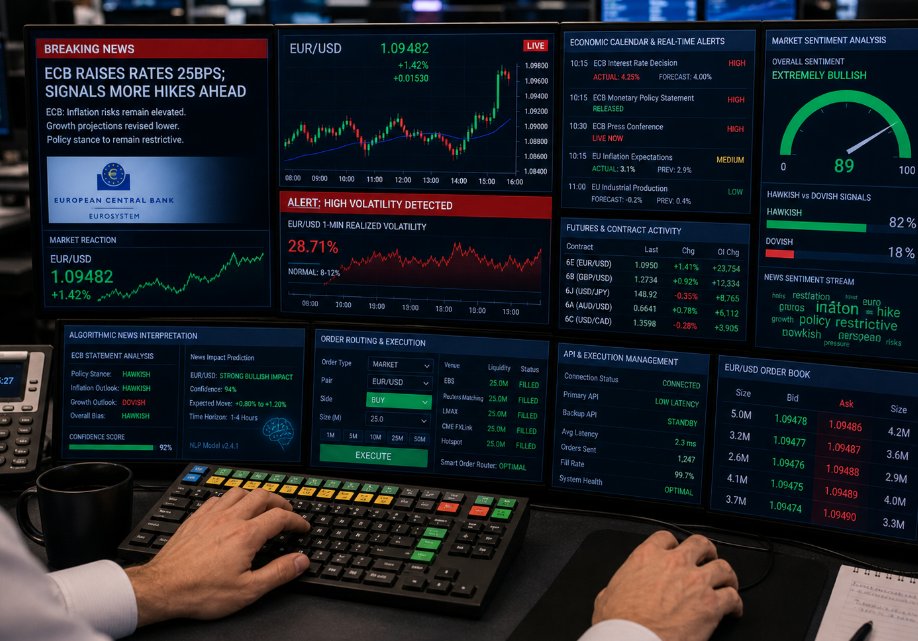
Hedge Funds Capitalize with Sentiment Analysis Tools
Sharp desks do not rely on headlines alone. In modern Forex Trading, speed meets data.
Hedge funds scan thousands of articles through sentiment analysis engines.
Algorithms digest tone, keywords, and news interpretation shifts.
Output feeds directly into algorithmic trading systems.
Quick breakdown of how this plays out:
Data Collection
Real-time feeds on market sentiment
Social chatter aligned with economic data
Data Processing
Natural language models score bullish or bearish bias.
Signals sync with existing investment strategy rules.
Trade Deployment
Automated entries in currency pairs.
Position sizing tied to volatility.
BIS research on high-frequency trading in foreign exchange explains that automated FX trading uses algorithms during the trade process, while algorithmic decision-making can respond to order book imbalance, momentum, correlations, economic data, or news headlines.
That explains why Forex Trading feels faster every year. Retail traders using platforms connected through services like EasyCashBackFx can tap into competitive spreads while staying active in online trading during these news bursts. Smart tools do not replace judgment, but in foreign exchange markets, they give an edge.
Execution Management Systems and API Integration in Action
Behind every clean fill in Forex Trading sits serious infrastructure:
Core Architecture
Pre-trade checks
Risk filters
Execution management system handles:
Direct API integration with each trading platform
Order Flow Routing
Multilateral venues
ECNs for deeper liquidity
Smart order routing scans:
Focus on low latency to cut slippage.
Market Connectivity
Stable market access across regions.
Support for automated trading strategies firing within milliseconds.
For active forex trading accounts, this stack means trades travel fast from click to confirmation. In high-volatility windows, that speed shapes results. Many traders in the Forex Trading space prefer setups connected through EasyCashBackFx, where consistent execution and cashback benefits add a practical boost to everyday currency trading routines.
5 Steps To Replicate That $2.4M Win
Forex Trading isn’t magic; it’s timing, discipline, and knowing where the real money flows. In forex trading and FX trading alike, small edges stack up. Here’s how smart traders approach the foreign exchange market without hype—just structure and hustle.
Step 1: Identify High-Impact Economic Indicators
In Forex Trading, volatility often starts with economic data and government releases. Serious FX trading desks track:
Central bank announcements (rate decisions, forward guidance)
Financial reports like CPI, NFP, GDP
Surprise shifts in macroeconomic trends
Under this, traders usually organize their watchlist:
Monetary Policy
Rate statements
Press conferences
Growth Metrics
GDP
PMIs
Inflation & Labor
CPI/PPI
Employment reports
In the foreign exchange market, reacting late is expensive. Many Forex Trading pros sync alerts with platforms connected through EasyCashBackFx, so rebates cushion spreads while tracking market moving events on an economic calendar.
Step 2: Develop a Trend-Following Quantitative Strategy
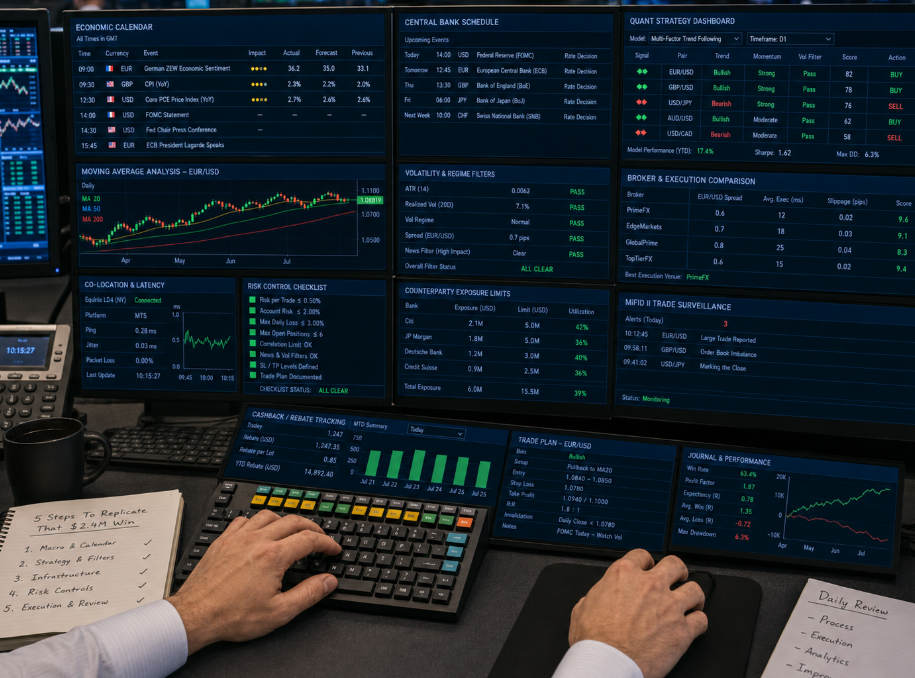
Consistent forex trading profits often come from structured quantitative analysis. A typical build looks like this:
Core Engine
Trend identification using moving averages
Breakout confirmation via volatility filters
Validation Layer
Statistical models
Historical backtesting
Execution Rules
Fixed risk per trade
Algorithmic exits via algorithmic trading
Keep it simple. Clean market patterns beat overfitted code. In Forex Trading, disciplined forex trading strategy design matters more than fancy math.
Step 3: Secure Co-Location Services for Speed
Speed is oxygen in high-volume Forex Trading.
Infrastructure
Co-location inside exchange-linked data center hubs
Direct fiber to liquidity providers
Performance Goals
Sub-millisecond low latency
Optimized network infrastructure
Outcome
Faster fills
Better execution speed
High frequency trading desks obsess over this. Retail traders can’t rent a rack at LD4 easily, but they can choose best forex brokers offering tight market access and then optimize returns through EasyCashBackFx cashback models.
Step 4: Implement Counterparty Risk Controls
Forex Trading isn’t only about charts. It’s about survival.
Risk desks monitor:
Counterparty risk exposure
Prime broker limits
Net settlement lines
Credit risk scoring
CDS spreads
Balance sheet health
Operational Safeguards
Margin thresholds
Automated default prevention
Strong risk management avoids cascading settlement risk during liquidity shocks. Financial stability starts with boring discipline. In FX trading, boring pays.
Step 5: Automate Trade Surveillance under MiFID II
Regulators watch Forex Trading closely, especially in the EU.
Compliance stacks often include:
Real-time trade surveillance
Pattern detection for market abuse
Post-trade controls
Accurate transaction reporting
Governance
Full MiFID II audit trails
Integrated compliance systems
Automated monitoring flags anomalies before regulators do. For serious forex trading operations scaling volume, pairing transparent reporting with cost-efficient structures like EasyCashBackFx keeps margins healthy while staying clean.
Forex Trading success isn’t luck. It’s stacking smart systems, protecting capital, and squeezing every basis point the right way.
Risk Management: Turning 28 Minutes Into Millions
Forex Trading moves fast. One headline, one spike in volatility, and your account feels it. In Forex trading and currency trading, smart risk control keeps small losses small and stops big wins from slipping away. This is where disciplined trading, solid systems, and tools like EasyCashBackFx quietly stack the odds in your favor.
Market Risk Limits for Futures and Options Contracts
In Forex Trading, Market risk starts with uncontrolled Exposure. Tight Risk limits keep futures and options from running wild during high Volatility.
Core control layers
Stress-test under ±2% currency swings
Scenario shocks on implied volatility
Max 2% capital per contract
Daily aggregate cap across correlated pairs
Position sizing in Futures contracts
Premium thresholds in Options contracts
Define contract-level caps.
Stress-test across extreme currency trading events.
Rebalance Derivatives exposure weekly.
| Instrument | Max Exposure (%) | Stress Move (%) | Loss Threshold (%) |
|---|---|---|---|
| EUR/USD Futures | 2.0 | 1.5 | 1.8 |
| GBP/USD Options | 1.5 | 2.0 | 1.6 |
| USD/JPY Futures | 2.5 | 1.2 | 2.0 |
| AUD/USD Options | 1.2 | 1.8 | 1.3 |
Small limits. Clear rules. In online FX trading, that discipline keeps Forex Trading steady.
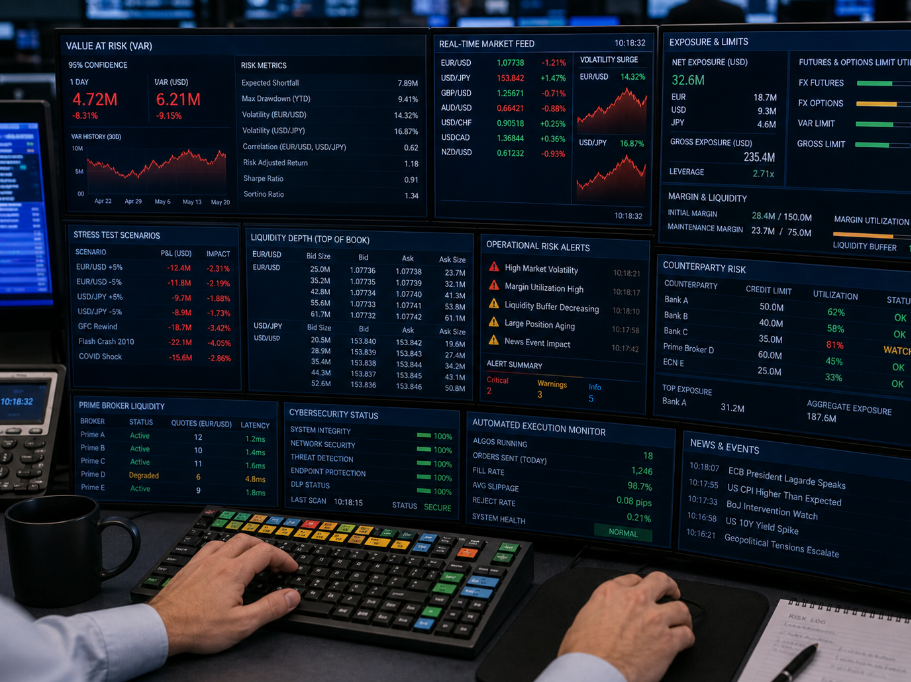
Value at Risk Models with Real-Time Data Feeds
Strong Value at Risk frameworks turn raw Market data into clear Risk measurement.
Data inputs
Tick-level Real-time data
Institutional Data feeds
Rolling volatility matrices
Model structure
Historical simulation
Monte Carlo Statistical analysis
Correlation-adjusted portfolio view
Intraday Forex Trading desks often follow a 99% one-day VaR rule.
BIS research on algorithmic and high-frequency FX trading highlights why real-time data, automated execution, and human monitoring matter when markets move quickly.
In Forex trading, numbers beat gut feelings. EasyCashBackFx users can offset transaction costs while monitoring VaR dashboards, helping currency trading stay efficient even when spreads widen.
Liquidity Risk Mitigation via Prime Brokers
Liquidity risk hits hard during sharp moves in Forex Trading.
Access model
Backup liquidity pools
Multi-bank streams
Credit intermediation
Tier-1 Prime brokers
Secondary Brokerage services
Diversify counterparties.
Monitor real-time depth.
Align Collateral with exposure.
Maintain stable Funding lines.
When capital flows tighten, depth matters more than tight spreads. Forex Trading accounts connected to strong brokerage networks avoid nasty slippage. Add EasyCashBackFx to reduce cost drag, and your trading edge grows quietly over time.
Operational Risk Safeguards in Execution Platforms
In Forex Trading, tech failure is pure Operational risk.
Infrastructure
Encrypted trade routing
Continuous Cybersecurity scans
Automated Automation failover
Latency monitoring
Dual Execution platforms
Secure servers
Control governance
Daily reconciliation for Trade execution
Logged audit trails for Compliance
Real-time alerts protecting System integrity
Forex trading runs 24 hours. One outage can erase weeks of gains. Keep backups live, updates tested, and permissions tight. That’s how serious Forex Trading stays smooth while others scramble.
Which Leverage Ratio Secured That $2.4M Gain?
Forex Trading is not just about picking a direction and hoping for the best. It’s about smart capital use, tight risk control, and knowing how far to push your margin. In forex trading, small moves can mean serious cash.
Carry Trade with 50:1 Margin
In Forex Trading, a Carry trade with 50:1 Leverage can turn a modest Interest rate gap into steady Profit.
Core setup
Borrowing low-yield Currency as Funding
Buying higher-yield Currency
Holding as part of a longer-term Strategy
Margin mechanics
50:1 Leverage means:
Small capital controls large exposure
Tight Margin monitoring is critical
Swap gains stack daily
In active forex trading accounts, traders often pair this approach with cashback programs like EasyCashBackFx. Rebates add a quiet boost to overall profit, especially when positions stay open for weeks.
Forex Trading at this level isn’t hype. It’s disciplined yield capture through currency trading.
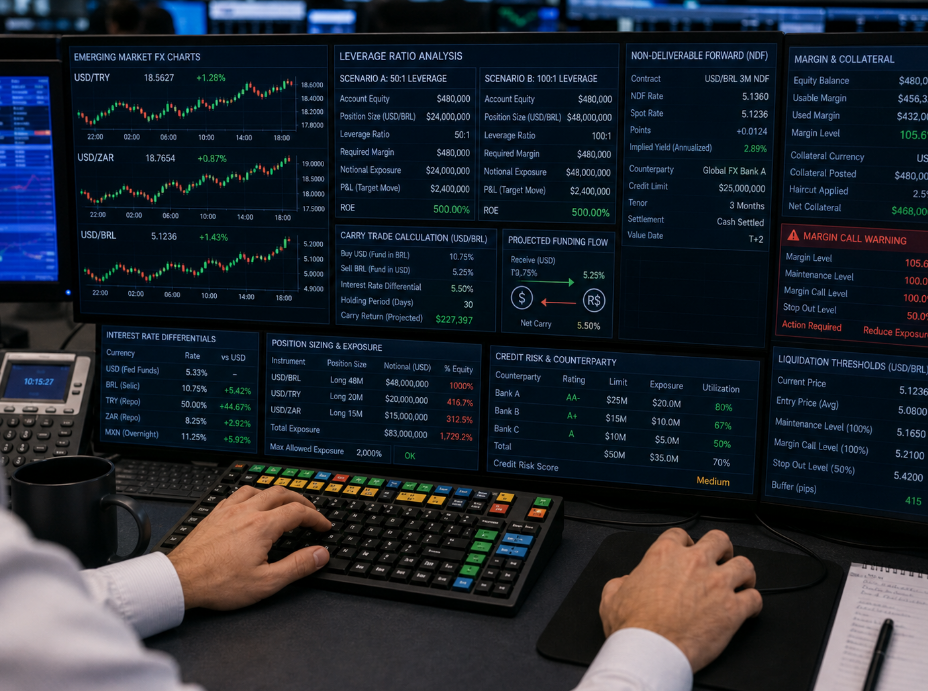
100:1 Leverage on Non-Deliverable Forwards
When Forex Trading shifts toward emerging markets, the Non-deliverable forward becomes a sharp tool.
Key traits:
It’s a Derivative contract.
No physical Settlement of Currency.
Cash difference based on the agreed Contract rate.
With 100:1 Leverage, traders amplify short-term Foreign exchange mispricing. Exposure grows fast. So does risk.
Smart forex traders:
Define max loss before entry.
Track political and liquidity shifts.
Scale out instead of all-in bets.
Add in cost control through EasyCashBackFx, and even high-frequency forex trading can reduce frictional expenses. That edge matters in leveraged forex markets.
Balancing Credit Risk and Margin Calls
Big gains in Forex Trading often sit right next to sharp drawdowns. Managing Credit risk keeps the account alive.
Counterparty layer
Assess Counterparty strength
Monitor posted Collateral
Review exposure concentration
Margin pressure
Track unrealized loss
Prepare for a Margin call
Avoid forced Liquidation
Volatility in currency trading spikes without warning. A tight Risk management routine means adjusting size before stress hits.
Forex Trading success is rarely about one lucky run. It’s about controlling Volatility, protecting capital, and using tools like EasyCashBackFx to quietly improve net returns over time.
References
[Bank for International Settlements – Triennial Central Bank Survey of foreign exchange and OTC derivatives markets in 2025 - https://www.bis.org/statistics/rpfx25.htm]
[BIS Markets Committee – High-frequency trading in the foreign exchange market - https://www.bis.org/publ/mktc05.pdf]
[Global Foreign Exchange Committee – FX Global Code - https://www.globalfxc.org/fx-global-code/]
[Financial Conduct Authority – Multi-firm review of algorithmic trading controls - https://www.fca.org.uk/publications/multi-firm-reviews/algorithmic-trading-controls-high-level-observations]
[European Securities and Markets Authority – MiFIR Reporting - https://www.esma.europa.eu/data-reporting/mifir-reporting]
[European Securities and Markets Authority – Final Report on RTS 22 transaction data reporting and RTS 24 order book data - https://www.esma.europa.eu/document/final-report-rts-22-transaction-data-reporting-and-rts-24-order-book-data]
[European Commission – MiFID II RTS 6 organisational requirements for algorithmic trading - https://ec.europa.eu/finance/securities/docs/isd/mifid/rts/160719-rts-6_en.pdf]
FAQ
How did proprietary trading firms generate millions in minutes through Forex Trading?
When volatility strikes EUR/USD, speed decides the winner.
Opportunity – Pricing gaps appear between electronic communication networks and the interbank market.
Action – Proprietary trading firms deploy algorithmic trading and high-frequency trading models through execution management systems.
Edge – Co-location services inside major data centers cut latency to microseconds.
Control – Value at Risk monitors market risk while real-time data feeds adjust positions in Spot contracts or Futures contracts.
Result: rapid arbitrage, tight spreads, disciplined exits before liquidity risk expands.
What infrastructure do institutional investors need for serious Forex Trading?
Behind every large EUR/USD order stands a layered system built for precision.
Core Components
Trading platforms connected to Tier 1 banks and prime brokers
Low-latency connectivity linked to multilateral trading facilities
API integration for hedge funds running quantitative strategies
Co-location services near liquidity hubs
| Layer | Function | Human Impact |
|---|---|---|
| Market Access | ECNs & market makers | Faster fills, less slippage |
| Risk Engine | Credit risk & counterparty risk checks | Capital protection |
| Data Layer | Real-time data, historical data, economic indicators | Better timing decisions |
Technology handles speed; experienced traders handle judgment.
How do hedge funds manage risk in volatile Forex Trading markets?
Pressure builds when central banks shift policy or liquidity thins.
Hedge funds respond through grouped controls:
Market Risk
Value at Risk models
Technical analysis tools on EUR/USD and Forward contracts
Credit & Counterparty Risk
Exposure limits with commercial banks
Margin oversight via prime brokers
Liquidity Risk
Split orders across ECNs and market makers
Use Non-deliverable forwards in restricted markets
Discipline keeps emotion out when spreads widen and positions swing fast.
Why is regulatory compliance critical in global Forex Trading?
Trust is the silent currency of foreign exchange.
Compliance frameworks such as MiFID II shape daily operations:
Anti-Money Laundering and Know Your Customer checks protect market integrity.
Trade surveillance systems flag suspicious activity across Spot contracts, Options contracts, and Futures contracts.
Regulatory reporting maintains transparency between asset managers, central banks, and institutional investors.
Without these controls, operational risk rises, capital hesitates, and liquidity providers step back.
With them, markets stay active—even when volatility surges.