


India forex reserves just hit over $640 billion—yep, that’s billion with a B. It’s like the country’s financial pantry is fully stocked while others are still clipping coupons. In a world where currencies play seesaw, this stash gives India some serious street cred in global trade.
Think of it like fuel in your trading rocket—without it, you’re not going far. A strong reserve means the rupee can flex when things get dicey, and for traders? That’s prime time to make moves.
“High reserves increase investor confidence and help buffer volatility,” says RBI’s 2024 bulletin. Translation: less whiplash when markets wobble.
If you're eyeballing forex plays involving INR or emerging market pairs, this isn’t background noise—it’s your cheat code.

Key Insights on India Forex Reserves
Understanding Levels: India's forex reserves have surpassed $640 billion, indicating a robust financial foundation amid global uncertainties.
→ Economic Indicators: Factors such as interest rates and GDP growth are crucial for influencing forex reserves and assessing economic health.
➔ Influencing Factors: Inflation rates and trade balance adjustments are key determinants of forex value and reserve stability.
Currency Composition: Major currency pairs like EUR/USD and USD/JPY play a significant role in shaping reserve strategies and diversifying assets.
Main Players: Regulated and ECN brokers are essential in managing forex reserves, ensuring compliance and transparency in trading strategies.
Global Impact: Economic trends, including GDP growth and unemployment rates, directly affect currency strength and forex reserves management.
Current Status of India Forex Reserves
Quick peek: India’s forex reserves are more than just numbers—they’re the country’s financial safety net, constantly shifting with global winds and economic pulse.
Understanding India's Current Forex Reserve Levels
RBI data shows that as of the latest reporting period, the total value of india forex reserves hovers around $640 billion.
These reserves offer critical support to manage currency volatility and ensure stable trade operations.
A strong reserve position boosts investor confidence, helping attract foreign capital even when markets get shaky.
Weekly updates from RBI provide insights into current trends and allow policymakers to adjust strategies swiftly.
The rising USD equivalent value is partly due to gains in gold holdings and foreign securities.
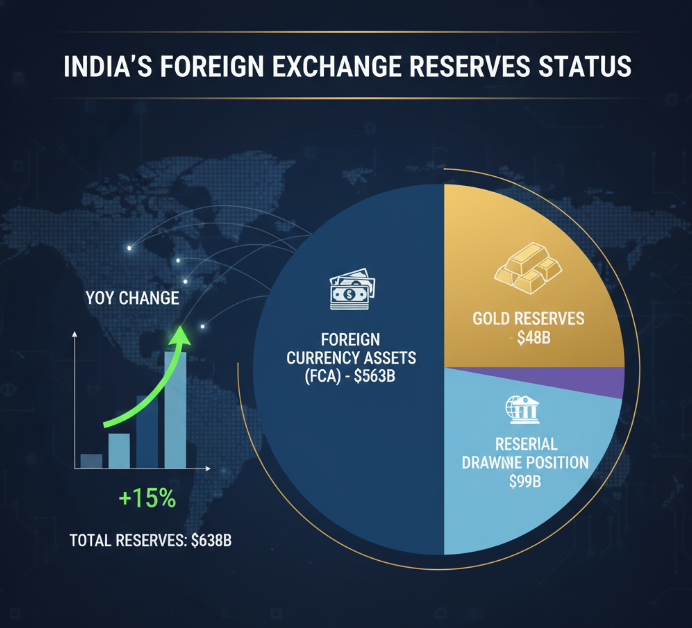
Currency Composition: How EUR/USD and USD/JPY Impact Reserves
Grouped by asset type, here’s how major currency pairs impact reserve allocation:
Heavily weighted in USD-denominated instruments due to global trade dominance.
EUR/USD shifts affect valuation adjustments.
Valued in USD, but sensitive to both EUR/USD and commodity pricing swings.
Tied to a basket including JPY; hence, USD/JPY fluctuations play a role.
Less volatile but still influenced by IMF-related valuations tied to major currencies.
Diversification across these ensures better risk management for currency stability.
The Role of Economic Indicators in Current Forex Reserves
Here’s how three key indicators directly influence the movement in india forex reserves:
GDP Growth Rate – A higher growth rate strengthens economic resilience, encouraging capital inflows.
Interest Rates – Rising domestic rates attract foreign investment, boosting reserves through higher FCA accumulation.
Inflation Trends – High inflation can devalue FX assets unless offset by policy tightening or hedging strategies.
These metrics help shape decisions around reserve buildup or drawdown during uncertain times. They also indirectly impact India’s global standing, especially among credit rating agencies.
Reserves Trends: How Interest Rates Affect Forex Stability
India's central bank often walks a tightrope between growth and stability. When interest rates rise globally:
• Foreign investors shift funds toward higher-yielding economies like the U.S., draining Indian markets. This puts pressure on the rupee and leads RBI to dip into its reserves for support.
• Conversely, when local rates rise faster than global averages, it attracts inflows—strengthening both INR and reserve levels simultaneously.
• Historical trends show that synchronized hikes between RBI and Fed maintain balance without eroding too much from either side of the equation.
This interplay is crucial for managing import cover, especially during periods of oil price spikes or geopolitical tensions.
Gold & SDR Share Within Total Reserves
| Component | Value ($ Bn) | Share (%) | Change YoY (%) |
|---|---|---|---|
| Foreign Currency Assets | 563 | 88% | +6.2 |
| Gold Reserves | 48 | 7.5% | +12.9 |
| Special Drawing Rights | 18 | 2.8% | +2.5 |
| Reserve Tranche Position | 9 | 1.7% | +0.8 |
Gold has seen the fastest YoY growth among all components—boosted by rising prices and strategic purchase timing by RBI—to enhance overall diversification within total holdings linked to india forex reserves.
What Drives Weekly Reserve Changes?
A mix of short-term factors drives those weekly ups-and-downs you see in RBI reports:
– Exchange rate revaluations based on dollar strength or weakness – Portfolio inflows/outflows triggered by FII behavior – Payments related to external debt servicing or defense imports
Each week tells its own story—sometimes it’s about bond yield spreads; other times it could be oil prices or even geopolitical tremors shaking up market sentiment tied directly back into India’s reserve composition strategy via shifts in FCA or RTP positions.
Why Forex Buffers Matter During Crisis Cycles
Short bursts ahead:
• Acts as insurance against external shocks like war or pandemic-driven supply chain breakdowns.
• Stabilizes INR when speculative attacks hit emerging markets hard—like during taper tantrums or sudden Fed pivots.
• Helps fund emergency imports without borrowing externally—keeping credit ratings intact while managing public perception wisely through consistent policy moves supported by strong buffers for better external debt management outcomes long term.
EasyCashBackFx Insight: Navigating Market Swings with Confidence
At EasyCashBackFx, we’ve noticed savvy traders increasingly track changes in india forex reserves as early warning signals before making big moves on currency pairs like USD/INR or GBP/INR. With real-time alerts synced with RBI releases, our platform helps users make smarter decisions backed by macroeconomic cues—not just gut feel trades anymore!
Factors Influencing India's Forex Reserves
The value of India forex reserves doesn’t just shift randomly—it reacts to inflation, trade imbalances, and technical cues from the markets.
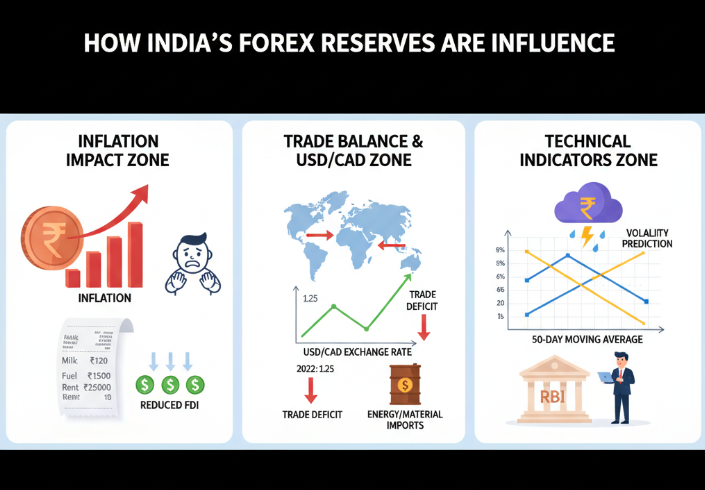
Inflation Rate: A Key Determinant of Forex Value
Inflation’s like that sneaky friend who messes with your shopping budget without warning. When domestic inflation rises:
• The rupee loses purchasing power, reducing the real value of forex reserves. • Higher prices push up import costs, widening the current account deficit. • Investors get jittery, slowing down foreign direct investment (FDI) inflows.
On the flip side, low inflation keeps the rupee attractive and stable—making it easier for India to hold on to its hard-earned dollars.
Trade Balance: The Influence of USD/CAD Fluctuations
Currency pairs like USD/CAD can seem distant, but they ripple into India’s world too. Here’s how:
| Year | USD/CAD Avg Rate | India Trade Deficit (USD Bn) | Impact on Reserves |
|---|---|---|---|
| 2021 | 1.25 | -157 | Moderate |
| 2022 | 1.29 | -190 | High |
| 2023 | 1.34 | -203 | Severe |
| 2024* | 1.31 | -189 | Moderate |
As Canadian exports become pricier due to exchange rate shifts, India’s import bill gets heavier—especially for energy and materials—draining its reserve components faster than expected.
Role of Technical Indicators: Using Moving Averages for Predictions
“Markets move not just by fundamentals but by momentum,” says a recent IMF Financial Surveillance Report (Jan 2024). That’s where technical tools come in.
Moving averages smooth out short-term volatility.
They help RBI time its currency intervention moves more precisely.
Analysts often watch the crossover between short-term (50-day) and long-term (200-day) moving averages to predict reserve pressure points.
In essence, technical indicators act like weather forecasts for currency storms—handy when managing billions in capital inflows and outflows tied to India forex reserves.
5 Key Players in Managing India Forex Reserves
India's forex reserves don't manage themselves—here’s a peek into the big players who keep those billions ticking.
The Role of Regulated Brokers in Forex Management
• Regulated brokers are like watchdogs with calculators—they ensure compliance, security, and transparency when dealing with massive foreign exchange volumes.
• These brokers provide platforms that allow smoother execution of trades involving foreign currency assets, helping stabilize reserve operations.
• They’re also crucial in preventing shady transactions, which protects the value of India forex reserves and builds investor trust.
• With round-the-clock surveillance mechanisms, these brokers reduce operational risks linked to volatile currency markets.
• Their role extends beyond execution—they also help interpret signals from the RBI’s monetary policy, aligning trading decisions with central bank cues.

How ECN Brokers Influence Forex Reserve Management Strategies
ECN brokers—Electronic Communication Network ones—are all about speed and transparency.
They directly connect buyers and sellers without intermediaries, lowering spreads during forex trades.
This real-time matching system helps optimize trade timing for managing reserve levels, especially during high volatility periods.
Grouped Impact Areas:
Trade Execution Efficiency: Faster settlements mean less exposure to currency fluctuations.
Spread Reduction: Narrower spreads reduce transaction costs tied to managing large-scale reserves.
Market Transparency: Clear order books aid better decision-making aligned with current market dynamics.
Liquidity Access: High-volume access allows smoother adjustments in reserve allocation across currencies like the US dollar or Euro.
In short, ECN brokers sharpen India's edge by enhancing how efficiently its forex reserves are deployed on global platforms.
Impact of Global Economy on India's Forex Reserves
India’s forex reserves don’t exist in a vacuum. They dance to the tunes of global cues—from oil prices to job data across the ocean.
Global Trends: The Effect of GDP Growth on Forex Stability
Global GDP growth often shifts how investors view risk; strong growth boosts optimism, drawing capital into emerging markets like India.
When major economies grow fast, demand for exports rises. That pumps up India’s trade surplus and adds to foreign currency assets, nudging up total forex reserve levels.
On the flip side, global slowdowns can trigger capital flight, weakening the rupee and forcing the RBI to dip into its reserves.
“Global growth upgrades by IMF have historically coincided with rising capital flows into India,” noted a recent report by Bloomberg Economics (2024).
Position Trading: A Strategy for Navigating Global Economic Changes
Traders eye long-term macro trends—like shifting global interest rates or inflation forecasts—to decide when to buy or hold currencies.
If USD strengthens due to US rate hikes, INR might weaken; traders anticipate this and adjust positions accordingly.
This strategy indirectly impacts india forex reserves, as central bank interventions to stabilize the rupee may increase during volatile swings.
Position trading is less about quick profits and more about riding the tide of economic cycles that shape currency valuation over months.
How Unemployment Rate Variations Influence Forex Reserves
✦ High unemployment in developed economies can shrink imports from countries like India—hurting our export revenue and thus our ability to build up foreign currency assets. ✦ But if joblessness leads central banks abroad to cut rates, it could attract more FPI inflows into Indian debt markets, boosting reserves.
Fluctuations in global job numbers might seem distant but ripple straight through your wallet via their impact on inflation, interest rates—and yes—our own stash of forex reserve levels.
Unemployment isn’t just a domestic issue anymore—it’s part of what shapes how strong or shaky India’s financial cushion really is.
Traders who want to learn forex trading or compare forex cashback and forex rebate program options can use EasyCashbackFX tools and education resources to turn these macro signals into practical trading strategies.
References
Reuters – India’s forex reserves jump to record high of $642.63 billion (March 22, 2024) - https://www.reuters.com/business/finance/indias-forex-reserves-jump-record-high-2024-03-29/
Reserve Bank of India – Weekly Statistical Supplement (Foreign Exchange Reserves) - https://rbi.org.in/Scripts/WSSViewDetail.aspx?TYPE=Section&PARAM1=2
Wikipedia – Foreign-exchange reserves of India - https://en.wikipedia.org/wiki/Foreign-exchange_reserves_of_India
Ministry of Statistics and Programme Implementation – Foreign Exchange Reserves (Section 10.11) - https://mospi.gov.in/1011-foreign-exchange-reserves
Moneycontrol – India’s forex reserves jump $4.36 billion to $693.3 billion as gold holdings surge - https://www.moneycontrol.com/news/business/india-s-forex-reserves-jump-4-36-billion-to-693-3-billion-as-gold-holdings-surge-13745526.html
Wikipedia – Special drawing rights - https://en.wikipedia.org/wiki/Special_drawing_rights
IMF – India: International reserves and foreign currency liquidity - https://dsbb.imf.org/sdds/dqaf-base/country/IND/category/ILV00
IMF – World Economic Outlook, October 2025 - https://www.imf.org/en/publications/weo/issues/2025/10/14/world-economic-outlook-october-2025
IMF – Global Financial Stability Report - https://www.imf.org/en/publications/gfsr
Reuters – India’s forex reserves rise to $676.3 billion, provide 11-month import cover (April 9, 2025) - https://www.reuters.com/world/india/indias-forex-reserves-rise-6763-billion-central-bank-governor-says-2025-04-09/
FAQs about India Forex Reserves
What are india forex reserves and why do they matter to traders?
Think of them as India’s protective chest—filled with foreign currencies, gold, and IMF Special Drawing Rights.
They steady the rupee against wild swings in EUR/USD or USD/JPY.
Offer psychological calm in turbulent markets where Position Trading thrives on reliable trends.
Regulated Brokers draw confidence from these reserves when managing large Market Orders for clients.
Which economic indicators most influence India’s current forex reserve trends?
Reserves feel the push and pull of global data:
Interest Rates – Higher domestic rates can slow capital outflow; boosting reserve stability against GBP/JPY shockwaves.
Inflation Rate – Rising costs cut into trade competitiveness, altering AUD/USD exposure within holdings.
Trade Balance – Surplus tilts USD/CAD assets upward; deficits may invite cautionary Stop Loss Orders by savvy traders tracking MACD signals.
Can moving averages assist buyers evaluating potential trades tied indirectly to india forex reserves?
Yes—smooth lines often whisper market direction when sentiment sways:
• Simple Moving Average keeps Swing Traders attuned to developing Head and Shoulders reversals linked with GDP Growth data releases.
• EMA reacts quicker during Bollinger Bands squeezes triggered by Inflation surprises.
This clarity shapes Limit Order placement ahead of anticipated shifts in cross-pair strength.
Are technical tools like Bollinger Bands useful when analyzing shifts related to reserve-backed currency strength?
Picture volatility zones as breathing spaces for Scalping or Trend Following:
Tight bands around EUR/USD hint restrained moves before Trade Balance results blow them wide apart like unfolding Flags.
Breakouts across AUD/USD show pressure points impacted by Unemployment Rate drops—perfect fuel for ECN Brokers pushing Take Profit Orders at decisive levels.
Here, every ripple echoes through the pulse of india forex reserves’ global interplay.