

Getting ready to Learn Forex Trading in Nigeria can feel a bit like walking into a store with no price tags — you’re interested, but you’re not trying to get blindsided by mystery costs.
I’ve met plenty of beginners who jumped in too fast and later said, “Man, I wish someone had told me the real expenses upfront.” That mix of curiosity and caution is normal, especially when you’re trying to avoid shady “gurus” who promise the moon.
“Transparency saves people money,” notes an EasyCashBackForex training engineer — a reminder that honest guidance matters more than flashy marketing.
This guide hits the real pressure points: course fees, trustworthy training options, learning timelines, and the budget you’ll actually need to get started and stay safe.

How Much to Learn Forex Trading in Nigeria?
This part of the article gets straight to what most Nigerians are asking: what’s the real cost of getting into forex trading?
Mastering the Basics: From Free to Premium Options
Forex trading in Nigeria comes with learning choices: some cost nada, others hit your pocket.
Free resources like YouTube, Reddit, and Telegram groups are decent but often lack structure.
Premium courses bring order, step-by-step coaching, and deeper knowledge — but they charge from ₦25,000 to ₦300,000.
If you’re a visual learner or hands-on type, free stuff might feel scattered.
Table: Cost Comparison of Forex Learning Types in Nigeria
| Learning Option | Average Cost (₦) | Content Depth | Ideal For |
|---|---|---|---|
| YouTube Tutorials | 0 | Low to Medium | Beginners |
| E-books & Blogs | 0 – 5,000 | Medium | Independent learners |
| Local Bootcamps | 30,000 – 70,000 | Medium to High | Practical learners |
| Certified Courses | 80,000 – 300,000 | High (Structured) | Career-minded traders |
Private Mentors vs Online Academies: Which Fits Nigerian Learners?
Private mentors give you that personalized coaching vibe, but they cost more — sometimes ₦100K+.
Online academies offer structure at a lower price and are great for self-paced learners.
Nigerian traders often pick mentors for forex trading because of real-time feedback and flexible timing.
But if you like set modules and steady pacing, online learning might just work better.
It's all about your learning style, budget, and how much hand-holding you need.
Time Cost vs Skill Depth: What Are You Really Paying For?
Let’s keep it real: every ₦1 you spend on learning forex trading is actually a time trade too.
A 2-week crash course might teach you scalping, but don’t expect deep skill depth.
3-month programs dig into chart patterns like Double Tops and Triangles — more time, more cost, but way better learning outcomes.
Think of it like this: less time = faster entry, but slower growth.
Invest time = sharpen skills faster = higher return on investment in live markets.
Urban vs Rural: How Location Impacts Access and Price
Urban areas in Nigeria like Lagos and Abuja have more forex training hubs and bootcamps.
You’re more likely to find face-to-face options, plus fast internet access for online classes.
Meanwhile, rural areas may rely mostly on free downloads, phone data, and Telegram channels.
Pricing also shifts — bootcamps in cities cost more, but sometimes offer better value.
Scared of scams? Affordable, trustworthy forex training options
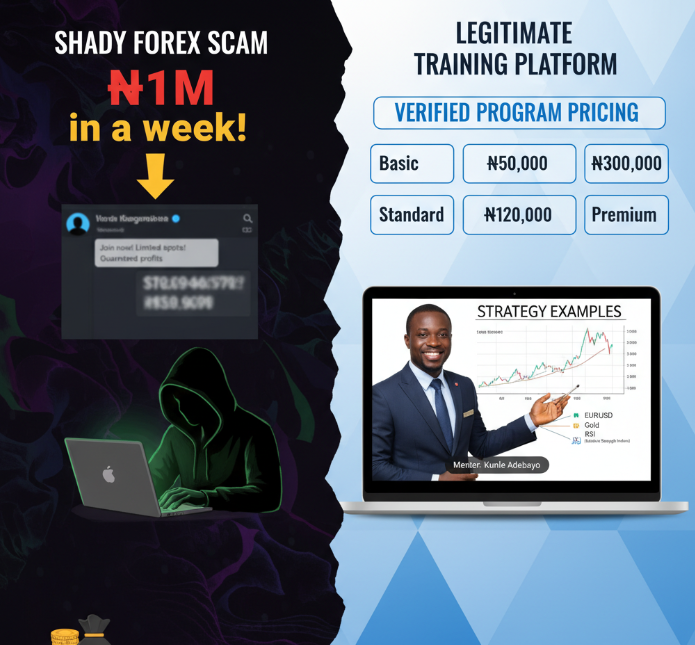
Signs of a Forex Training Scam in Nigeria
Watch out, this isn’t just paranoia—it’s protection. Spotting shady forex training in Nigeria is a must before dropping your hard-earned cash.
Unrealistic promises like “₦1M in a week” are almost always a lie.
No transparency in course pricing? That’s a red flag.
Pressure tactics like “limited slots left” = manipulation.
No verifiable results from students or trainers = avoid.
Generic content without examples of EUR/USD or USD/CAD trades? Sketchy.
Always check for real contact info, refund policies, and business registration in Nigeria. (See SEC Nigeria warnings on unlawful market operators and unregistered platforms.)
Top Low-Cost Programs with Verified Track Records
Looking for affordable forex training in Nigeria that’s not a scam? These programs are both pocket-friendly and proven.
FxLevelUp Academy
Fee: ₦35,000
Verified results shared monthly
Good for beginners & scalpers
Tradewise Bootcamp (Lagos)
Fee: ₦50,000
Practical training using Gold and RSI
Includes weekly live trading
eNairaTrade School (Online)
Fee: ₦20,000
Uses MACD and Fibonacci in real case studies
Great reviews from Nigerian students
Table: Program Snapshot
| Program Name | Cost (₦) | Key Strategy | Verified Tools |
|---|---|---|---|
| FxLevelUp Academy | 35,000 | Scalping | Risk Reward, ATR |
| Tradewise Bootcamp | 50,000 | Day Trading | RSI, Gold |
| eNairaTrade School | 20,000 | Swing Trading | MACD, Fibonacci |
What Real Traders Say: Reviews on Forex Learning Platforms
Before you pay, hear what fellow Nigerian traders are saying. Real talk, real reviews.
“I joined a ₦25k course on Telegram. Waste of money—no examples, no Gold or EUR/USD trades. Just vibes.” — Ugo from Abuja
“Tradewise taught me risk management in a week. I now trade Silver and USD/CHF with confidence.” — Shade, final-year student
“The best part of eNairaTrade? The group coaching on breakout trading and using MACD in sideways markets.” — Ibrahim, Kaduna
? Platform comparison:
Telegram-only groups: Cheap but lack structure (and ripe for fraud; see Telegram scams).
Web platforms (Zoom + dashboard): Better for practicing with indicators like RSI or Bollinger Bands
Offline centers in Lagos/PH: Good hands-on mentoring, but pricier
“We only highlight platforms that show actual progress—risk-to-reward ratios, strategy match, and student feedback,” says Chinelo Emeka, QA lead at EasyCashBackForex.
Avoiding Ponzi Schemes Disguised as Trading Courses
Some “courses” are just sugarcoated Ponzi schemes. Here’s how to stay clear.
High returns guaranteed = scam alert (SEC Nigeria lists cases like MBA Forex and Investment Ltd under unlawful operators).
You must recruit others to earn = big red flag (see known investment scams).
No real teaching on EUR/USD or indicators = waste
No use of proper case studies or analysis = avoid
Always do due diligence: Ask for past trade logs, transparency in Gold trades, or use of tools like Bollinger Bands and RSI.
If they avoid risk topics like Stop Loss or Margin, they’re likely not even traders.
How to Validate Forex Mentors with EUR/USD or Gold Case Studies
Don’t just trust a mentor—test them. Their trades should talk louder than their pitch.
Ask for a breakdown of their trades on EUR/USD or Gold.
Look at strategy choices — do they apply Trend Following or just random entries?
Check for use of tools like MACD, Moving Average, Fibonacci Retracement — do they align with current market conditions?
Request live or past session recordings with clear performance analysis.
Short Descriptions:
A legit mentor should show how they handled Bullish and Volatile markets.
If they avoid using proper chart patterns like Triangles or Wedges, that’s sus.
Most solid mentors provide monthly Stop Loss vs Take Profit breakdowns.
Types of Learn Forex Trading courses and price ranges
Picking a Forex course in Nigeria? Let’s break down your options, so you don’t waste your naira on hype.
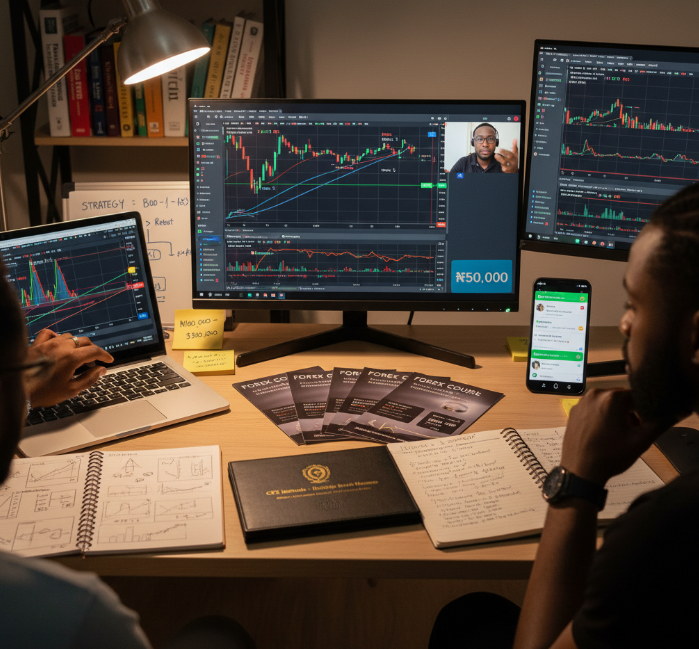
Self-Taught with YouTube: From Head and Shoulders to Fibonacci
YouTube learning is cheap, but you’ll need serious discipline.
Expect to learn chart basics like Head and Shoulders and Fibonacci setups.
Most channels skip deep risk management or position tracking.
No mentorship, no feedback — you're flying solo.
Ideal for folks who want to test Forex Trading waters without dropping ₦1.
Live Bootcamps: Learning Scalping and Risk Reward in Real-Time
Register for a weekend or week-long Live Bootcamp (₦50,000–₦150,000 typical range).
Dive into Scalping tactics and how to enter/exit fast trades.
Practice reading Risk Reward setups using live data — often with Real-Time feedback from trainers.
Great for folks who need structure and speed, but can be overwhelming for total newbies.
Mentorship Programs: One-on-One Swing Trading with Position Sizing
“One-on-one mentorship isn’t just a course — it’s a performance accelerator,” says Ugo Nnamdi, training coordinator at EasyCashBackForex.
Swing Trading focus: Learn to hold positions for days using clean entry signals.
Position Sizing: Your mentor helps you plan trade volume, balance risk.
Direct feedback: Mistakes are corrected fast — no guessing.
Cost: Usually ₦100,000–₦300,000 depending on duration and mentor’s reputation.
Perfect for: Traders who want to grow fast and have some starting capital.
Certification Courses: Advanced Chart Pattern Analysis and Bollinger Bands
Scientific Table: Course Features Breakdown
| Course Provider | Duration | Indicators Covered | Price Range (₦) |
|---|---|---|---|
| CFX Institute | 3 months | Bollinger Bands, RSI | ₦180,000 – ₦250,000 |
| FXMasters Online | 2 months | Chart Pattern Analysis | ₦100,000 – ₦160,000 |
| Global Traders Academy | 6 weeks | Advanced Trading Systems | ₦120,000 – ₦200,000 |
Long descriptive segment: These aren’t your basic YouTube tutorials. Certification Courses dive deep into Technical Indicators like Bollinger Bands and complex patterns. You’ll work with backtests, simulations, and exams. This is for folks aiming to trade full-time or add credentials to their portfolio. It's pricey but serious.
Telegram Signals Groups: Are Breakout Trading Tips Worth Paying For?
Promises? Plenty. Results? Often mixed.
Breakout Trading tips are sent via Telegram Signals, sometimes multiple times a day.
Subscriptions usually cost ₦5,000–₦30,000/month.
Watch out for pump-and-dump scams or lazy copy-paste signals.
If the group doesn't explain why a tip is good — move on.
Better as a learning supplement, not a full education path.
Community Forums vs Structured Learning: Depth of RSI & ATR Explained
Structured Learning offers:
Clear progression from basics to pro-level indicators like RSI and ATR.
Practice quizzes, feedback, and peer review.
A sense of accountability and direction.
Community Forums offer:
Free advice — sometimes gold, sometimes junk.
Great for troubleshooting and peer support.
No quality control or educational roadmap.
3 realistic timelines to Learn Forex Trading and their costs
The right plan makes all the difference. Whether you're rushing in or pacing it out, each timeline has its own budget, style, and outcomes.
Quick Start in 2 Weeks: Day Trading with Moving Averages
Want it fast? This is your crash course to jump into the Forex buzz in just 14 days.
Learn the basics of Day Trading using demo accounts
Get comfy with Moving Averages (SMA & EMA) — spot signals like a pro
Stick to 1–2 currency pairs (like EUR/USD) to avoid overload
Practice in uptrend and sideways markets for flexibility
Spend smart: You can get started with ₦10,000–₦30,000 total
90-Day Journey: From Double Bottoms to Carry Trade Concepts
You’ve got 3 months? That’s enough to start building your real skill set.
Month 1: Spotting Double Bottoms, Head and Shoulders, and learning what trend strength looks like
Month 2: Enter the world of MACD, RSI, and risk tricks like Stop Loss
Month 3: Begin demo trading Carry Trade strategies with NZD/USD and AUD/USD pairs
“For beginners aiming to grow fast but safe, 90 days gives structure without burnout,” — Ayodeji, FX education head at EasyCashBackForex
6-Month Commitment: Master Trend Following and Risk Management
This one’s for serious learners ready to master the game.
Spending half a year gives you room to breathe, experiment, and sharpen your judgment. You’ll get solid on Trend Following, long-term setups, and all the essential tools in Risk Management. You’ll play with different market moods — bullish, volatile, consolidating — and use indicators like Ichimoku Cloud, ATR, and Volume like a strategist. At ₦100,000–₦250,000, it’s not cheap, but it’s way cheaper than losing real money unprepared.
Choosing Your Strategy Path: Scalping vs Position Trading
Choosing your path changes how you live the trader life.
Scalping:
Short and intense. You’re entering and exiting trades fast, using tools like Stochastic Oscillator. It fits those glued to screens and ready for action.
Position Trading:
Slower, calmer, with bigger-picture plays based on Triangles, Flags, and higher timeframes. You’ll rely on Risk Reward and ride out trends.
Match it to your lifestyle. Fast-paced job? Scalping’s tight. Got time and patience? Position Trading’s the move.
What You Can Learn for ₦50,000, ₦150,000, and ₦300,000
Different pockets, different paths — but there's value at every level.
| Budget Level | Topics Covered | Tools Included | Outcome by Month 3 |
|---|---|---|---|
| ₦50,000 | Basics, Moving Averages, Risk Reward | Free PDFs, mobile apps | Demo-ready in Day Trading |
| ₦150,000 | Adds Chart Patterns, MACD, some mentorship | Live Q&A, bootcamp access | Confident in Swing Trading setups |
| ₦300,000 | Full curriculum, private coaching, real strategy drills | Paid indicators, VIP mentorship | Ready for live trades + risk controls |
Budgeting for Forex Learning
Kicking off your forex trading journey in Nigeria? Let’s break down the real cash you’ll need—nothing fancy, just the raw numbers and what they mean for your wallet.
What You’ll Actually Spend On
1. Course Fees
If you’re aiming to skip the guesswork and avoid losing sleep over fake signals, it’s smart to invest in structured learning. Expect these:
Free YouTube crash courses — ₦0 (but you’re mostly on your own)
Online courses — ₦25,000 to ₦150,000
In-person seminars or expert mentorship — ₦100,000 to ₦400,000
Quote from EasyCashBackForex Learning Manager, Bolu Alade:
"When people ask if mentorship is worth the cost, I tell them — how much would you pay to not blow your first ₦200,000? That's your real comparison."
2. Internet Data
Streaming live charts or watching scalping tutorials on GBP/JPY eats data real quick. If you're serious:
Full-time desktop + multiple chart apps: ₦10,000–₦15,000/month
Pro tip: Night plans help cut costs if you're practicing on off-peak hours.
3. Trading Books & Subscriptions
Wanna get good at spotting Double Tops or reading RSI setups? You’ll want:
Trading eBooks or hardcopy books — ₦2,000 to ₦10,000
Monthly software tools (like TradingView Pro or signal groups): ₦5,000–ₒ15,000
4. Hardware Upgrades
If your current laptop lags every time you pull up the Ichimoku Cloud, consider this:
| Item | Basic Option (₦) | Recommended (₦) | Notes |
|---|---|---|---|
| Laptop/Desktop | 120,000 | 250,000+ | Smooth backtesting & multi-window charts |
| Smartphone | 70,000 | 150,000+ | Mobile trading & alerts |
| Power Backup | 25,000 | 80,000+ | Inverter/UPS for power outages |
5. Risk Capital (Demo or Real)
Yes, learning has its own budget, but so does trading after you “graduate.” Here’s a cheat sheet:
Demo accounts: ₦0 (but avoid spending forever here) — try a MetaTrader 4 or MetaTrader 5 demo first.
Live account starter: ₦50,000 minimum for micro lots
Realistic comfort zone: ₦100,000–₦300,000
“You don’t need millions,” says Ife Olojo, Junior Analyst at EasyCashBackForex.
“You need discipline, smart risk management, and the guts to follow through.”
6. Seminar Fees & Travel
If you want to join a live workshop or conference:
Seminar fees: ₦20,000–₦70,000
Travel + hotel (Lagos, Abuja events): ₦30,000–ₒ100,000 depending on city
Only invest here once you’ve covered the essentials and know what you’re hunting for — live strategy breakdowns, Q&A with seasoned traders, or networking.
Quick Budget Summary Table
| Expense Type | Range (₦) | Essential? | Notes |
|---|---|---|---|
| Course Fees | 0 – 400,000 | ✅ | Free to full mentorship options |
| Internet Data | 5,000 – 15,000/month | ✅ | Continuous need |
| Trading Books | 2,000 – 10,000 | Optional | Good for foundational study |
| Software Subscriptions | 5,000 – 15,000/month | Optional | TradingView, Signal groups |
| Hardware Upgrades | 70,000 – 250,000+ | ✅ | Must run tools smoothly |
| Risk Capital | 50,000 – 300,000 | ✅ | Start small, grow over time |
| Seminar Fees + Travel | 20,000 – 100,000+ | Optional | Advanced learners |
After learning forex: How much starting capital is needed?
Minimum Capital for Trading USD/CHF and NZD/USD
Not everyone starts with a fat wallet — so how little can you trade with? Here's what matters for USD/CHF and NZD/USD:
Minimum Capital: Start with ₦50,000–₦100,000 if you're trading micro-lots
These currency pairs have lower pip volatility, so great for new traders
Lower spreads = more value per trade
Stick to 1:10 or 1:20 leverage for risk control
Avoid overtrading — 2 trades/day max is plenty starting out
Perfect if you're testing the waters without draining your savings.
Trading Gold and Crude Oil: Margin and Leverage Considerations
Gold and Crude Oil look sexy on a chart — but they demand serious capital and Risk Management. Here’s how to approach it:
Gold moves in huge pips — so keep margin tight and leverage lower (1:10 or less)
Crude Oil is even more volatile — expect bigger drawdowns
Use Stop Loss every single time
Never risk more than 2% of your account on a single trade
| Asset | Recommended Capital | Leverage Max | Margin Requirement | Daily Volatility |
|---|---|---|---|---|
| Gold | ₦150,000+ | 1:10 | 10% | High |
| Crude Oil | ₦200,000+ | 1:5 | 20% | Very High |
| USD/CHF | ₦50,000 | 1:20 | 5% | Low |
Building a Low-Risk Portfolio with Diversification and Stop Loss
A solid Low-Risk Portfolio in Forex isn't about picking “winners,” it’s about smart Diversification, tight Stop Loss, and long-term mindset. Blend your trades across different market conditions — some trending, some ranging — and avoid putting all your margin on a single chart.
*"Think of your Forex trades like eggs in baskets,” says Timi Olagunju, Portfolio Engineer at EasyCashBackForex. “One bad trade shouldn’t cook your whole account."
Pairing Swing Trading with smarter Position Sizing gives you flexibility and cushion.
Starting Small: How Risk Reward Ratios Protect ₦100,000 Accounts
Starting Small doesn’t mean thinking small — with the right Risk Reward, your ₦100,000 can stretch like elastic.
1:2 Ratio is King
Risk ₦5,000 to potentially make ₦10,000 — do that consistently, and your account lives to trade another day.Smaller wins stack fast
5 wins at ₦7,000 each = ₦35,000. Do the math.Capital Preservation > Profits
Bleeding your account on one bad Breakout Trade ruins months of gains.Every trade needs a plan
Choose setups with RSI, MACD, or Triangles, but never go in blind.
This is how smart traders stay alive while their capital grows up.
Conclusion
Figuring out how much it really costs to Learn Forex Trading in Nigeria can feel like peeling an onion — there’s always another layer. From free YouTube tutorials to full-blown mentorship programs, the costs can swing wildly. But once you understand your timeline, your risk tolerance, and the strategy you want to master, it gets way easier to pin down a budget that works for you. The truth? It's not about spending big — it’s about spending smart.
Here’s what to keep in mind before jumping in:
Set aside funds for both learning and live trading — they’re not the same thing
Do a background check before paying any “guru” online (use SEC Nigeria’s pages on unlawful operators)
Match your strategy to your lifestyle — Scalping ain’t great if you work 9 to 5
Try demo accounts — it’s like practice rounds before betting real chips (start on MetaTrader 4 or MetaTrader 5)
Forex is no get-rich-quick scheme — it’s skill over flash. As trader and author Kathy Lien once said, “Successful trading is about finding the edge and managing risk, not predicting the future.” Make your moves carefully, but don’t sit on the sidelines forever. You’ve got this.
References
School of Pipsology — Learn Forex Trading Free — https://www.babypips.com/learn/forex
SEC Nigeria: Activities of Unlawful Market Operators — https://sec.gov.ng/for-investors/keep-track-of-circulars/activities-of-unlawful-market-operators/
SEC Nigeria: Warning Against Unregistered Platforms — https://sec.gov.ng/for-investors/keep-track-of-circulars/re-warning-against-investing-with-unregistered-investments-crowdfunding-platforms/
TradingView — Subscriptions & Pricing — https://www.tradingview.com/pricing/
MetaTrader 4 — Official Site — https://www.metatrader4.com/en
MetaTrader 5 — Official Site — https://www.metatrader5.com/en
Investopedia — Stop-Loss Order — https://www.investopedia.com/terms/s/stop-lossorder.asp
Investopedia — Risk/Reward Ratio — https://www.investopedia.com/terms/r/riskrewardratio.asp
Investopedia — The 2% Rule — https://www.investopedia.com/terms/t/two-percent-rule.asp
Norton LifeLock — Telegram Scams — https://lifelock.norton.com/learn/internet-security/telegram-scams
Aura — Telegram App Scams (2025) — https://www.aura.com/learn/telegram-app-scams
Google Play — MetaTrader 5 (Demo Accounts Available) — https://play.google.com/store/apps/details?hl=en_US&id=net.metaquotes.metatrader5
Forex Trading FAQ (Nigeria)
How much does it cost to learn Forex Trading in Nigeria?
Free: YouTube, blogs, Telegram groups
₦20,000–₦150,000: Online courses
₦100,000–₦300,000: Mentorship or live classes
Bootcamps: ₦70,000+ for real-time training
Certifications: Up to ₦500,000 for advanced tools like Ichimoku Cloud
Can I learn Forex Trading through free platforms like YouTube?
Yes, many people start with free videos. You can learn chart patterns like Double Bottom, basic strategies, and how indicators like RSI work. Just note that no one will guide you if you get stuck.
What tools do I need to start trading after I learn?
A phone or laptop
Fast internet
MetaTrader or TradingView
A broker account
Risk tools: Stop Loss, Position Size Calculator
Indicators: MACD, Moving Average, Volume
Are mentorship programs worth it for beginner traders?
Get real-time feedback on trades
Watch live setups with GBP/JPY or EUR/USD
Learn how to use Stochastic or MACD properly
Understand risk using live Position Sizing examples
What are the signs of a fake forex course in Nigeria?
Fake courses overpromise. Be careful if the trainer:
Pushes referrals aggressively
Shows fake profit screenshots (especially Gold trades)
Doesn’t provide real contact info
How long does it take to master technical indicators like RSI or MACD?
2–3 weeks: Learn the basics
1–2 months: Practice on demo
3–6 months: Apply in live trades
More time needed to get used to volatile or sideways markets
Is it better to focus on one trading strategy when starting?
Yes. Stick to one approach such as Swing Trading or Trend Following. Use one or two indicators — like Bollinger Bands and Volume — and master them first.
What trading instruments are safest for beginners in Nigeria?
Start with major pairs like EUR/USD or AUD/USD. They move smoothly and work well with simple strategies like MA crossovers and breakout setups.
What is the minimum capital needed to trade Gold or Crude Oil?
₦150,000+ for small Gold trades
₦200,000+ for Crude Oil
Always use Stop Loss and proper Risk–Reward ratios
What does a complete forex learning budget typically include?
Training (₦50k–₦300k)
Monthly data costs (₦10k–₦15k)
Paid indicators or charting tools (optional)
Extra budget for mentorship or demo accounts