


Misjudge a pip by a hair, and your profit can slip through the cracks. A forex pip calculator helps keep those tiny price moves in check — because when you're trading real money, decimals matter. This isn't just math; it's money on the line.
Think of a pip like the “cents” in your trading dollars. Small? Sure. But miss a few, and your P&L could flip faster than you can say “stop-loss.” That’s where knowing how to calculate pips — the right way — saves your bacon.
“We built our pip calculator for speed and accuracy, so traders don't have to second-guess the numbers,” says Lucas Tran, Lead Engineer at EasyCashBackFx.
In this guide, you’ll get a clear 5-step method to nail pip values, a cheat sheet you can check mid-trade, and tips to dodge the most common (and costly) mistakes.
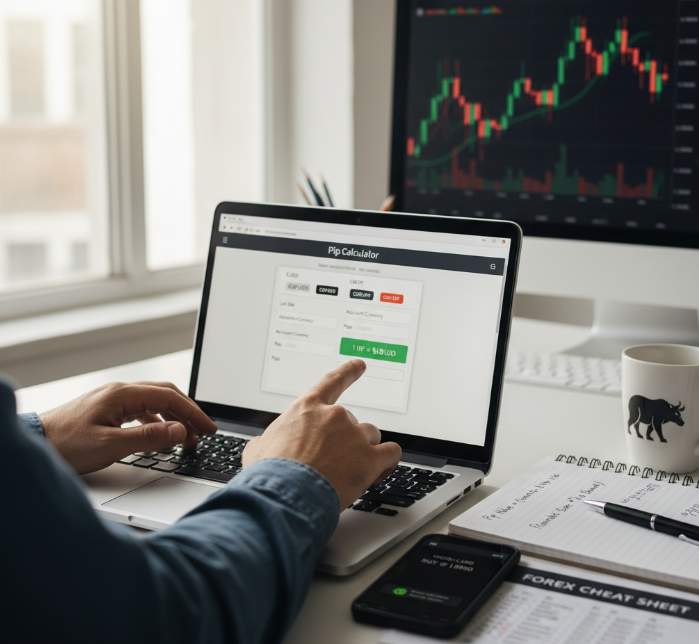
5 steps to compute pip value with a forex pip calculator
Get your pip math right without frying your brain. These steps keep it clean and simple.
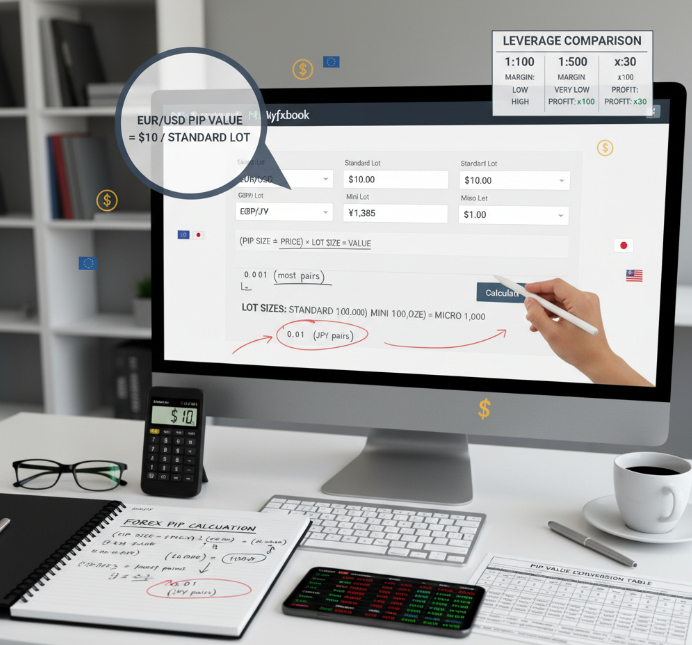
Identify the Correct Pip Position for EUR/USD and GBP/JPY
In most forex pairs, like EUR/USD, the pip position is the 4th decimal place (0.0001). See pips & pipettes for a quick refresher.
For pairs with JPY, like GBP/JPY, it’s the 2nd decimal (0.01), also confirmed by brokers and educators (e.g., Pepperstone on USD/JPY pips).
That tiny spot matters! One pip can mean $10 or more with a standard lot (see standard lot basics).
Most forex pip calculators auto-detect this, but knowing it manually helps you catch errors before they cost you.
? Tip: Double-check the number of decimal places. Brokers sometimes use extra digits (a “pipette”), so don’t get tripped up.
Use the Current Rate and Bid Price to Find the Value of One Pip
Grab the current rate and bid price for your currency pair—say, EUR/USD.
Find the pip size (usually 0.0001 for 4-decimal pairs).
Divide the pip size by the exchange rate (e.g., 0.0001 / 1.0850).
Multiply that by the lot size to get the pip value. A common formula reference:
(pip size ÷ price) × lot size.For multi-currency accounts, apply a conversion to your account currency (see examples at Myfxbook’s pip calculator).
? Pip Value Calculator Table (Sample)
| Currency Pair | Current Rate | Pip Size | 1 Pip Value (Standard Lot) |
|---|---|---|---|
| EUR/USD | 1.0850 | 0.0001 | $10.00 |
| GBP/JPY | 183.52 | 0.01 | ¥1,000 |
| AUD/USD | 0.6650 | 0.0001 | $10.00 |
(Corrected AUD/USD sample to reflect that USD-quoted pairs are ~$10 per pip for a standard lot.)
Calculate Pip Cost Using Standard Lot, Mini Lot, or Micro Lot
Trading volume makes all the difference. Here's how it plays out:
Standard Lot (100,000 units): One pip equals about $10.
Mini Lot (10,000 units): That drops to around $1 per pip.
Micro Lot (1,000 units): You're looking at roughly $0.10 per pip.
Bigger trades? Bigger stakes. The pip cost grows with lot size—fast. Always know your size before pulling the trigger, especially when using a forex pip calculator.
? “We’ve seen traders misjudge pip cost by confusing 0.01 with a micro lot. One zero off and your risk is off the rails.” — Maria T., Trade Ops Manager, EasyCashBackFx
Convert Pip Worth into US Dollar or Euro Based on Account Currency
Sometimes your pip value is quoted in one currency, but your account currency is another. That’s where conversion kicks in.
If you’re trading EUR/GBP but your base currency is US Dollar, you’ll convert pip worth from EUR to USD.
Use the live conversion rate—not yesterday’s quote—to stay accurate.
Most calculators do this on the fly, but always check the conversion math if the numbers feel off. See the conversion logic in the Myfxbook pip calculator.
This step matters most when using exotic pairs or multi-currency accounts like Swiss Franc or Japanese Yen.
Apply Leverage Levels such as 1:100 or 1:500 to Estimate Profit per Pip
Leverage is where the action (and risk) happens.
Say you’re trading with 1:100 leverage on a mini lot.
That pip that’s worth $1? It could swing $10–$50 in seconds depending on your margin.
With 1:500, a small move can wreck or rocket your account.
Lower leverage (like 1:30) gives you breathing room, but you’ll need more capital.
Here’s how leverage shakes up the math:
| Leverage Level | Lot Size | Margin Required | Potential Profit per Pip |
|---|---|---|---|
| 1:100 | Mini Lot | $100 | $1 |
| 1:500 | Standard Lot | $200 | $10 |
| 1:30 | Micro Lot | $33.33 | $0.10 |
Leverage doesn’t change pip value directly, but it changes how quickly P&L moves and how much margin you need.
Precise Pip Value Guide
Knowing exactly how much a pip is worth makes or breaks your trade planning. Here's a quick-hit guide to pip values in real trading situations.
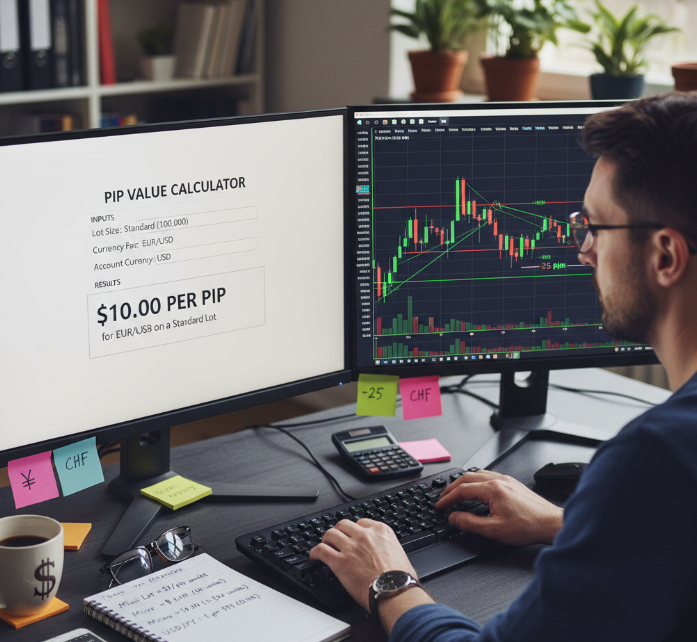
Pip Values Based on Lot Size and Currency Pair Type
| Currency Pair Type | Standard Lot Pip Value (100,000 units) | Mini Lot Pip Value (10,000 units) | Micro Lot Pip Value (1,000 units) |
|---|---|---|---|
| EUR/USD | $10.00 | $1.00 | $0.10 |
| GBP/JPY | ¥1000 (approx) | ¥100 (approx) | ¥10 (approx) |
| USD/CHF | CHF 10.00 | CHF 1.00 | CHF 0.10 |
| AUD/CAD | CAD 10.00 | CAD 1.00 | CAD 0.10 |
These numbers assume the base currency value is USD unless otherwise noted, and exchange rate impact is averaged around typical live market prices.
What EasyCashBackFx Engineers Say
? Jackson, FX Platform Engineer
"Traders underestimate pip value until a tiny move ruins their setup. We see mispriced trades every day because folks don’t match their lot sizes to the correct pip value calculation. EUR/USD at $10 per pip on a standard lot can blow your margin if you're not ready."
? Lily, Account Manager
"We get tons of questions about the difference between a mini lot pip value and a micro lot pip value. It’s super simple: mini means $1 a pip on most USD pairs. Micro? That’s just 10 cents. But mistakes happen when people skip the calculator."
Real-World Reminders
Trading AUD/USD with a micro lot? You’re risking about $0.10 per pip. Chill, but don’t get cocky—it still adds up.
Running 0.1 lots on USD/CHF? That’s a mini lot—expect $1 per pip, and mind the quote currency value when converting to USD.
EUR/GBP looking quiet? Don’t assume it won’t bite. Even small moves can matter when you’re trading 100,000 units.
Fast Facts (Bullet Style)
Pip value calculation is based on lot sizes and the currency pair type.
Base currency value and quote currency value impact the math, especially when your account currency is different.
Use a pip calculator to avoid brain fog, especially if you’re trading exotic pairs or switching lot sizes a lot.
One standard lot pip value = $10 in most USD-based pairs — don’t forget that when you scale up.
Even with a mini lot pip value, $1/pip can stack up fast in fast-moving markets.
Forex pip calculator vs manual calculation: pros and cons
Comparing manual and calculator methods? Here's where speed, precision, and trade size all start to matter.
Manual Calculation for AUD/USD Pip Worth
Manual calculation's like brewing your own coffee—great control, but more effort.
1. Start with the formula:
(0.0001 / Exchange Rate) × Trade Size = Pip Worth (see the core formula explained here).
2. For AUD/USD at 0.6892 with a 100,000-unit standard lot:
→ Pip Worth = (0.0001 / 0.6892) × 100,000 ≈ $14.51
3. AUD is the base currency, so pip worth is expressed in USD.
4. Manual missteps? Misplacing a decimal or using the wrong rate can sting hard.
5. Great for math whizzes, but risky mid-trade without a calculator backup.
Calculator-Based Pip Value for USD/CHF Trades
Let’s be honest—manual math during fast trades? Brutal.
Plug in the currency pair (USD/CHF), lot size, and account currency.
The calculator instantly uses live exchange rate data to show pip value.
Say you're trading 1 standard lot at 0.8880: calculator returns ~$11.26 per pip.
It also adjusts based on whether your account is in Swiss Francs or USD.
No fumbling for formulas. (Example workflow mirrored by FOREX.com’s pip & margin tools.)
? “Speed and precision in pip value tools are vital, especially with fast-moving pairs like USD/CHF,” says Marvin Lee, product engineer at EasyCashBackFx.
Different Pip Cost Outputs for 0.1 Lot and 0.01 Lot
You'd think pip cost just scales linearly, but different lot sizes throw curveballs.
| Lot Size | Trade Size | Pip Value at 1.0000 | Output Difference |
|---|---|---|---|
| 1.0 lot | 100,000 | $10.00 | Base reference |
| 0.1 lot | 10,000 | $1.00 | 10x lower |
| 0.01 lot | 1,000 | $0.10 | 100x lower |
Smaller trade sizes = tinier profits/losses per pip. A 0.01 lot feels safer for newbies, but you need more pips to see serious gain. It’s all about balance between risk and reward.
Speed Difference in Live Rate Inputs and Market Price Updates
Here's where calculators shine — speed is everything in Forex.
Manual route: By the time you've Googled the current rate and done the math, the market's shifted.
Calculator method: Pulls real-time data and updates instantly. No lag.
Example: Trading on AUD/USD with a live rate of 0.6821? The pip value is calculated and refreshed every tick.
Slower manual updates = delayed decisions = missed profit.
Remember: spreads widen around news — track releases on an economic calendar for fewer surprises.
How does a forex pip calculator handle currency pairs with different quotes?
You’d be surprised how messy pip calculations can get once currency pairs start playing by their own rules. This part breaks down how forex pip calculators make sense of it all.

Direct Quotes in USD/JPY and CAD/JPY Using Price Interest Point Value
USD/JPY and CAD/JPY are direct quotes, where the quote currency is JPY.
JPY pairs usually use two decimal places, meaning the pip is in the second digit.
The price interest point (pip value) for JPY pairs commonly uses:
Pip Value = (0.01 / Exchange Rate) × Lot Size × Quote Currency Conversion.A forex pip calculator automates this for you. It’s like having a math geek do the work—instantly.
Especially handy when the market’s flying and you don’t want to mess up decimal places.
Indirect Quotes Like EUR/GBP and Their Impact on Pip Cost
EUR/GBP is an indirect quote—it shows how many British Pounds you need for one Euro.
In these currency pairs, pip cost isn’t just about decimal places; it shifts with the exchange rate.
A forex pip calculator checks the latest exchange rate before spitting out the pip cost.
Because indirect quotes fluctuate more during news spikes, pip cost can swing too.
Not tracking this? You might get caught with bigger exposure than expected. (Formula reminders:
(pip size ÷ price) × lot size).
Cross-Pair Conversions When Account Currency Is British Pound or Japanese Yen
It gets dicey when your account currency isn’t USD—say you’re working with the British Pound or Japanese Yen. In this case, your pip values depend on cross-pair conversions. Here's how it works:
Pip cost is first calculated in the quote currency of the trade.
Then it gets converted into your account currency, using the current market rate.
Example: Trading EUR/USD with a GBP account? Your pip value depends on the EUR/USD rate and the EUR/GBP conversion.
A forex pip calculator handles all of this under the hood, even if you’re juggling 3 different currencies.
EasyCashBackFx engineer Lisa Watanabe says, “Cross-currency errors are one of the top reasons traders miscalculate PNL—let the tool do the conversion for you.”
Live Rate Adjustments for Ask Price and Quoted Rate Fluctuations
Live rate inputs make the difference when precision matters. Here’s what a forex pip calculator keeps track of:
Ask price: The rate you're buying at.
Quoted rate: What’s shown on the screen.
Fluctuations: Price changes that happen every few seconds.
| Currency Pair | Ask Price | Quoted Rate | Pip Value (Mini Lot) |
|---|---|---|---|
| EUR/USD | 1.0895 | 1.0890 | $1.00 |
| GBP/JPY | 181.85 | 181.75 | ¥100 |
| AUD/USD | 0.6671 | 0.6669 | $1.00 |
Even tiny differences in the ask price vs. bid price can cost you when trading big volume. A calculator that updates with live rate adjustments keeps your pip math on point.
Handling Variable Contract Size and Trade Volume in Cross Calculations
Currency pairs + variable contract sizes + shifting trade volumes = headache. Here’s how pip calculators sort it out:
Standard lots (100,000 units) move pip value fast—tiny price changes mean big money.
Mini (10,000) and micro lots (1,000)? Much slower pip impact, great for smaller accounts.
In cross calculations, your pip value is based on lot size × exchange rate × conversion factor.
Example: EUR/GBP trade using 0.1 lot has a very different pip impact than 1 full lot of USD/CHF.
Instead of punching numbers in Excel, use a forex pip calculator to avoid weird rounding errors. (See Investopedia for lot-size effects.)
Confused by varying lot sizes? Use a pip calculator for accuracy
This chapter breaks down how different lot sizes can trip up your pip calculations—and how a forex pip calculator can sort that mess out fast.
Pip Worth Differences Between Standard Lot, Mini Lot, and Micro Lot
Standard lot = 100,000 units
Mini lot = 10,000 units
Micro lot = 1,000 units
Pip worth changes with lot size
In EUR/USD, 1 pip =
$10 (Standard lot)
$1 (Mini lot)
$0.10 (Micro lot)
In forex trading, lot size seriously changes your pip worth. So if you’re trading a standard lot, every pip move is $10. Switch to a mini lot? That's $1. And a micro lot gives you $0.10 per pip. That’s why beginners often start small to avoid heavy losses—and pip calculators help you double-check before jumping in.
Nano Lot and 1000 Units Trading for Smaller Market Exposure
Nano lots = 100 units, good for low-risk experimenting
1000 units = Mini-mini lot, suitable for micro strategies
Pip worth here? Often less than $0.01
Smaller exposure = better control over wild markets
When you're just getting into forex or trying out new strategies, nano lots and 1000-unit orders are your safety net. You can keep your exposure low and your learning curve manageable. As EasyCashBackFx’s senior analyst Ben Tao puts it: “Nano lots let you lose small while learning big.” With such tiny position sizes, it’s more about practicing smart than cashing in big.
Position Size Calculation for EUR/AUD and NZD/USD Orders
EUR/AUD and NZD/USD have unique volatility profiles, so choosing the right position size isn't one-size-fits-all. Break it down like this:
• If your trading strategy targets small moves on NZD/USD, a tighter order size makes sense.
• EUR/AUD, being more volatile, might justify larger lot sizes—but only if your risk management is on point.
• Pip calculators help map out how each currency pair reacts based on your chosen lot and strategy.
Pip Cost Variations When Account Currency Is Swiss Franc or Canadian Dollar
| Currency Pair | Account Currency | Lot Size | Pip Cost |
|---|---|---|---|
| EUR/USD | Swiss Franc | 10,000 | 8.92 CHF |
| USD/JPY | Canadian Dollar | 100,000 | 12.75 CAD |
| GBP/JPY | Swiss Franc | 1,000 | 0.94 CHF |
Using a Swiss Franc or Canadian Dollar account? Your pip cost changes because the pip’s value must be converted into your account currency. That’s a hidden forex cost many traders miss. Luckily, most pip calculators adjust for currency conversion in real time, so you're not left guessing—or worse, losing. (See conversion notes at Myfxbook.)
Impact of Leverage Levels Such as 1:30 and 1:1000 on Risk per Pip
When you go with 1:30 leverage, you’re keeping things chill. Each pip loss affects your account less—but so does profit. Crank it up to 1:1000 and every pip move hits way harder, good or bad.
1:30 = safer margin, ideal for long-term plays
1:1000 = higher exposure, bigger swings
Your risk per pip explodes with leverage. That's why seasoned traders use pip calculators alongside their risk management setups to stay in control. (Overview: How leverage affects pip risk).
Trade Volume Scaling and Its Effect on Profit per Pip
Scaling your trade volume changes the game.
Double your position size? Your profit per pip doubles, too.
But so does your risk.
Say you're trading a 0.5 lot on EUR/GBP with a 10-pip move—that's $50. Switch to a full lot? Now it's $100.
Scaling is sweet, but you’ve gotta match it with a solid risk/reward strategy. Pip calculators help you run these numbers before things get spicy.
3 common mistakes traders make when calculating pips
Don’t let simple pip mistakes mess with your trades. Let’s run through three screw-ups traders make over and over—and how to fix them fast.
Incorrect Pip Position on AUD/CAD and EUR/USD Market Price
Pip position can vary depending on how many decimal places the pair has.
EUR/USD usually has 4 decimal spots, so 0.0001 is one pip.
AUD/CAD often shows 2 or 3 decimals—don’t treat it like a 4-digit pair.
One tiny misplacement can throw off your entire market price estimate.
Always double-check against current exchange rates in your platform. See the decimals rule in pips & pipettes.
"Most trading errors we see aren’t about strategy—they’re about decimals."
—Dylan Hu, Senior Analyst, EasyCashBackFx
Using Wrong Contract Size When Trading 10000 Units or 0.01 Lot
A standard lot = 100,000 units
A mini lot = 10,000 units
A micro lot = 1,000 units
A 0.01 lot = 1,000 units
Here's where people mess up:
If you're manually entering 10,000 units, don’t assume that equals 0.01 lot—it actually equals 0.1 lot, and that boosts your pip value 10x. (Lot-size basics: standard vs mini vs micro).
Table: Pip Value Comparison by Contract Size (EUR/USD)
| Contract Size | Lot Equivalent | Pip Value (USD) | Common Use Case |
|---|---|---|---|
| 1,000 | 0.01 | $0.10 | Beginners, testing |
| 10,000 | 0.1 | $1.00 | Small live accounts |
| 100,000 | 1.0 | $10.00 | Standard trading |
Ignoring Ask Price and Bid Price Differences in Pip Value Calculations
This one’s sneaky. Pip value isn’t just about movement—it’s also about the spread between the ask price and the bid price.
Quick bites:
Buy orders get filled at ask price
Sell orders get filled at bid price
The spread (ask - bid) eats into your gains, especially in fast markets
If you’re trading tight currency pairs like EUR/USD, spread is usually 1–2 pips
But in pairs like GBP/JPY, it can jump to 4–6 pips
Always factor in this hidden cost before hitting buy/sell
Ignoring this? You're not seeing the real cost of your trade.
Conclusion
Learning to calculate pips isn’t just number crunching — it’s like knowing the cost of every mile before you hit the road. One wrong decimal, and you're either overestimating profits or walking into risk blindfolded. A forex pip calculator takes that guesswork off your plate, especially when you’re juggling different lot sizes, currencies, and fast-moving markets. Mastering this tool means fewer surprises and more control.
Here’s how to keep things tight and tidy:
Use a pip calculator for all trades involving exotic pairs like NZD/USD or CAD/JPY.
Don’t mix up micro, mini, and standard lots — size really does matter.
Always check your account currency before locking in a trade.
Stop eyeballing pip value — precision wins.
When volatility spikes around news, plan ahead with an economic calendar and run the numbers with our forex profit calculator to keep your risk in check.
References
What Are Pips in Forex Trading, and What Is Their Value? - https://www.investopedia.com/terms/p/pip.asp
What is a Pip in Forex? (Pips & Pipettes) - https://www.babypips.com/learn/forex/pips-and-pipettes
How the USD/JPY Pip Value Shapes Your Forex Strategy - https://pepperstone.com/en-af/analysis/trading-guides/usd-jpy-pip-value/
What Is a Standard Lot in Forex Trading? - https://www.investopedia.com/terms/s/standard-lot.asp
Pip Calculator (examples & base-currency conversion) - https://www.myfxbook.com/forex-calculators/pip-calculator
How to Calculate Pips in Forex (Formula) - https://fxglobe.com/how-to-calculate-pips-in-forex-trading-a-step-by-step-guide/
Bid and Ask Definition (and spread) - https://www.investopedia.com/terms/b/bid-and-ask.asp
What Is a Bid-Ask Spread? - https://www.investopedia.com/terms/b/bid-askspread.asp
Ask Price (definition) - https://www.investopedia.com/terms/a/ask.asp
Bid Price (definition) - https://www.investopedia.com/terms/b/bidprice.asp
Understanding Forex Margin (leverage & margin requirement) - https://www.schwab.com/learn/story/what-is-leverage-forex-trading-understanding-forex-margin
FOREX.com Margin & Pip Calculator (tool reference) - https://www.forex.com/en-us/help-and-support/margin-pip-calculator/
How Does Leverage Affect Pip Value? - https://www.investopedia.com/ask/answers/06/leverageandpipvalue.asp
Forex Pip Calculator – FAQ
What is a forex pip calculator and how does it help traders?
It shows how much a pip is worth for your trade
Select your trading pair (EUR/USD, USD/JPY, etc.)
Choose your lot size (standard, mini, micro)
Pick your account currency (USD, GBP, etc.)
Reduces calculation errors and saves time
How do I manually calculate pip value for EUR/USD?
Use this formula:
(0.0001 ÷ exchange rate) × lot size
Example: Standard lot at 1.2000 → 1 pip = $10.
Why does pip value change with different lot sizes?
Bigger lots = more money per pip
Standard lot → about $10 per pip
Mini lot → about $1 per pip
Micro / Nano → much smaller pip values
Smaller lots reduce risk but also profit
Can I use a forex pip calculator with exotic currency pairs like EUR/GBP?
Yes. Calculators work on all pairs, including EUR/GBP or NZD/USD.
If your account currency is not USD, pip value will be auto-converted.
How does leverage affect pip value and trade results?
Pip value stays the same
Leverage reduces required capital
Profits & losses feel larger with higher leverage
Always know your risk per pip before trading
Why is pip position different in USD/JPY vs. EUR/USD?
USD/JPY uses 2 decimals → 1 pip = 0.01
EUR/USD uses 4 decimals → 1 pip = 0.0001
What common mistakes should I avoid when calculating pips manually?
Choosing the wrong decimal place
Mixing unit sizes (0.01 lot vs 10,000 units)
Forgetting account currency conversion
Using outdated prices
Ignoring the spread
How does my account currency affect pip value?
If your account currency differs from the quote currency, the pip value must be converted.
Should I calculate pip value differently when trading 0.01 lots?
0.01 lot = 1,000 units (micro lot)
EUR/USD pip ≈ $0.10
Good for beginners or risk management
Can a forex pip calculator help me manage trade risk?
Yes — by showing your gain or loss per pip, it helps determine risk based on lot size and stop-loss distance.