


Ever stared at a trading screen, eyes glazed over, wondering if you’re actually making money—or just donating it to the market gods? That’s where a solid forex profit calculator earns its keep. It’s not just about numbers; it’s about turning chaos into clarity.
A proper calculator helps you answer questions like:
“If I risk 1% per trade, how many lots is that?”
“How much do I really make if EUR/USD moves 50 pips in my favor?”
“What happens to my profit if the spread widens during news?”
Get those wrong, and you’re not “trading”—you’re gambling. Get them right, and suddenly your strategy has structure. You’re no longer guessing; you’re measuring.
Regulators and brokers regularly warn that most retail CFD and forex accounts lose money, often because of poor risk management and position sizing—not just because traders “pick the wrong direction.”
Forex isn’t Vegas with better lighting. The spread can sneak up like a ninja tax. Leverage can flip a tiny loss into a full account drain. One misunderstood pip value and you’re wondering why your “small” loss equals half your paycheck.
That’s why understanding how a forex profit calculator works—under the hood—is non-negotiable. Once you grasp currency pairs, lot sizes, leverage, and how pips translate into money, you stop flying blind and start driving with your headlights on.
Essential Insights on the Forex Profit Calculator
Understanding Currency Pairs
➔ Understanding Currency Pairs: Currency pairs represent the exchange rate between two currencies and are the foundation of forex trading. Each pair consists of a base and quote currency, affecting how profits and losses are calculated.
Lot Sizes Impact
➔ Lot Sizes Impact: Familiarity with different lot sizes—standard, mini, micro, and nano—allows traders to scale positions appropriately and configure entries in a forex profit calculator based on risk tolerance and account size.
Leverage Dynamics
➔ Leverage Dynamics: Grasping the risks and benefits of leverage helps traders comprehend how relatively small price changes can result in magnified gains or losses, which a forex profit calculator clearly translates into monetary terms.
Account Types Matter
➔ Account Types Matter: Choosing the right account currency, such as USD or EUR, influences how profits are converted and displayed, ultimately affecting the real-world value of gains and losses you experience due to exchange rate fluctuations.
Understanding the Basics of Forex Profit
Let’s strip away the fancy jargon and get to the core: In forex, your profit or loss depends on:
How far the price moves (in pips)
Your position size (lot size)
The currency pair you’re trading
The direction you chose (buy or sell)
Any fees: spread, swaps, and commissions
In its simplest form, your profit is:
Profit = (Exit Price – Entry Price) × Position Size
…but because forex trades are based on leveraged contracts with pip values, base currencies, and quote currencies, real-world profit calculation looks like this:
Profit = Pip Movement × Pip Value × Number of Lots
A forex profit calculator automates this, so you don’t have to manually crunch numbers every time. You just plug in:
Currency pair
Entry and exit price
Lot size
Account currency
Leverage (if applicable)
…and it spits out your expected profit or loss—before you commit.
Why Profit Calculation Matters
Knowing how profit is calculated protects you from:
Underestimating risk on highly volatile pairs like GBP/JPY or XAU/USD
Overleveraging on small accounts
Misjudging how spreads and fees reduce net returns
Letting a “small” loss balloon because you miscalculated pip value
Serious traders treat profit calculation like a pre-flight checklist. Every parameter is tested before takeoff.
Currency Pairs Explained
Understanding currency pairs is like knowing who’s playing offense and defense in a game—one leads, one follows. Here’s what you need to know:
Base currency vs quote currency: The first part of the pair (EUR in EUR/USD) is the base. The second (USD) is the quote. The rate tells you how much of the quote currency you need to buy one unit of the base.
Example: In EUR/USD, EUR is the base, and USD is the quote. If EUR/USD = 1.10, it means €1 = $1.10.
Major vs minor pairs: Major pairs include currencies like USD, EUR, JPY, GBP, AUD, and CAD, usually with tighter spreads. Minor pairs exclude USD but still involve strong economies.
Exotic pairs: These combine a major with an emerging or smaller economy's currency—think USD/TRY or EUR/ZAR.
Bid and ask prices: You’ll always see two prices—the bid (what buyers will pay) and the ask (what sellers want). The spread between them? That’s where your broker earns their cut.
Why it matters for calculators: When using a forex profit calculator, the pair you're trading affects pip value calculations big time.
According to recent triennial surveys by the Bank for International Settlements (BIS), the US dollar is on one side of roughly 88–89% of all global FX trades, so understanding USD dynamics isn’t optional if you're serious about trading smartly.
Whether you're hedging risk or just trying to figure out if that trade made you lunch money or rent money, getting familiar with how these pairs work will make every entry on your forex profit calculator way more meaningful.
Exploring Lot Sizes: Standard, Mini, Micro, and Nano
Understanding lot sizes is key to managing risk and scaling trades using any reliable forex profit calculator.
Standard Lot
A standard lot equals 100,000 units of the base currency.
It’s usually preferred by seasoned traders with bigger bankrolls.
Each pip movement can mean a $10 shift per standard lot in most USD-based pairs.
Higher trade volume means higher exposure—both gains and losses are amplified.
Requires more margin and greater capital commitment due to larger position size.
Ideal when you're confident in the trend or running a well-tested strategy.
Works best when paired with tight spreads and low-latency execution from your broker.
Mini Lot
A mini lot equals 10,000 units—one-tenth of a standard lot.
Each pip movement typically equals around $1 in most USD-based pairs.
Good middle ground for serious traders with modest accounts.
Allows for layered entries and exits without overstretching risk.
More flexible for scaling into and out of positions over time.
Helps mitigate emotional decisions because the monetary swing per pip is smaller than a standard lot.
Micro Lot
A micro lot equals 1,000 units of the base currency.
Each pip is worth about $0.10 in most USD-based pairs.
Perfect for beginners or traders testing new strategies live.
Allows you to survive losing streaks without blowing the account.
Encourages disciplined position sizing and low emotional pressure.
Common with brokers that support smaller accounts and cent-based structures.
Nano Lot
A nano lot equals 100 units of the base currency.
Each pip is worth around $0.01 in USD-based pairs—almost training-wheel level risk.
Great for first-time traders dipping their toes into live markets.
Gives maximum flexibility in risk control on tiny accounts.
Useful for testing EAs (expert advisors) or algorithms in live but ultra-low-risk conditions.
Not all brokers offer nano lots, but where they exist, they're a game-changer for cautious learners.
Using a forex profit calculator, you can experiment with different lot sizes and see exactly how much you stand to gain or lose for each pip of movement—before placing the trade.
Leverage and Margin in Forex Profit Calculation
Leverage is the double-edged sword of forex. It lets you control a large position with a relatively small amount of capital—but it can also amplify losses just as quickly as gains.
What is Leverage?
In simple terms, leverage is:
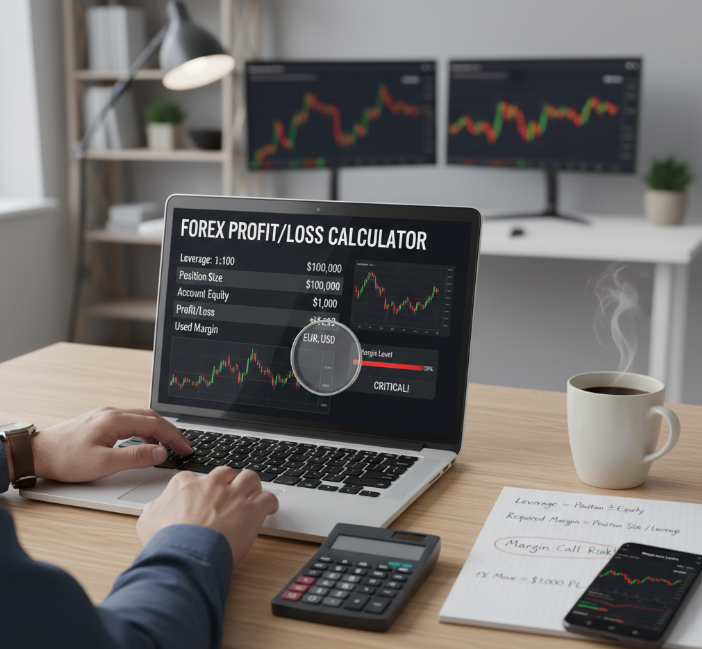
Leverage Ratio = Position Size ÷ Account Equity
So, if you have $1,000 in your account and open a $100,000 position, you're using 1:100 leverage.
A forex profit calculator that factors in leverage helps you see:
How much margin your trade will require
How big your potential profit or loss will be
How close you are to a margin call if price moves against you
Brokers often explain that leverage allows you to use a smaller amount of initial capital to control larger positions—but they also emphasize the downside: a small adverse move can mean a very large percentage loss on your account.
Margin and How It Works
Margin is the amount of your account balance set aside by the broker to keep a leveraged trade open. Think of it as a security deposit, not a fee.
Key points:
Used margin: The capital locked to maintain open positions.
Free margin: The remaining equity available for new trades or to absorb drawdowns.
Margin level: Usually shown as a percentage—if it drops too low, you’re in margin-call territory.
A forex profit calculator that includes margin fields can show:
Required margin for your lot size and leverage
How much “breathing room” your account has before a margin call
The risk of liquidation if volatility spikes
When margin is miscalculated or ignored, traders often end up wondering how a “small” trade wiped out their entire equity after a sudden market move.
Example: Impact of Leverage on Profit and Loss
Let’s look at a practical example using EUR/USD.
Account balance: $1,000
Leverage: 1:100
Position: 1 standard lot (100,000 units)
Each pip ≈ $10
You go long EUR/USD at 1.1000 and close at 1.1050.
Pip movement: 50 pips
Profit = 50 pips × $10 = $500
That’s a 50% return on a $1,000 account—in a single trade.
But if price dropped 50 pips instead?
Loss = -50 pips × $10 = -$500
Half the account gone.
This example shows how leverage multiplies everything—profits and losses. A forex profit calculator makes this instantly obvious, forcing you to confront whether that risk/reward ratio is really acceptable.
Types of Forex Accounts and Their Impact on Profit
Your account configuration also affects how you calculate profit:
Account Currency
If your account is in USD:
Trading EUR/USD? Profits/losses already denominated in USD—easy.
Trading GBP/JPY? Profit may be calculated in JPY first, then converted to USD at the current USD/JPY rate.
A good forex profit calculator handles these conversions automatically, so you don’t have to juggle multiple exchange rates in your head.
Spread and Commission Models
Some brokers are:
Spread-only: Their fee is baked into the bid–ask spread.
Spread + commission: Tighter raw spreads but an additional per-lot commission.
When using a forex profit calculator, always make sure:
You factor in spread costs (difference between entry and exit price)
You consider per-lot commissions if applicable
You adjust your target profits accordingly (e.g., aiming for 2× or 3× your transaction costs)
Ignoring these small friction costs can quietly erode your edge over hundreds of trades.
How a Forex Profit Calculator Works Step-by-Step
Here’s how you typically use a forex profit calculator before entering a trade:
Select your currency pair
Example: EUR/USDChoose your account currency
Example: USDInput your position size
Example: 0.50 lots (50,000 units)Enter entry and exit price
- Entry: 1.1000
- Target: 1.1050
- Stop-loss: 1.0975Set leverage (optional)
This helps estimate required margin.Calculate
The calculator returns:
- Pip distance to target and stop
- Monetary profit at target
- Monetary loss at stop
- Required margin
From this, you can immediately see:
Reward-to-risk ratio (e.g., $250 potential profit vs $125 potential loss = 2:1)
Whether the trade fits your rules (e.g., 1–2% risk per trade)
Whether you have enough free margin to safely enter
Over time, this process trains your brain to think in probabilities, not emotions.
Profit Calculation for Buy (Long) Trades
When you buy a currency pair (go long), you profit if the price rises.
General formula:
Profit (long) = (Exit Price – Entry Price) × Pip Value × Lots
Example:
Pair: EUR/USD
Account: USD
Position: 1 standard lot (100,000 units)
Entry: 1.1000
Exit: 1.1055
Pip movement
- 1.1055 – 1.1000 = 0.0055 = 55 pipsPip value
- For EUR/USD, 1 pip ≈ $10 per standard lotProfit
- 55 pips × $10 = $550
So, the forex profit calculator will show:
Profit: $550
Potential margin used: Depends on leverage (e.g., 1:100 or 1:30)
Percentage return relative to your account size
Brokers often offer educational tools to remind traders that pip value × lot size is what really drives monetary outcome—not just the number of pips alone.
Profit Calculation for Sell (Short) Trades
When you sell a currency pair (go short), you profit if the price falls.
Formula:
Profit (short) = (Entry Price – Exit Price) × Pip Value × Lots
Example:
Pair: GBP/USD
Position: 0.50 lots (50,000 units)
Entry (sell): 1.2600
Exit (buy-back): 1.2520
Pip movement
- 1.2600 – 1.2520 = 0.0080 = 80 pipsPip value
- For GBP/USD, with a USD account, pip value ≈ $5 per 0.50 lotProfit
- 80 pips × $5 = $400
Your forex profit calculator confirms:
80 pips in your favor
$400 profit before spreads/fees
Margin impact depending on leverage
Shorting feels counterintuitive at first—making money when price drops—but once you understand the math, it becomes just another tool in your playbook.
Role of Pips in Profit Calculation
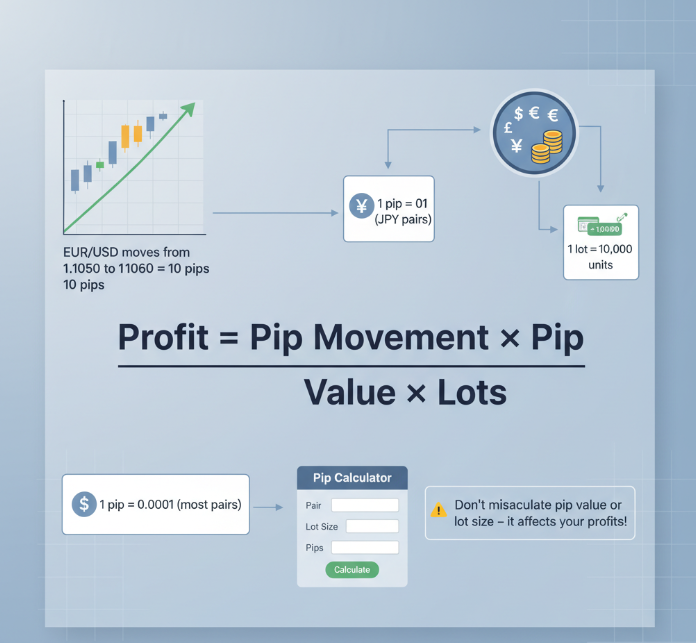
A pip (percentage in point) is the smallest standard unit of price movement in most forex pairs.
For most pairs: 1 pip = 0.0001
For JPY pairs: 1 pip = 0.01
Once you know pip movement, you can translate it into money:
Profit = Pip Movement × Pip Value × Lots
Pip value depends on:
The pair’s quote currency
Your account currency
Your lot size
Broker education materials show that many new traders miscalculate pip value or lot size, which can completely throw off their profit expectations—don’t be one of them!
Many brokers and platforms provide integrated tools and calculators to help you verify pip value before opening a position.
Worked Examples with Different Currency Pairs
Let’s look at a few table-style examples using standard lots and typical pip values:
| Pair | Entry | Exit | Pips Gained | Approx. Profit (1 lot) |
|---|---|---|---|---|
| EUR/USD | 1.1000 | 1.1050 | 50 | $500 |
| GBP/USD | 1.2500 | 1.2440 | -60 | -$600 |
| USD/JPY | 150.00 | 149.20 | 80 | ¥80,000 (≈ $533) |
| AUD/USD | 0.6500 | 0.6585 | 85 | $850 |
The above assumes standard lots and USD quote currency pairs like EUR/USD or AUD/USD, where each pip equals roughly $10 per lot.
Your forex profit calculator does all this instantly—especially helpful on pairs where your account currency isn’t the quote currency.
Incorporating Spread and Fees into Profit
Ignoring spread and fees is like ignoring taxes—you’ll be disappointed at the end.
Spread Impact
If EUR/USD shows:
Bid: 1.1000
Ask: 1.1002
That’s a 2-pip spread.
If you buy at 1.1002 and price moves to 1.1004, your trade is only at breakeven (ignoring commissions), because:
Entry: 1.1002
Current bid: 1.1004
Difference: 2 pips = spread cost
Your forex profit calculator should:
Allow input for spread
Show net expected profit after spread
Commission Fees
If your broker charges $7 per round-turn on a standard lot:
Raw profit from 50 pips: $500
Net after commission: $493
On high-frequency strategies (scalping, intraday), these small differences compound significantly.
Swaps (Overnight Financing)
If you hold trades overnight, swaps (positive or negative) also affect net profit.
A good calculator may let you:
Estimate swap impact per day
Project profit/loss over multiple days
Compare holding vs closing before rollover
Ignoring swaps is a classic mistake among new traders who wonder why long-term positions don’t match their initial expectations.
Real-Time Market Data and Profit Calculation
Market prices are moving constantly. Using stale quotes in your forex profit calculator is like checking yesterday’s weather to decide whether to bring an umbrella today.
Real-time data matters because:
Spread changes during news or low liquidity
Volatility spikes alter pip value relevance and risk exposure
Price gaps can skip over stop-loss or take-profit levels
Real-time profit calculators or integrated platform tools:
Sync live bid/ask prices from your broker
Auto-update pip values and margin requirements
Help avoid entering trades during unfavorable conditions (e.g., abnormally wide spreads)
Many platforms now integrate calculators directly into order tickets, so you can see the potential P&L before pressing “Buy” or “Sell.”
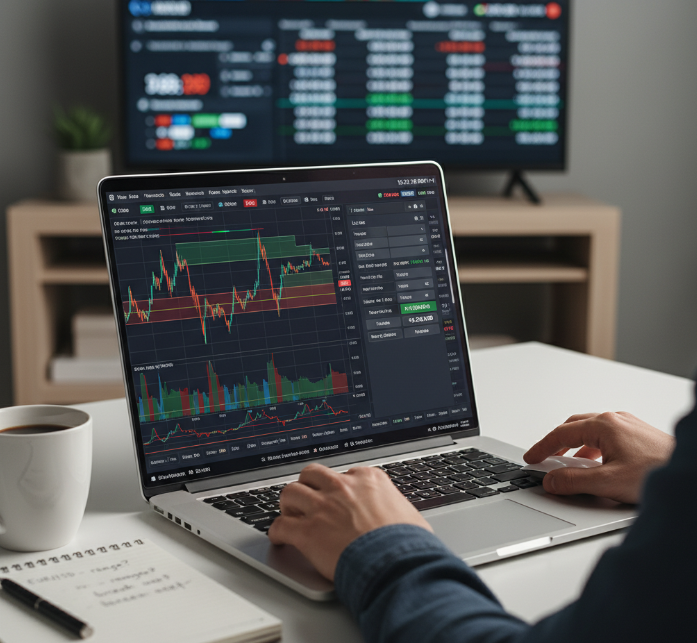
Example: Live Profit Estimation with Volatile Pairs
Say you’re trading GBP/JPY:
Account: $2,000
Pair: GBP/JPY (high volatility)
Position: 0.20 lots
Entry: 190.00
Stop-loss: 189.50 (50 pips)
Target: 190.80 (80 pips)
Using a forex profit calculator with live data:
1 pip ≈ ¥200 per 0.20 lot
Convert to USD based on current USD/JPY rate
You’ll see:
Potential loss: ~$70 at the stop
Potential profit: ~$112 at target
Reward-to-risk ≈ 1.6:1
If, due to volatility, the spread widens right when you’re about to enter, the calculator will reflect the new effective entry cost—sometimes making the difference between a valid setup and a forced pass.
Position Sizing and Risk per Trade
Proper position sizing turns guesswork into a repeatable, risk-controlled process.
Common risk guidelines:
Risk 0.5%–2% of your account per trade
Never size positions based purely on “feeling confident” about a setup
Let math dictate your lot size, not emotion
Position size formula:
Position Size (lots) = (Account Risk per Trade ÷ (Stop-Loss in Pips × Pip Value per Lot))
A forex profit calculator with risk features lets you:
Input account size (e.g., $5,000)
Choose % risk per trade (e.g., 1% = $50)
Set stop-loss distance (e.g., 25 pips)
Calculate optimal lot size to stay within risk parameters
This prevents you from accidentally turning a “controlled risk” trade into a potential account-destroyer.
The Role of Market Volatility in Profit Outcomes
Volatility is a double-edged sword:
Higher volatility = more pip potential, but also more risk
Lower volatility = slower moves, often tighter ranges, but potentially reduced risk per trade
Average daily range (ADR) by pair (approximate):
EUR/USD: ~50–70 pips
GBP/USD: ~70–100 pips
USD/JPY: ~40–70 pips
GBP/JPY: ~100–150 pips
If your target profit is 120 pips but the pair’s daily average range is 60 pips, your expectations might be unrealistic. That’s where combining volatility data with your forex profit calculator helps refine targets.
Real-time volatility tools and calculators with live feeds—they sync with real-time data so you’re not stuck with yesterday’s guesses while today’s prices are sprinting.
Strategies for High Volatility
Risk management resources from major derivatives exchanges such as CME Group often note that highly leveraged positions are among the first to be liquidated during extreme market events.
Short-term chaos calls for smarter moves—not just gutsy ones.
Use smaller position sizes when volatility is extreme.
Place wider but well-calculated stop-losses based on ATR or recent swing highs/lows.
Reduce leverage deliberately instead of chasing explosive moves.
Use your forex profit calculator to model “worst-case” scenarios before entering trades.
Avoid trading right into high-impact news releases unless your strategy is designed for it.
Your job in volatile conditions isn’t just to chase big wins—it’s to survive long enough to catch the clean setups.
Margin Calls and Liquidation Risks
Margin calls occur when your account equity falls below a certain threshold relative to used margin.
Key terms:
Equity: Account balance ± open P&L
Used margin: Capital locked for open trades
Free margin: Equity – Used margin
Margin level: (Equity ÷ Used Margin) × 100%
If the margin level falls below the broker’s maintenance requirement (e.g., 50% or 100%), they may:
Issue a margin call
Start closing losing positions automatically
Using a forex profit calculator alongside a margin calculator helps you estimate:
How many pips against your position before you reach a dangerous margin level
Whether opening additional trades is safe or reckless
Smart traders think: “How bad can this get?” before hitting the button—not after.
Common Mistakes When Calculating Forex Profit
Even with a forex profit calculator, traders make avoidable mistakes:
Ignoring the Spread
Only counting raw pip distance between entry and exit.
Forgetting that entering at the ask and exiting at the bid always costs something.
Underestimating how spreads widen during volatile conditions.
Misjudging Lot Size
Thinking “0.10” is always a small size without considering account balance.
Overestimating comfort with drawdowns when real money is on the line.
Entering multiple positions that, combined, exceed safe risk levels.
Misunderstanding Pip Value on Cross Pairs
Assuming pip value is constant across all pairs.
Forgetting that non-USD quotes require conversion back into account currency.
Skipping a pip value check and being shocked by the final P&L.
When using any kind of forex profit calculator, make sure you double-check that pip values and lot sizes are aligned correctly to your risk threshold—not just gut feeling or guesswork.
Ignoring Leverage Risks
Leverage feels like rocket fuel—until it blows up the engine.
You might think higher leverage means faster profits, but it also means faster losses.
Some traders crank their leverage without adjusting their stop-loss range or checking volatility levels.
Others rely on a forex profit calculator but forget that calculators don’t warn you when you’ve gone off the rails with risk exposure.
Always consider market conditions—like news events or low liquidity—that could magnify leveraged positions unpredictably.
If you're using 1:500 leverage on a tiny account, even a small pip movement can wipe out half your equity.
Smart traders use leverage like salt: enough for flavor but never so much that it ruins the entire dish.
Final Thoughts: Turning Numbers into Strategy
A forex profit calculator isn’t some optional gadget—it’s core trading infrastructure. It helps you:
Translate market movement into real money
Align risk with your account size and emotional tolerance
Compare potential setups quickly and objectively
Build a rule-based, repeatable trading plan
Instead of asking, “Will this trade win?” start asking:
“How much can I afford to lose on this idea?”
“Does the potential reward justify the risk?”
“What does my calculator say—not my impulses?”
When you consistently run your trades through a forex profit calculator before entering, you’re no longer reacting to the market; you’re executing a plan.
And in forex, the traders with a plan—and the discipline to follow the math—are the ones who stick around long enough to become consistently profitable.
References
[BIS Triennial Central Bank Survey of Foreign Exchange and OTC Derivatives Markets - https://www.bis.org/press/p221027.htm]
[Why Do Most Retail Traders Fail and What Can I Do to Improve My Chances of Success? - https://www.fxstreet.com/education/why-do-most-retail-traders-fail-and-what-can-i-do-to-improve-my-chances-of-success-202503311406]
[What Is Leverage Trading? – OANDA Education - https://www.oanda.com/us-en/learn/introduction-to-leverage-trading/what-is-leverage-trading/]
[How Can I Find or Calculate the Pip Value on My Trade? – FXCM Help - https://www.fxcm.com/markets/help/trading-basics-how-to-calculate-pip-value/]
[Risk Management Resources – CME Group - https://www.cmegroup.com/solutions/risk-management.html]
[How to Reduce Risk With Optimal Position Size – Investopedia - https://www.investopedia.com/articles/trading/09/determine-position-size.asp]
FAQ
How does it work for different currency pairs?
A forex profit calculator captures the thrill of small price shifts—say EUR/USD moving from 1.1050 to 1.1100, or GBP/JPY rising from 150.50 to 151.00.
For a Buy, it’s ExitPrice – EntryPrice; for a Sell, reversed.
Multiply by your lot choice: Standard Lot feels big, Mini Lot has more control, Micro Lot is intimate in scale.
Even spreads—tiny yet sly—can turn victory into just breaking even.
Can calculation be done without digital tools?
Yes—but the human touch must be precise:
Note your EntryPrice and ExitPrice (e.g., AUD/USD 0.7525 → 0.7575).
Choose Party Size: Standard, Mini, Micro, Nano, or Half Lot — each holds its mood and risk weight.
Account for hidden spread before claiming triumph in US Dollar or Euro terms.
How do account currencies sway the final numbers?
Trading success dances differently if your account rests in US Dollar vs Japanese Yen:
With EUR/USD gains flowing into a Euro account, there’s harmony; less conversion friction.
A Canadian Dollar base may soften profit edges when settling trades from USD/CHF.
Why use one when working with high ratio settings like 1:500?
Under ratios such as 1:500, emotion surges—the smallest pip journeys expand dramatically. The calculator measures this energy instantly so traders can see whether they stand on solid ground before pressing ‘Confirm Trade’. One wrong guess at that scale can change moods fast.
What shapes precision inside these calculators?
Details whisper purpose:
Pair type matters (NZD/USD vs GBP/JPY tell different stories).
TradeType alignment—Long versus Short shifts math direction.
Spread adjustments alter every pip value silently but surely.
Accurate live data makes results feel alive instead of stale figures frozen in time.
Does volatility echo through results shown by the calculator?
Yes—in moments when GBP/JPY jumps wildly within minutes:
Prices update rapidly,
Profits swing from green to red breathlessly,
Tools capture those beats so you see not just numbers but rhythm — each tick like a pulse marking fortune's tempo across currencies and lots alike.