



Ever stared at a screen of squiggly lines and blinking numbers and thought, “How the heck do people actually make money doing this?” You’re not alone. Forex for beginners feels like walking into a high-stakes poker game where everyone else already knows the rules—but here’s the kicker: most of them learned exactly where you are now—curious, cautious, maybe a little skeptical—but ready to figure it out.
Starting in forex isn’t about being born with a Wall Street brain or memorizing cryptic charts. It’s about knowing when to jump in—and who’s got your back when you do. The folks at EasyCashBackFx say many new traders pick platforms based on familiarity rather than function—and that costs them, big time.
So if your goal is more than just dabbling—if you're serious about turning confusion into clarity—this guide cuts through the noise and walks you straight into what matters: smart tools, simple strategy, and avoiding rookie mistakes that bleed accounts dry.
Essential Insights for Forex for Beginners
➔ Currency Pairs: Understanding pairs like EUR/USD and GBP/JPY is crucial for conquering the forex landscape.
➔ Trading Platforms: Choose wisely between MetaTrader 4 and MetaTrader 5 to tap into the features that suit your trading style.
➔ Market Sentiment: Grasping market moods—bullish, bearish, and sideways—will enhance your ability to predict currency movements.
➔ Trading Strategies: Explore different strategies—scalping, day trading, and swing trading—to find one that aligns with your risk tolerance and time commitment.
➔ Technical Indicators: Master indicators such as Moving Average and RSI to inform your trading decisions and improve accuracy.
➔ Risk Management: Implement stop loss and take profit strategies to safeguard your investments from unforeseen market shifts.
➔ Common Mistakes: Avoid pitfalls like overleveraging and mismanaging your risk-reward ratio to keep your trading career on a stable path.
➔ Market Analysis: Utilize both technical and fundamental analysis to make informed trading choices and adapt to market changes effectively.
Getting Started With Forex For Beginners
A no-nonsense guide to help newbies crack into the forex for beginners world—without drowning in jargon or fluff.
Understanding Currency Pairs: EUR/USD and Beyond
Major pairs like EUR/USD, USD/JPY, and GBP/USD dominate the market for a reason—they’re liquid, stable, and widely traded.
Think of minor pairs as the underdogs—less popular but still with potential, like AUD/CAD or EUR/NZD.
Then there are the wildcards—exotic pairs, often involving emerging markets (like USD/TRY). They’re volatile, risky, but sometimes rewarding.
? A quick tip? Always know which is your base currency and which is your quote currency. It’s literally how you read a pair.
Here’s a simple breakdown:
| Pair Type | Example | Liquidity Level | Typical Spread |
|---|---|---|---|
| Major Pair | EUR/USD | Very High | Low |
| Minor Pair | EUR/GBP | Medium | Medium |
| Exotic Pair | USD/SGD | Low | High |
Understanding these categories helps you avoid rookie mistakes when starting out in forex trading for beginners.
Selecting Your Trading Platform: MetaTrader 4 vs. MetaTrader 5
→ Step 1: Choose your vibe—do you want something time-tested or cutting-edge?
→ Step 2: If you're just starting out in the world of forex for beginners, go with MetaTrader 4 (MT4). It's simpler, lighter on resources, and has decades of user support.
→ Step 3: Want more features like advanced order types or integrated economic calendars? Then go with MetaTrader 5 (MT5). It’s built for serious multitaskers.
?️ Both platforms offer solid basics:
Real-time quotes
Customizable charts
Automated trading via Expert Advisors
But only MT5 supports stock CFDs too—not just forex. So if you're planning to diversify later, it might be worth considering from day one.
The Importance of Market Sentiment: Bullish, Bearish, and Sideways Trends
• When everyone’s buying? That’s a classic sign of a bullish trend. Prices rise because confidence runs high.
• If traders are dumping assets left and right? You’ve got yourself a classic bearish trend, where fear drives prices lower fast.
• And when nobody knows what to do? Welcome to the limbo zone—a slow-moving or stuck-in-place chart signals a sideways trend.
Understanding this stuff isn’t optional—it’s how you read between the lines of price charts. Market movement isn’t random; it reflects real human emotion—aka investor psychology—and knowing that gives new traders an edge in reading overall market direction before placing trades.
Basic Trading Strategies: Scalping, Day Trading, and Swing Trading
Scalping:
Short bursts.
Tiny profits per trade.
Needs lightning-fast execution tools on your chosen platform.
Day Trading:
In-and-out within hours.
No overnight positions = less risk.
Requires sharp focus during active sessions (think London/New York overlap).
Swing Trading:
Holding trades over days/weeks.
Relies heavily on technical analysis + timing entry points & exit points using larger timeframes.
Each strategy has its own rhythm—and not all will suit every beginner learning about trading strategies in the world of forex. Try demo accounts first with different approaches before diving into real capital management strategies like stop-losses or position sizing. It’s all about finding your groove while keeping risk management tight from day one in your journey through forex trading basics.
Essential Tools For Forex For Beginners
Getting started in forex for beginners? Here’s your go-to guide for tools that help you trade smarter, not harder.
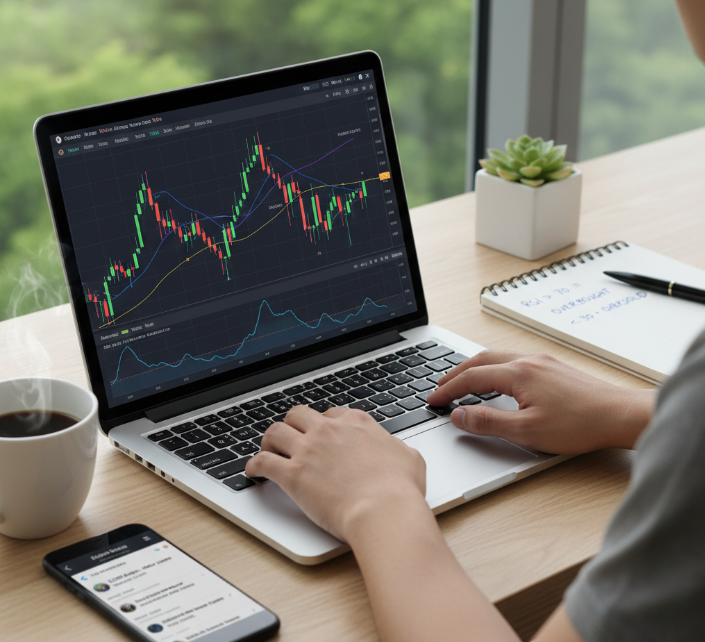
Key Technical Indicators: Moving Average and RSI Explained
Understanding how technical analysis works is like learning the controls before flying a plane. You don’t just wing it. Two indicators that every newbie should keep on their radar are the Moving Average and the RSI—they’re like your compass and altimeter.
Moving Average (MA):
Smooths out price data over time.
Helps spot the direction of the trend, whether it’s up or down.
Common types include Simple MA (SMA) and Exponential MA (EMA).
Relative Strength Index (RSI):
Measures recent price changes to evaluate if a currency is overbought or oversold.
RSI values above 70 = overbought; below 30 = oversold.
Acts as a momentum oscillator, giving early warnings before reversals.
| Indicator | Function | Ideal Range | Use Case |
|---|---|---|---|
| SMA | Trend tracking | Depends on period set | Long-term trend spotting |
| EMA | Reacts faster to price changes | Shorter periods preferred for day trading | Scalping/short-term trades |
| RSI | Momentum & reversal signal | 30–70 optimal zone | Identifying market entry/exit points |
When you're diving into forex as a beginner, these tools help cut through noise so you can read what the market's whispering instead of guessing wildly.
Understanding Chart Patterns: Head and Shoulders and Double Bottom
Recognizing classic chart patterns is like reading street signs while driving through volatile markets. Miss one, and you might crash into losses. But spot them right, and you're steering toward smart decisions.
The Head and Shoulders pattern signals a possible reversal in an uptrend:
Left shoulder forms after a peak followed by a dip.
The head peaks higher than both shoulders.
Right shoulder dips again but doesn’t exceed the head height.
Once it breaks below the “neckline,” traders often expect prices to fall.
The opposite? A Double Bottom, signaling bullish reversal:
• Price hits support once—bounces. • Returns to same level—bounces again. • If it breaks resistance between those bottoms, bulls take charge.
Pattern recognition is common in technical analysis, but it works best when you pair it with confirmation—like volume and key levels.
So yeah—these aren’t just shapes on charts. They’re psychological footprints left by traders acting en masse around key levels of support, resistance, and emotional tipping points.
Risk Management Essentials: Stop Loss and Take Profit Strategies
Even if your setups are perfect, without solid risk rules in place, forex becomes more gamble than game plan. That’s where smart use of tools like Stop Loss and Take Profit comes in handy—they protect your capital like seatbelts during turbulence.
Grouped into three practical strategies:
? Fixed Pip Strategy • Predetermine how many pips you're willing to lose or gain per trade. • Keeps emotions out when trades go sideways fast.
? Percentage-Based Strategy • Risk only X% of your capital per trade—common rule is no more than 2%. • Helps preserve funds over long stretches even if some trades flop.
? Risk-to-Reward Ratio • Aim for at least a risk-to-reward ratio—risk $50 to make $100. • Ensures potential gains outweigh losses consistently across trades.
When navigating forex for beginners, these strategies are less about being fancy—and more about staying in the game long enough to get better at it. Traders who skip this part often wipe out fast; those who respect risk tend to last longer than luck ever could.
3 Mistakes To Avoid When Starting Forex
New to forex? Don’t fall into these beginner traps—your wallet will thank you.
Common Pitfalls: Overleveraging and Risk Reward Ratio Mismanagement
Getting greedy with trades is like trying to sprint before you can crawl. Overleveraging is the number one account killer for those learning forex for beginners.
Many newbies crank up their position size thinking it’ll speed up profits, but it just speeds up losses.
A poor risk reward ratio, like risking $100 to make $20, means even one bad trade wipes out five wins.
Keep your position sizing small until your win rate proves itself.
Smart traders focus on capital preservation, not flashy returns.
One seasoned trader once said, “Trading isn’t about being right—it’s about surviving long enough to be right.” That mindset separates gamblers from professionals.
Ignoring Key Indicators: The Impact of MACD and Fibonacci Retracement
Ignoring key tools like the MACD or Fibonacci retracement levels is like driving blindfolded. These indicators aren’t magic—they’re road signs.
? Use the MACD:
Spot momentum shifts before price moves.
Confirm trends by watching signal line crossovers.
Stay alert when histogram bars shrink—momentum may be fading.
? Trust Fibonacci levels:
Identify potential bounce zones after pullbacks.
Combine with support/resistance for better accuracy.
Look at the golden ratio (61.8%) as a magnet for price action.
For those exploring forex trading strategies, understanding these tools adds serious clarity to your chart reading game. You don’t need every indicator—just know how to read the ones that matter.
Failing to Adapt Strategies: Comparing Trend Following and Position Trading
Some traders stick rigidly to one method, even when markets scream for change. That’s where things go sideways fast.
Trend following works best when markets are moving cleanly in one direction: Short-term gains, frequent trades, reactive style. Ideal during high volatility phases where momentum carries trades quickly in your favor.
Position trading takes a longer view: Think weeks or months instead of hours. It needs patience but pays off when big macro themes unfold slowly—like central bank policy shifts or geopolitical events affecting currency pairs.
In this world of forex for beginners, flexibility beats stubbornness every time. Understand both styles so you can shift gears when market dynamics demand it.
How To Analyze Forex Markets Effectively
Understanding how to break down the market is key when you're learning forex for beginners. Let’s unpack the tools, patterns, events, and psychology that drive smart trading.
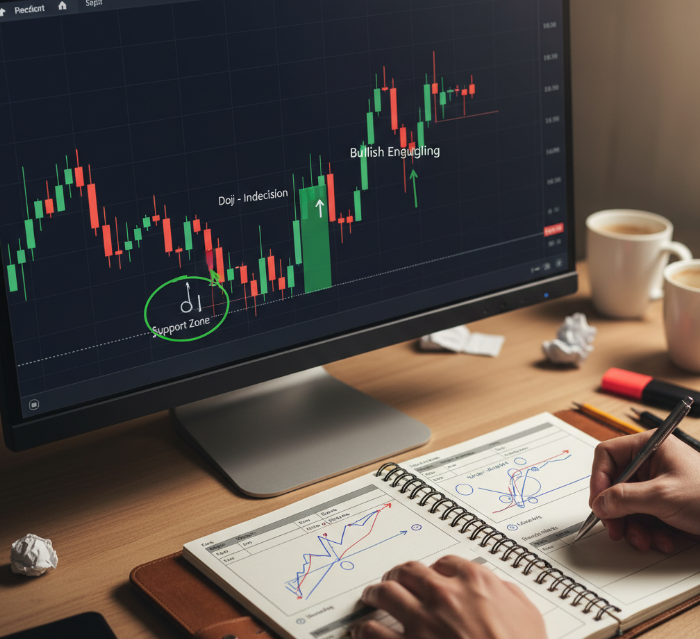
Technical Analysis: Utilizing Bollinger Bands and Chart Patterns
Bollinger Bands show volatility — prices hugging the upper band? Market may be overheated.
Spotting classic chart patterns like head-and-shoulders or triangles can signal trend reversals or continuations.
Use candlestick patterns, like dojis or engulfing candles, alongside support and resistance zones for precise entries.
If you're new to forex trading, these visual clues help simplify decision-making without diving too deep into economic theory.
Fundamental Analysis: How Currency Events Impact GBP/JPY and USD/CHF
Economic indicators such as inflation rates shake up both the GBP/JPY and USD/CHF, often triggering sharp moves.
Central bank chatter — especially from the BoE or SNB — can jolt these pairs mid-session.
Interest rate changes? They’re like caffeine shots for forex markets, especially when unexpected.
Political curveballs or trade tensions involving Switzerland or Japan also tend to move these pairs fast.
According to the IMF, macrofinancial uncertainty and policy divergence can intensify exchange rate volatility. That’s not just noise — it’s a signal worth watching if you’re serious about mastering fundamentals.
The Role of Market Sentiment: Identifying Overbought and Oversold Conditions
• Traders often overlook how much crowd behavior affects price swings in forex markets • The RSI indicator, when above 70, suggests overbought conditions; below 30 hints at oversold setups • Combine RSI with the Stochastic Oscillator for double confirmation before pulling the trigger • Watch out for extreme positioning in weekly COT reports — they reveal what big players are betting on
Using sentiment tools gives beginners an edge by showing where emotion might be driving irrational price action.
Practical Analysis Techniques: Tools for Day Trading and Long-term Positions
Longer-term traders lean heavily on broader trends using higher timeframes like daily or weekly charts. On the flip side, day traders stick with shorter windows — think M5s or M15s — where speed matters more than macro views.
Both styles need solid platforms with real-time data feeds, customizable charting tools, plus tight spreads. Risk control is non-negotiable regardless of your timeframe; always use stop-losses based on volatility levels rather than emotions.
For anyone navigating forex for beginners territory, balancing strategy with discipline is what separates dabblers from consistent earners.
References
Currency Pair Definition - https://www.investopedia.com/terms/c/currencypair.asp
MetaTrader 4 Platform for Forex Trading and Technical Analysis - https://www.metatrader4.com/en
MetaTrader 5 Trading Platform for Forex, Stocks, Futures - https://www.metatrader5.com/en
Learn About Major, Minor And Exotic Currency Pairs - https://www.equiti.com/sc-en/education/trading-101/major-minor-and-exotic-currency-pairs/
What is Forex Trading? - https://www.forex.com/en-us/forex-trading/what-is-forex-trading/
Forex Trading Sessions & Best Times to Trade - https://www.oanda.com/us-en/trade-tap-blog/trading-knowledge/when-is-the-best-time-for-forex-trading/
Moving Average - https://www.investopedia.com/terms/m/movingaverage.asp
What is RSI? - Relative Strength Index - https://www.fidelity.com/learning-center/trading-investing/technical-analysis/technical-indicator-guide/RSI
Understanding the Head and Shoulders Pattern - https://www.investopedia.com/terms/h/head-shoulders.asp
Understanding Double Bottom Patterns in Technical Analysis - https://www.investopedia.com/terms/d/doublebottom.asp
Master Technical Analysis - https://www.investopedia.com/terms/t/technicalanalysis.asp
Support and Resistance Basics - https://www.investopedia.com/trading/support-and-resistance-basics/
Stop-Loss Order - https://www.investopedia.com/terms/s/stop-lossorder.asp
Take-Profit Order - https://www.investopedia.com/terms/t/take-profitorder.asp
The 2% Rule - https://www.cmegroup.com/education/courses/trade-and-risk-management/the-2-percent-rule.html
Risk/Reward Ratio - https://www.investopedia.com/terms/r/riskrewardratio.asp
Position Sizing - https://www.investopedia.com/terms/p/positionsizing.asp
What Is MACD? - https://www.investopedia.com/terms/m/macd.asp
Strategies for Trading Fibonacci Retracement Levels - https://www.investopedia.com/articles/active-trading/091114/strategies-trading-fibonacci-retracements.asp
Fibonacci Retracements - https://chartschool.stockcharts.com/table-of-contents/chart-analysis/chart-annotation-tools/fibonacci-retracements
Bollinger Bands: What They Are and How to Use Them - https://www.schwab.com/learn/story/bollinger-bands-what-they-are-and-how-to-use-them
Economic Indicator - https://www.investopedia.com/terms/e/economic_indicator.asp
Global Financial Stability Report, October 2025 - https://www.imf.org/en/publications/gfsr/issues/2025/10/14/global-financial-stability-report-october-2025
How to Tell If a Market Is Overbought or Oversold - https://www.schwab.com/learn/story/how-to-tell-if-market-is-overbought-or-oversold
Stochastic Oscillator - https://www.investopedia.com/terms/s/stochasticoscillator.asp
Commitments of Traders (COT) Reports - https://www.cftc.gov/MarketReports/CommitmentsofTraders/index.htm
Understanding forex spreads - https://www.ig.com/en-ch/learn-to-trade/ig-academy/the-basics-of-forex-trading/understanding-forex-spreads
FAQ
What is the best material for custom keychains?
It depends on your goal. For durability and a polished look, metal (like zinc alloy or stainless steel) is hard to beat. Acrylic is the fan favourite for artists—lightweight, vibrant, and wallet-friendly. If you're going eco-friendly, wood or cork options are worth a look.
How thick should an acrylic keychain be?
Most acrylic keychains are around 3mm thick, which is sturdy enough to feel high-quality but not too bulky. Some shops offer thinner (2mm) for cost savings or thicker (5mm) for premium designs.
Can I sell keychains with copyrighted images?
Technically, no—and it’s not worth the risk. Using images of popular characters, logos, or memes without permission can get your shop flagged or even legally challenged. Instead, try:
Creating fan-inspired original art
Licensing artwork through stock or artist partnerships
Joining affiliate programs if you want to sell branded items legally
How much does it cost to make custom keychains?
It varies based on materials, order size, and design complexity. Here's a rough range:
Acrylic keychains (bulk): $0.50–$1.50 each
Metal keychains: $1.50–$3.00+
DIY kits at home: around $2–$5 per keychain
Design software/tools: Free (like Canva) to $20+/mo (like Adobe Illustrator)
Do keychain manufacturers have minimum order quantities (MOQs)?
Yes, most do. Platforms like Vograce or Alibaba often set MOQs around 10 to 50 units, depending on the material and style. Some Etsy-based suppliers or print-on-demand services may let you order just one or two for a higher price.
What file format should I use for keychain design?
Always check with your supplier, but in general:
.AI or .SVG for vector artwork (best choice)
.PNG with transparent background (300dpi or higher)
Avoid .JPG unless you’re sending photo-based artwork
Keep all text outlined to avoid font issues
Can I make keychains without expensive equipment?
Definitely! Many people start with simple tools at home or use online printing services. Here's how you can get going on a budget:
Use free design tools like Canva or Photopea
Buy blank keychains and apply your art with stickers, resin, or shrink plastic
Outsource printing to platforms like StickerMule, Vograce, or local print shops
Start small—just make a few and test the waters
What are the most popular shapes for keychains?
Classic rectangle and circle shapes are still common, but custom die-cut designs are trending. People love shapes that follow the contour of the artwork (like a cartoon head or logo). Unique shapes make your keychain feel less mass-produced and more you.