


On many Indian bank holidays, your charts still tick, but fills feel strange. forex market holidays confuse clients who ask, “Market khula hai ya band?” and frustrate treasury teams who see spreads widen without any “obvious news”.
A simple yes/no answer clearly doesn’t cut it for a brokerage desk.
For brokers, payment firms, and treasury teams, a bank holiday calendar is not “decorative information” – it’s a live risk input that affects liquidity, margin calls, client communication about slippage, and last-minute jugaad to change trading hours.
As easycashbackfx risk manager Rahul jokes, “On holidays, spreads bhi chhutti pe chale jaate hain – agar tum calendar nahi dekho, toh risk management ro lega, client email pe email lagao, warna P&L ro lega.” This guide takes that joke seriously.
We’ll break down how bank holidays and forex trading sessions actually interact, why liquidity changes even when a pair is on local holiday, and what smart planning looks like.
Use this article as your ready checklist and playbook: align trading schedules, liquidity alerts, and client messaging before any holiday hits – and you stay one step ahead of the “Why did my order slip?” calls.
Types of Trading Sessions on Bank Holidays
Asian Session liquidity in Tokyo and Hong Kong
Liquidity in the Asian Session starts with Tokyo and Hong Kong, and it’s way more uneven on bank holidays than many desks expect.
When Bank of Japan is closed, JPY pairs show thin trading volume and spiky volatility.
Local breaks in Hong Kong can drain HKD flows even if Nikkei futures still trade.
Price any “off-hours” quotes with wider spreads.
Warn clients about fragile liquidity during Asian cross fixes.

European Session on bank holidays in London and Frankfurt
During a UK Bank Holiday (like Easter Monday or Boxing Day), London desks are quiet, but EUR crosses can still move if Frankfurt is open.
EUR/USD may see reduced liquidity if major EU centers are on holiday even when US markets are open.
GBP pairs often show wider spreads when London liquidity is missing.
On the flip side, when Germany is on holiday but London is open, you sometimes get two-tier liquidity: some EUR books are thin, while GBP and USD flows remain more normal.
North American Session (New York, Toronto) during US/Canadian bank holidays
New York remains the gravity center for USD flows. When the US is off but Canada or LATAM are open, liquidity is distorted:
USD/CAD may trade thinner if Canadian desks are short-staffed.
Crosses like USD/MXN or USD/BRL see patchy liquidity if US-based market makers scale back.
During US Thanksgiving and Christmas week, you’ll often see:
Decent liquidity at the open.
A rapid fade as New York goes quiet and algo participation drops.
Sudden spikes or micro-gaps on even moderate tickets.
The key theme: “Forex is open” doesn’t mean “liquidity is healthy”. It simply means matching engines are accepting orders. Market quality is an entirely different question.
Bank Holidays vs Forex Market Hours: Key Differences
24-hour forex reality
Forex is a decentralized OTC market that runs all day, but holidays twist the flow a bit.
Liquidity jumps as trading sessions hand over between Sydney, Tokyo, London and New York.
Banks, hedge funds, and corporates might be closed even when price feeds are alive.
Local payment systems (RTGS, ACH, NEFT, SWIFT cut-off windows) follow their own holiday calendars.
So while your MT4/MT5 platform may stay open from Monday to Friday, the effective depth in the order book and market impact per trade change dramatically.
Business day and value date considerations
Settlement and value dates obey banking rules, not “trader views”.
Spot trades usually follow T+2, pushing the settlement date two business days forward.
If a holiday hits between trade date and settlement date in either currency’s jurisdiction, the value date shifts.
Example with USD/INR:
You trade USD/INR spot on Thursday.
Friday is a US working day, but Monday is an Indian bank holiday.
The value date may slide, and your treasury or funding team must adjust cash management accordingly.
This matters for:
Swap points and forward curves.
Overlapping holidays between two countries.
Margin and funding cost estimation.
Daylight Saving Time shifts
DST (Daylight Saving Time) is a silent killer for trading teams who don’t track it properly.
London and New York clocks shift at different times.
Asian centers generally don’t observe DST.
Liquidity patterns and session overlaps shift by one hour for a few weeks each year.
If your brokerage doesn’t adjust server time or communication properly, clients may trade into “unexpected thin patches” simply because they misread when London or New York is truly active.
Do Forex Markets Close on Bank Holidays?
True market closure vs reduced liquidity
A true closure is rare for spot FX outside of the standard weekend shutdown and a few global events. But liquidity can be so poor on some bank holidays that it feels like a practical closure.

True closure-like situations:
Christmas Day and New Year’s Day: Most liquidity providers are shut or quoting extremely wide.
Good Friday: Many major markets are closed or semi-closed, so FX volumes collapse.
Reduced liquidity situations:
Regional holidays (like Golden Week in Japan or Diwali in India).
National days (like Independence Day in the US or Republic Day in other countries).
In those cases, trading is technically available, but:
Spreads widen significantly.
Depth on both sides of the book is shallow.
Stop orders and market orders are at higher risk of slippage and gaps.
Central bank and payment system closures
Even if your platform shows live prices, settlement and bank transfers may not be available.
If RTGS in India or Fedwire in the US is closed due to a bank holiday, your onshore funding or withdrawals may be delayed.
Nostro and vostro accounts in specific currencies may not move cash until the next business day.
So, do forex markets close on bank holidays?
Retail platforms: Usually open, except for globally recognized holidays.
Wholesale banking/payment rails: Follow each country’s bank holiday rules.
Liquidity: Often degraded, sometimes dramatically.
Holiday Impact by Major Trading Centers
Asian hubs: Tokyo, Hong Kong, Singapore
Asian holidays are particularly important for JPY, HKD, SGD, CNH, and regional crosses.
Japanese bank holidays reduce participation from Tokyo-based institutions.
Golden Week, Obon, and other Japanese holidays can seriously thin JPY liquidity.
Hong Kong public holidays impact HKD and local stock/derivatives markets, even when offshore CNH liquidity remains.
Practical desk implications:
Avoid large-ticket JPY and HKD trades during major local holidays unless necessary.
During Golden Week, even EUR/JPY and GBP/JPY can become jumpy on modest flow.
European centers: London, Frankfurt, Zurich
London remains the single largest FX center by volume. UK bank holidays (like Summer Bank Holiday or Boxing Day) strongly influence global liquidity.
EUR, GBP, CHF pairs see thinner books.
Crosses like EUR/GBP or EUR/CHF can become choppy as fewer market makers stream tight prices.
Continental Europe (Frankfurt, Paris, Zurich) adds an additional layer:
Local holidays in Germany or Switzerland can distort EUR and CHF liquidity.
Swiss public holidays can reduce CHF depth even if London is open.
Traders who ignore Zurich holidays around events like Swiss National Day or other local festivals get surprised by sudden CHF spikes on minimal flow.
North America: New York and Toronto
US and Canadian bank holidays like:
Independence Day (4th July),
Labor Day,
Thanksgiving,
Victoria Day (Canada),
Canada Day,
change USD and CAD liquidity profiles.
During Thanksgiving week, expect stretched spreads and random spikes.
On US holidays that are not Canadian holidays (or vice versa), you get asymmetric liquidity in USD/CAD and related crosses.
This makes it harder to manage:
End-of-day fixing.
Large corporate flows.
Algo execution benchmarks.
For desks managing client execution, it becomes critical to adjust “normal” expectations and clearly warn about unusual slippage.
Common Pitfalls When Trading on Bank Holidays
Misreading broker “holiday trading hours” emails
Brokers often send holiday schedules that say:
“Normal trading hours,” yet spreads and slippage behave abnormally.
“Modified trading hours” where some instruments open later or close earlier.
Pitfall: Clients see “open” and assume normal liquidity. They underestimate:
Internal risk limits at your LPs.
Reduced staffing at banks and hedge funds.
Thinner participation from large corporates.
A cleaner explanation to clients is:
“Trading is open, but liquidity is limited. That means wider spreads and more slippage risk, especially on large orders.”
Ignoring liquidity provider (LP) limits
Your upstream LPs may:
Reduce maximum ticket size.
Widen spreads.
Disable certain exotic pairs on holidays.
If your risk and dealing team doesn’t align with LP holiday schedules, you may end up:
Routing large client orders into thin markets.
Taking on additional exposure as you internalize risk you normally hedge.
Over-leverage and margin calls
On quiet holiday sessions, traders sometimes increase leverage, assuming volatility is low.
Reality:
One unexpected headline or big order can cause outsized moves in thin books.
Margin calls can trigger rapid cascades, especially in retail-heavy pairs.
Brokers who don’t adjust margin requirements or communicate holiday risks may face:
Spikes in margin call tickets.
Disputes over slippage and stop-out levels.
Complaints about “platform manipulation”.
Holiday Risk Checklists by Currency Pair
Use these patterns to structure your internal risk run-throughs and client messaging.

USD/INR and regional INR crosses
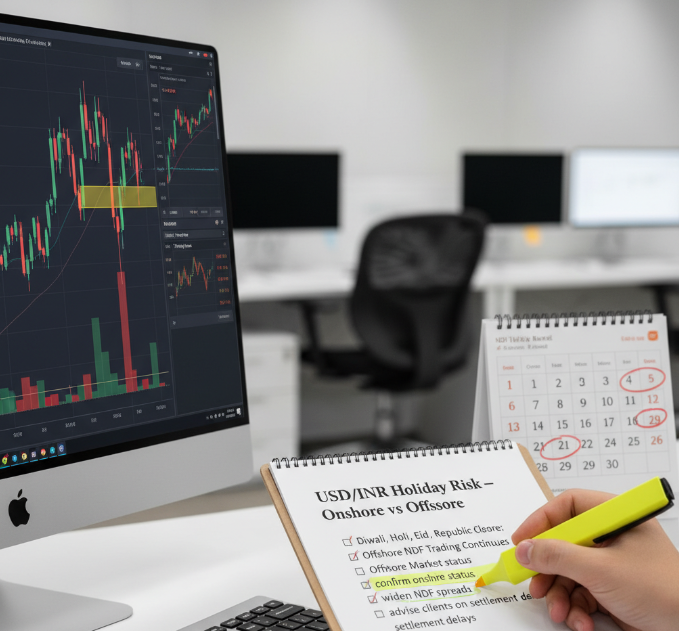
Indian bank holidays (Diwali, Holi, Eid, Republic Day) impact onshore INR markets.
Offshore NDFs may still trade, but pricing reflects uncertainty about onshore liquidity.
Large corporate hedging flows typically avoid these dates.
Checklist:
Confirm onshore market status (banks, exchanges, payment systems).
For NDFs, widen spreads and increase internal limits on ticket sizes.
Let clients know if onshore settlement or conversions will be delayed.
JPY majors and JPY crosses during Japanese holidays
Liquidity for JPY is heavily concentrated in Tokyo and major international hubs.
During Golden Week or other Japanese holidays:
JPY liquidity thins.
Crosses like EUR/JPY, AUD/JPY, and GBP/JPY can swing more than expected.
Checklist:
Avoid non-essential large orders in JPY during major local holidays.
Implement tighter risk monitoring around key fixes.
Consider pre-hedging or partial hedges when large flows are expected right after holidays.
GBP and EUR around UK and EU public holidays
UK bank holidays knock out a major share of global FX trading volume.
Continental public holidays (like German Unity Day) reduce EUR flows even if London is open.
Checklist:
Monitor event clustering: holidays that fall near NFP, ECB, or Fed decisions are particularly risky.
Watch for irregular price action during London fixings when London is closed or thin.
Coordinating with LPs and ensuring lines are open at overlapping centers (e.g., New York) becomes essential.
Operational Planning for Brokers and Payment Firms
Aligning trading hours with LPs and exchanges
You can’t simply copy-paste an exchange calendar and call it done.
Many LPs publish their own holiday trading hours.
Payment providers and card networks follow separate regional calendars.
FX swaps and forwards might have different value date rules than spot.
Action points:
Maintain a consolidated calendar that merges:
Global bank holidays.
LP holiday schedules.
Payment rail availability (SWIFT, SEPA, RTGS, NEFT, etc.).
Communicate clearly to clients which instruments are:
Fully closed.
Open with limited trading hours.
Open but with “high risk of wider spreads and slippage”.
Margin and leverage adjustments
Holiday sessions justify different risk parameters.
Consider:
Temporarily increasing margin requirements on volatile or thinly traded pairs.
Restricting leverage on exotics and high-beta pairs during major holidays.
Disabling certain instruments when upstream liquidity is unreliable.
Good practice:
Notify clients at least 48–72 hours before changes.
Provide plain-language screenshots or examples to illustrate what higher margin means.
Give a clear end date/time for temporary measures to avoid confusion.
Client communication templates for holiday trading
Prepare templates for:
General holiday trading notice
Which markets are affected.
Expected impact on spreads, liquidity, and slippage.
Instrument-specific changes
Margin adjustments.
Trading hour modifications.
Support availability
Whether customer support is operating on limited hours.
Emergency contacts for serious issues (e.g., stuck orders or platform outages).
Your goal is to pre-empt complaints. If clients understand the holiday environment, they’re less likely to accuse the platform when inevitable slippage happens.
Case Study 1: US Bank Holiday but London Open
Scenario:
US markets are shut for Independence Day.
London and European markets are open.
Many USD liquidity providers are based in New York and are fully or partially offline.
What happens:
EUR/USD and GBP/USD continue trading, but:
Order book depth is shallower.
Spreads are wider, especially outside core European hours.
USD/EM pairs like USD/TRY or USD/ZAR can become extremely fragile.
Risk response:
Avoid marketing highly leveraged trading products around such holidays.
Monitor LP performance and switch routing if drops in fill quality appear.
Advise clients to reduce position sizes or avoid intraday scalping.
Client education:
“Even though London is open, US-based banks are closed, so USD liquidity behaves differently. Expect more slippage on USD pairs.”
Case Study 2: Asian Holiday Overlaps with Major Economic Data
Scenario:
Japan and several Asian markets are on holiday.
A major global event (like a US CPI release or Fed decision) is scheduled during late Asian or early European hours.
What can go wrong:
Thin liquidity in JPY and regional currencies.
Larger than usual price gaps immediately after the data release.
Reduced ability to hedge positions in a timely manner.
Risk response:
Temporarily increase margin on affected pairs.
Consider widening spreads or even disabling certain exotic pairs during the key event window.
Closely monitor LP behavior and be ready to throttle routes that show unstable pricing.
Client education:
“Because Japan and other Asian centers are on holiday, liquidity is thinner than usual. When major data hits, prices may jump more and stop orders can be filled at worse levels than requested.”
Spot, Forwards, and Swaps Across Bank Holidays
Spot vs tom-next vs forwards – holiday handling
Holiday handling differs between:
Spot (T+2 in most currency pairs).
Tom-next swaps (rolling exposure by one business day).
Forward contracts (custom settlement dates).
Key points:
If a value date falls on a bank holiday in either currency jurisdiction, settlement usually moves to the next common business day.
Some specific market conventions (e.g., USD/CAD Good Friday/Easter adjustments) require close attention.
Practical implications for brokers:
Rollovers and swap charges can look “weird” around holidays.
Clients may see overnight financing costs spike or invert due to clustered holidays.
Poor explanations around this can trigger support tickets and distrust.
Impact on swap points and carry trades
Carry traders (and clients trying to earn overnight interest differentials) are sensitive to:
Large multi-day roll charges when holidays bundle together.
Odd-looking swap debits/credits immediately before or after a long weekend.
Best practice:
Provide a simple FAQ or explainer with examples of how swaps behave around holidays.
Show real examples from previous years to set expectations for big clusters like Christmas/New Year or local festive seasons.
Holiday Trading Around Indian Bank Holidays
NEFT/RTGS and INR market closures
In India, bank holidays impact:
Onshore FX markets.
Payment systems like NEFT and RTGS.
Local liquidity in INR pairs (USD/INR, INR crosses).
Even when offshore NDFs trade in Singapore or London:
Pricing reflects uncertainty around the onshore close.
Corporates and importers/exporters may avoid hedging on holiday dates.
Broker and payment firm actions:
Adjust INR-related spreads on holidays.
Delay onshore conversions and settlements until the next working day.
Inform clients ahead of time if bank transfers and withdrawals will be delayed.
Retail client expectations vs professional reality
Many Indian traders assume:
“If my app shows green, I can trade normally.”
“If the bank is closed, the market must be closed.”
Desks must explain:
Platform uptime is not the same as healthy liquidity.
Many international players treat Indian holidays as low-risk time to pull back and reduce exposure.
Holiday Trading Around Reserve Bank of Australia Holiday Gaps
Holiday gaps around the Reserve Bank of Australia can wreck AUD/USD books if your risk management is half asleep.
Commodity currency flows dry up, then snap back the moment Sydney wakes up.
Margin call storms hit accounts that ran too hot through quiet Bank Holiday hours.
| Holiday Period | Avg AUD/USD Gap (pips) | Avg Spread (pips) | Margin Call Rate (%) |
|---|---|---|---|
| Christmas–Boxing | 12 | 3.5 | 14 |
| Easter Long Week | 9 | 3.2 | 11 |
| Local NSW Holiday | 6 | 2.4 | 7 |
(*Illustrative internal brokerage stats, not a regulated disclosure.*)
Risk practices:
Watch open positions heading into long weekends.
Ask LPs for indicative holiday depth or max ticket sizes.
Cap leverage on AUD crosses for retail clients during peak holiday dates.
Holiday Trading in CHF: Swiss National Bank and Local Holidays
Holiday trading in Zurich often looks calm until CHF suddenly jumps on low volume.
Safe-haven flows can punch straight through levels, creating sharp price spikes and awkward liquidity gaps.
When Swiss National Bank sits in the background, many desks still treat CHF as “do not touch” unless spreads are fat.
A brokerage that explains this clearly keeps clients from blaming the platform for every quirky tick.
Bank Holidays vs Forex Market Hours: Key Differences
24-hour forex reality
Forex is a decentralized OTC market that runs all day, but holidays twist the flow a bit.
Liquidity jumps as trading sessions hand over between Sydney, Tokyo, London and New York.
Banks, hedge funds, and corporates might be closed even when price feeds are alive.
Local payment systems (RTGS, ACH, NEFT, SWIFT cut-off windows) follow their own holiday calendars.
So while your MT4/MT5 platform may stay open from Monday to Friday, the effective depth in the order book and market impact per trade change dramatically.
Business day and value date considerations
Settlement and value dates obey banking rules, not “trader views”.
Spot trades usually follow T+2, pushing the settlement date two business days forward.
If a holiday hits between trade date and settlement date in either currency’s jurisdiction, the value date shifts.
Example with USD/INR:
You trade USD/INR spot on Thursday.
Friday is a US working day, but Monday is an Indian bank holiday.
The value date may slide, and your treasury or funding team must adjust cash management accordingly.
This matters for:
Swap points and forward curves.
Overlapping holidays between two countries.
Margin and funding cost estimation.
Daylight Saving Time shifts
DST (Daylight Saving Time) is a silent killer for trading teams who don’t track it properly.
London and New York clocks shift at different times.
Asian centers generally don’t observe DST.
Liquidity patterns and session overlaps shift by one hour for a few weeks each year.
If your brokerage doesn’t adjust server time or communication properly, clients may trade into “unexpected thin patches” simply because they misread when London or New York is truly active.
Using Calendars and Data to Stay Ahead
A sloppy holiday and economic calendar process is expensive
If your desk relies on “someone remembering” important holidays and economic data releases, you’re running unnecessary risk.
Missed central bank holidays can lead to unexpected funding gaps.
Overlooking clusters of local holidays around major data events amplifies volatility risk.
Manually checking multiple calendars (central bank sites, payment systems, LP notices) is prone to human error.
Instead, you want:
A combined holiday calendar that integrates multiple sources.
Automated alerts for upcoming bank holidays and major economic events.
Coordination between trading, treasury, operations, and client communication teams.
Start with the economic calendar
A high-quality, FX-focused economic calendar should help you track:
Major central bank meetings (Fed, ECB, BoJ, BoE, RBA, etc.).
Top-tier macro data that moves FX: NFP, CPI, GDP, PMI, etc.
Regional releases that matter for specific currencies (like German data for EUR, UK data for GBP, Chinese data for AUD/NZD/Asian FX).
Combine this with:
Central bank and public holiday calendars.
LP and exchange holiday schedules.
Internal risk parameters and margin policy changes.
Treat calendars as a shared risk tool, not a static web page
A great risk team:
Integrates calendar data into position dashboards and P&L views.
Triggers internal alerts when holidays overlap with large event risks or outsized client positions.
Holds quick stand-up calls around high-risk dates to align the desk.
Rahul’s team at easycashbackfx has a simple rule: “If a sudden move makes us say ‘Did we forget something?’, that’s our fault, not the market’s.”
Practical Q&A for Brokers and Payment Firms
Q1: “If the forex market is technically open, why do my clients complain more on bank holidays?”
Because “open” is not the same as “liquid”.
Fewer banks and hedge funds are quoting.
LPs may widen spreads and reduce max ticket sizes.
Algo participation drops during holidays, making the market more jumpy.
Your job is to set expectations well before the holiday with clear client communication.
Q2: “Should we block trading on some holidays to protect clients?”
Blocking trading entirely is usually too harsh, but you can:
Increase margin requirements.
Restrict leverage.
Disable some exotic or illiquid pairs during extreme holidays (like Christmas or New Year).
Explain:
“We’re not trying to block you from trading; we’re trying to protect you from trades where the odds are stacked against you due to poor market conditions.”
Q3: “How do we explain holiday slippage without sounding like we’re making excuses?”
Use concrete language:
“On normal days, spreads on EUR/USD are around X pips; on major holidays, they can widen to Y–Z pips because fewer large banks are active.”
“On thin holiday books, a single medium-sized order can move the price several pips, which is why your stop loss may fill at a worse level.”
The more transparent your explanations, the more clients trust you long term.
Q4: “Can we turn holiday risk into a competitive advantage?”
Absolutely.
Better holiday communication = fewer complaints.
Smarter margin and risk controls = fewer client blow-ups.
A more mature approach to holiday liquidity can attract more serious traders.
The brokers who treat holidays as a “minor inconvenience” lose clients. The ones who treat holidays as a risk factor to manage win loyalty.
How to Build Your Internal Bank Holiday FX Playbook
You can build a robust internal playbook for holiday trading in four steps:
Calendar consolidation
Merge central bank, public holiday, LP, and payment system calendars into one view.
Tag high-risk days (e.g., overlapping holidays + big data releases).
Risk policy mapping
Define rules for:
Margin changes.
Leverage restrictions.
Instrument suspensions.
Pre-approve emergency controls for unexpected holiday volatility.
Client communication templates
Prepare emails, in-app banners, and FAQs explaining:
Holiday trading hours.
Spread and slippage expectations.
Margin changes and risk warnings.
Post-holiday reviews
After each major holiday, review:
Slippage.
Client complaints.
LP performance.
Update playbook based on lessons learned.
Final Thoughts: Is Forex Market Open on Bank Holidays?
So, is the forex market open on bank holidays?
Yes, in the sense that platforms remain technically open most of the time.
No, in the sense that liquidity, spreads, and execution quality may be so degraded that “normal trading” conditions don’t apply.
For brokers, payment firms, and treasury teams, the real question is:
“Are we pricing, communicating, and managing risk as if holidays change the market – or are we pretending everything is normal?”
If you treat bank holidays as a serious risk factor, align your calendars, and educate your clients, you don’t fear holidays. You plan for them.
And you turn one of the most confusing topics (“Market khula hai ya band?”) into a moment to show that your platform and your risk management are genuinely on your client’s side.
References
Is Forex Market Open on Bank Holidays?
On many Indian bank holidays, your charts still tick, but fills feel strange. forex market holidays confuse clients who ask, “Market khula hai ya band?” and frustrate treasury teams who see spreads widen without any “obvious news”.
A simple yes/no answer clearly doesn’t cut it for a brokerage desk.
For brokers, payment firms, and treasury teams, a bank holiday calendar is not “decorative information” – it’s a live risk input that affects liquidity, margin calls, client communication about slippage, and last-minute jugaad to change trading hours.
As easycashbackfx risk manager Rahul jokes, “On holidays, spreads bhi chhutti pe chale jaate hain – agar tum calendar nahi dekho, toh risk management ro lega, client email pe email lagao, warna P&L ro lega.” This guide takes that joke seriously.
We’ll break down how bank holidays and forex trading sessions actually interact, why liquidity changes even when a pair is on local holiday, and what smart planning looks like.
Use this article as your ready checklist and playbook: align trading schedules, liquidity alerts, and client messaging before any holiday hits – and you stay one step ahead of the “Why did my order slip?” calls.
Types of Trading Sessions on Bank Holidays
Asian Session liquidity in Tokyo and Hong Kong
Liquidity in the Asian Session starts with Tokyo and Hong Kong, and it’s way more uneven on bank holidays than many desks expect.
When Bank of Japan is closed, JPY pairs show thin trading volume and spiky volatility.
Local breaks in Hong Kong can drain HKD flows even if Nikkei futures still trade.
Price any “off-hours” quotes with wider spreads.
Warn clients about fragile liquidity during Asian cross fixes.
European Session on bank holidays in London and Frankfurt
During a UK Bank Holiday (like Easter Monday or Boxing Day), London desks are quiet, but EUR crosses can still move if Frankfurt is open.
EUR/USD may see reduced liquidity if major EU centers are on holiday even when US markets are open.
GBP pairs often show wider spreads when London liquidity is missing.
On the flip side, when Germany is on holiday but London is open, you sometimes get two-tier liquidity: some EUR books are thin, while GBP and USD flows remain more normal.
North American Session (New York, Toronto) during US/Canadian bank holidays
New York remains the gravity center for USD flows. When the US is off but Canada or LATAM are open, liquidity is distorted:
USD/CAD may trade thinner if Canadian desks are short-staffed.
Crosses like USD/MXN or USD/BRL see patchy liquidity if US-based market makers scale back.
During US Thanksgiving and Christmas week, you’ll often see:
Decent liquidity at the open.
A rapid fade as New York goes quiet and algo participation drops.
Sudden spikes or micro-gaps on even moderate tickets.
The key theme: “Forex is open” doesn’t mean “liquidity is healthy”. It simply means matching engines are accepting orders. Market quality is an entirely different question.
Bank Holidays vs Forex Market Hours: Key Differences
24-hour forex reality
Forex is a decentralized OTC market that runs all day, but holidays twist the flow a bit.
Liquidity jumps as trading sessions hand over between Sydney, Tokyo, London and New York.
Banks, hedge funds, and corporates might be closed even when price feeds are alive.
Local payment systems (RTGS, ACH, NEFT, SWIFT cut-off windows) follow their own holiday calendars.
So while your MT4/MT5 platform may stay open from Monday to Friday, the effective depth in the order book and market impact per trade change dramatically.
Business day and value date considerations
Settlement and value dates obey banking rules, not “trader views”.
Spot trades usually follow T+2, pushing the settlement date two business days forward.
If a holiday hits between trade date and settlement date in either currency’s jurisdiction, the value date shifts.
Example with USD/INR:
You trade USD/INR spot on Thursday.
Friday is a US working day, but Monday is an Indian bank holiday.
The value date may slide, and your treasury or funding team must adjust cash management accordingly.
This matters for:
Swap points and forward curves.
Overlapping holidays between two countries.
Margin and funding cost estimation.
Daylight Saving Time shifts
DST (Daylight Saving Time) is a silent killer for trading teams who don’t track it properly.
London and New York clocks shift at different times.
Asian centers generally don’t observe DST.
Liquidity patterns and session overlaps shift by one hour for a few weeks each year.
If your brokerage doesn’t adjust server time or communication properly, clients may trade into “unexpected thin patches” simply because they misread when London or New York is truly active.
Do Forex Markets Close on Bank Holidays?
True market closure vs reduced liquidity
A true closure is rare for spot FX outside of the standard weekend shutdown and a few global events. But liquidity can be so poor on some bank holidays that it feels like a practical closure.
True closure-like situations:
Christmas Day and New Year’s Day: Most liquidity providers are shut or quoting extremely wide.
Good Friday: Many major markets are closed or semi-closed, so FX volumes collapse.
Reduced liquidity situations:
Regional holidays (like Golden Week in Japan or Diwali in India).
National days (like Independence Day in the US or Republic Day in other countries).
In those cases, trading is technically available, but:
Spreads widen significantly.
Depth on both sides of the book is shallow.
Stop orders and market orders are at higher risk of slippage and gaps.
Central bank and payment system closures
Even if your platform shows live prices, settlement and bank transfers may not be available.
If RTGS in India or Fedwire in the US is closed due to a bank holiday, your onshore funding or withdrawals may be delayed.
Nostro and vostro accounts in specific currencies may not move cash until the next business day.
So, do forex markets close on bank holidays?
Retail platforms: Usually open, except for globally recognized holidays.
Wholesale banking/payment rails: Follow each country’s bank holiday rules.
Liquidity: Often degraded, sometimes dramatically.
Holiday Impact by Major Trading Centers
Asian hubs: Tokyo, Hong Kong, Singapore
Asian holidays are particularly important for JPY, HKD, SGD, CNH, and regional crosses.
Japanese bank holidays reduce participation from Tokyo-based institutions.
Golden Week, Obon, and other Japanese holidays can seriously thin JPY liquidity.
Hong Kong public holidays impact HKD and local stock/derivatives markets, even when offshore CNH liquidity remains.
Practical desk implications:
Avoid large-ticket JPY and HKD trades during major local holidays unless necessary.
During Golden Week, even EUR/JPY and GBP/JPY can become jumpy on modest flow.
European centers: London, Frankfurt, Zurich
London remains the single largest FX center by volume. UK bank holidays (like Summer Bank Holiday or Boxing Day) strongly influence global liquidity.
EUR, GBP, CHF pairs see thinner books.
Crosses like EUR/GBP or EUR/CHF can become choppy as fewer market makers stream tight prices.
Continental Europe (Frankfurt, Paris, Zurich) adds an additional layer:
Local holidays in Germany or Switzerland can distort EUR and CHF liquidity.
Swiss public holidays can reduce CHF depth even if London is open.
Traders who ignore Zurich holidays around events like Swiss National Day or other local festivals get surprised by sudden CHF spikes on minimal flow.
North America: New York and Toronto
US and Canadian bank holidays like:
Independence Day (4th July),
Labor Day,
Thanksgiving,
Victoria Day (Canada),
Canada Day,
change USD and CAD liquidity profiles.
During Thanksgiving week, expect stretched spreads and random spikes.
On US holidays that are not Canadian holidays (or vice versa), you get asymmetric liquidity in USD/CAD and related crosses.
This makes it harder to manage:
End-of-day fixing.
Large corporate flows.
Algo execution benchmarks.
For desks managing client execution, it becomes critical to adjust “normal” expectations and clearly warn about unusual slippage.
Common Pitfalls When Trading on Bank Holidays
Misreading broker “holiday trading hours” emails
Brokers often send holiday schedules that say:
“Normal trading hours,” yet spreads and slippage behave abnormally.
“Modified trading hours” where some instruments open later or close earlier.
Pitfall: Clients see “open” and assume normal liquidity. They underestimate:
Internal risk limits at your LPs.
Reduced staffing at banks and hedge funds.
Thinner participation from large corporates.
A cleaner explanation to clients is:
“Trading is open, but liquidity is limited. That means wider spreads and more slippage risk, especially on large orders.”
Ignoring liquidity provider (LP) limits
Your upstream LPs may:
Reduce maximum ticket size.
Widen spreads.
Disable certain exotic pairs on holidays.
If your risk and dealing team doesn’t align with LP holiday schedules, you may end up:
Routing large client orders into thin markets.
Taking on additional exposure as you internalize risk you normally hedge.
Over-leverage and margin calls
On quiet holiday sessions, traders sometimes increase leverage, assuming volatility is low.
Reality:
One unexpected headline or big order can cause outsized moves in thin books.
Margin calls can trigger rapid cascades, especially in retail-heavy pairs.
Brokers who don’t adjust margin requirements or communicate holiday risks may face:
Spikes in margin call tickets.
Disputes over slippage and stop-out levels.
Complaints about “platform manipulation”.
Holiday Risk Checklists by Currency Pair
Use these patterns to structure your internal risk run-throughs and client messaging.
USD/INR and regional INR crosses
Indian bank holidays (Diwali, Holi, Eid, Republic Day) impact onshore INR markets.
Offshore NDFs may still trade, but pricing reflects uncertainty about onshore liquidity.
Large corporate hedging flows typically avoid these dates.
Checklist:
Confirm onshore market status (banks, exchanges, payment systems).
For NDFs, widen spreads and increase internal limits on ticket sizes.
Let clients know if onshore settlement or conversions will be delayed.
JPY majors and JPY crosses during Japanese holidays
Liquidity for JPY is heavily concentrated in Tokyo and major international hubs.
During Golden Week or other Japanese holidays:
JPY liquidity thins.
Crosses like EUR/JPY, AUD/JPY, and GBP/JPY can swing more than expected.
Checklist:
Avoid non-essential large orders in JPY during major local holidays.
Implement tighter risk monitoring around key fixes.
Consider pre-hedging or partial hedges when large flows are expected right after holidays.
GBP and EUR around UK and EU public holidays
UK bank holidays knock out a major share of global FX trading volume.
Continental public holidays (like German Unity Day) reduce EUR flows even if London is open.
Checklist:
Monitor event clustering: holidays that fall near NFP, ECB, or Fed decisions are particularly risky.
Watch for irregular price action during London fixings when London is closed or thin.
Coordinating with LPs and ensuring lines are open at overlapping centers (e.g., New York) becomes essential.
Operational Planning for Brokers and Payment Firms
Aligning trading hours with LPs and exchanges
You can’t simply copy-paste an exchange calendar and call it done.
Many LPs publish their own holiday trading hours.
Payment providers and card networks follow separate regional calendars.
FX swaps and forwards might have different value date rules than spot.
Action points:
Maintain a consolidated calendar that merges:
Global bank holidays.
LP holiday schedules.
Payment rail availability (SWIFT, SEPA, RTGS, NEFT, etc.).
Communicate clearly to clients which instruments are:
Fully closed.
Open with limited trading hours.
Open but with “high risk of wider spreads and slippage”.
Margin and leverage adjustments
Holiday sessions justify different risk parameters.
Consider:
Temporarily increasing margin requirements on volatile or thinly traded pairs.
Restricting leverage on exotics and high-beta pairs during major holidays.
Disabling certain instruments when upstream liquidity is unreliable.
Good practice:
Notify clients at least 48–72 hours before changes.
Provide plain-language screenshots or examples to illustrate what higher margin means.
Give a clear end date/time for temporary measures to avoid confusion.
Client communication templates for holiday trading
Prepare templates for:
General holiday trading notice
Which markets are affected.
Expected impact on spreads, liquidity, and slippage.
Instrument-specific changes
Margin adjustments.
Trading hour modifications.
Support availability
Whether customer support is operating on limited hours.
Emergency contacts for serious issues (e.g., stuck orders or platform outages).
Your goal is to pre-empt complaints. If clients understand the holiday environment, they’re less likely to accuse the platform when inevitable slippage happens.
Case Study 1: US Bank Holiday but London Open
Scenario:
US markets are shut for Independence Day.
London and European markets are open.
Many USD liquidity providers are based in New York and are fully or partially offline.
What happens:
EUR/USD and GBP/USD continue trading, but:
Order book depth is shallower.
Spreads are wider, especially outside core European hours.
USD/EM pairs like USD/TRY or USD/ZAR can become extremely fragile.
Risk response:
Avoid marketing highly leveraged trading products around such holidays.
Monitor LP performance and switch routing if drops in fill quality appear.
Advise clients to reduce position sizes or avoid intraday scalping.
Client education:
“Even though London is open, US-based banks are closed, so USD liquidity behaves differently. Expect more slippage on USD pairs.”
Case Study 2: Asian Holiday Overlaps with Major Economic Data
Scenario:
Japan and several Asian markets are on holiday.
A major global event (like a US CPI release or Fed decision) is scheduled during late Asian or early European hours.
What can go wrong:
Thin liquidity in JPY and regional currencies.
Larger than usual price gaps immediately after the data release.
Reduced ability to hedge positions in a timely manner.
Risk response:
Temporarily increase margin on affected pairs.
Consider widening spreads or even disabling certain exotic pairs during the key event window.
Closely monitor LP behavior and be ready to throttle routes that show unstable pricing.
Client education:
“Because Japan and other Asian centers are on holiday, liquidity is thinner than usual. When major data hits, prices may jump more and stop orders can be filled at worse levels than requested.”
Spot, Forwards, and Swaps Across Bank Holidays
Spot vs tom-next vs forwards – holiday handling
Holiday handling differs between:
Spot (T+2 in most currency pairs).
Tom-next swaps (rolling exposure by one business day).
Forward contracts (custom settlement dates).
Key points:
If a value date falls on a bank holiday in either currency jurisdiction, settlement usually moves to the next common business day.
Some specific market conventions (e.g., USD/CAD Good Friday/Easter adjustments) require close attention.
Practical implications for brokers:
Rollovers and swap charges can look “weird” around holidays.
Clients may see overnight financing costs spike or invert due to clustered holidays.
Poor explanations around this can trigger support tickets and distrust.
Impact on swap points and carry trades
Carry traders (and clients trying to earn overnight interest differentials) are sensitive to:
Large multi-day roll charges when holidays bundle together.
Odd-looking swap debits/credits immediately before or after a long weekend.
Best practice:
Provide a simple FAQ or explainer with examples of how swaps behave around holidays.
Show real examples from previous years to set expectations for big clusters like Christmas/New Year or local festive seasons.
Holiday Trading Around Indian Bank Holidays
NEFT/RTGS and INR market closures
In India, bank holidays impact:
Onshore FX markets.
Payment systems like NEFT and RTGS.
Local liquidity in INR pairs (USD/INR, INR crosses).
Even when offshore NDFs trade in Singapore or London:
Pricing reflects uncertainty around the onshore close.
Corporates and importers/exporters may avoid hedging on holiday dates.
Broker and payment firm actions:
Adjust INR-related spreads on holidays.
Delay onshore conversions and settlements until the next working day.
Inform clients ahead of time if bank transfers and withdrawals will be delayed.
Retail client expectations vs professional reality
Many Indian traders assume:
“If my app shows green, I can trade normally.”
“If the bank is closed, the market must be closed.”
Desks must explain:
Platform uptime is not the same as healthy liquidity.
Many international players treat Indian holidays as low-risk time to pull back and reduce exposure.
Holiday Trading Around Reserve Bank of Australia Holiday Gaps
Holiday gaps around the Reserve Bank of Australia can wreck AUD/USD books if your risk management is half asleep.
Commodity currency flows dry up, then snap back the moment Sydney wakes up.
Margin call storms hit accounts that ran too hot through quiet Bank Holiday hours.
| Holiday Period | Avg AUD/USD Gap (pips) | Avg Spread (pips) | Margin Call Rate (%) |
|---|---|---|---|
| Christmas–Boxing | 12 | 3.5 | 14 |
| Easter Long Week | 9 | 3.2 | 11 |
| Local NSW Holiday | 6 | 2.4 | 7 |
(*Illustrative internal brokerage stats, not a regulated disclosure.*)
Risk practices:
Watch open positions heading into long weekends.
Ask LPs for indicative holiday depth or max ticket sizes.
Cap leverage on AUD crosses for retail clients during peak holiday dates.
Holiday Trading in CHF: Swiss National Bank and Local Holidays
Holiday trading in Zurich often looks calm until CHF suddenly jumps on low volume.
Safe-haven flows can punch straight through levels, creating sharp price spikes and awkward liquidity gaps.
When Swiss National Bank sits in the background, many desks still treat CHF as “do not touch” unless spreads are fat.
A brokerage that explains this clearly keeps clients from blaming the platform for every quirky tick.
Bank Holidays vs Forex Market Hours: Key Differences
24-hour forex reality
Forex is a decentralized OTC market that runs all day, but holidays twist the flow a bit.
Liquidity jumps as trading sessions hand over between Sydney, Tokyo, London and New York.
Banks, hedge funds, and corporates might be closed even when price feeds are alive.
Local payment systems (RTGS, ACH, NEFT, SWIFT cut-off windows) follow their own holiday calendars.
So while your MT4/MT5 platform may stay open from Monday to Friday, the effective depth in the order book and market impact per trade change dramatically.
Business day and value date considerations
Settlement and value dates obey banking rules, not “trader views”.
Spot trades usually follow T+2, pushing the settlement date two business days forward.
If a holiday hits between trade date and settlement date in either currency’s jurisdiction, the value date shifts.
Example with USD/INR:
You trade USD/INR spot on Thursday.
Friday is a US working day, but Monday is an Indian bank holiday.
The value date may slide, and your treasury or funding team must adjust cash management accordingly.
This matters for:
Swap points and forward curves.
Overlapping holidays between two countries.
Margin and funding cost estimation.
Daylight Saving Time shifts
DST (Daylight Saving Time) is a silent killer for trading teams who don’t track it properly.
London and New York clocks shift at different times.
Asian centers generally don’t observe DST.
Liquidity patterns and session overlaps shift by one hour for a few weeks each year.
If your brokerage doesn’t adjust server time or communication properly, clients may trade into “unexpected thin patches” simply because they misread when London or New York is truly active.
Using Calendars and Data to Stay Ahead
A sloppy holiday and economic calendar process is expensive
If your desk relies on “someone remembering” important holidays and economic data releases, you’re running unnecessary risk.
Missed central bank holidays can lead to unexpected funding gaps.
Overlooking clusters of local holidays around major data events amplifies volatility risk.
Manually checking multiple calendars (central bank sites, payment systems, LP notices) is prone to human error.
Instead, you want:
A combined holiday calendar that integrates multiple sources.
Automated alerts for upcoming bank holidays and major economic events.
Coordination between trading, treasury, operations, and client communication teams.
Start with the economic calendar
A high-quality, FX-focused economic calendar should help you track:
Major central bank meetings (Fed, ECB, BoJ, BoE, RBA, etc.).
Top-tier macro data that moves FX: NFP, CPI, GDP, PMI, etc.
Regional releases that matter for specific currencies (like German data for EUR, UK data for GBP, Chinese data for AUD/NZD/Asian FX).
Combine this with:
Central bank and public holiday calendars.
LP and exchange holiday schedules.
Internal risk parameters and margin policy changes.
Treat calendars as a shared risk tool, not a static web page
A great risk team:
Integrates calendar data into position dashboards and P&L views.
Triggers internal alerts when holidays overlap with large event risks or outsized client positions.
Holds quick stand-up calls around high-risk dates to align the desk.
Rahul’s team at easycashbackfx has a simple rule: “If a sudden move makes us say ‘Did we forget something?’, that’s our fault, not the market’s.”
Practical Q&A for Brokers and Payment Firms
Q1: “If the forex market is technically open, why do my clients complain more on bank holidays?”
Because “open” is not the same as “liquid”.
Fewer banks and hedge funds are quoting.
LPs may widen spreads and reduce max ticket sizes.
Algo participation drops during holidays, making the market more jumpy.
Your job is to set expectations well before the holiday with clear client communication.
Q2: “Should we block trading on some holidays to protect clients?”
Blocking trading entirely is usually too harsh, but you can:
Increase margin requirements.
Restrict leverage.
Disable some exotic or illiquid pairs during extreme holidays (like Christmas or New Year).
Explain:
“We’re not trying to block you from trading; we’re trying to protect you from trades where the odds are stacked against you due to poor market conditions.”
Q3: “How do we explain holiday slippage without sounding like we’re making excuses?”
Use concrete language:
“On normal days, spreads on EUR/USD are around X pips; on major holidays, they can widen to Y–Z pips because fewer large banks are active.”
“On thin holiday books, a single medium-sized order can move the price several pips, which is why your stop loss may fill at a worse level.”
The more transparent your explanations, the more clients trust you long term.
Q4: “Can we turn holiday risk into a competitive advantage?”
Absolutely.
Better holiday communication = fewer complaints.
Smarter margin and risk controls = fewer client blow-ups.
A more mature approach to holiday liquidity can attract more serious traders.
The brokers who treat holidays as a “minor inconvenience” lose clients. The ones who treat holidays as a risk factor to manage win loyalty.
How to Build Your Internal Bank Holiday FX Playbook
You can build a robust internal playbook for holiday trading in four steps:
Calendar consolidation
Merge central bank, public holiday, LP, and payment system calendars into one view.
Tag high-risk days (e.g., overlapping holidays + big data releases).
Risk policy mapping
Define rules for:
Margin changes.
Leverage restrictions.
Instrument suspensions.
Pre-approve emergency controls for unexpected holiday volatility.
Client communication templates
Prepare emails, in-app banners, and FAQs explaining:
Holiday trading hours.
Spread and slippage expectations.
Margin changes and risk warnings.
Post-holiday reviews
After each major holiday, review:
Slippage.
Client complaints.
LP performance.
Update playbook based on lessons learned.
Final Thoughts: Is Forex Market Open on Bank Holidays?
So, is the forex market open on bank holidays?
Yes, in the sense that platforms remain technically open most of the time.
No, in the sense that liquidity, spreads, and execution quality may be so degraded that “normal trading” conditions don’t apply.
For brokers, payment firms, and treasury teams, the real question is:
“Are we pricing, communicating, and managing risk as if holidays change the market – or are we pretending everything is normal?”
If you treat bank holidays as a serious risk factor, align your calendars, and educate your clients, you don’t fear holidays. You plan for them.
And you turn one of the most confusing topics (“Market khula hai ya band?”) into a moment to show that your platform and your risk management are genuinely on your client’s side.
FAQ
Are forex market holidays the same in London and New York?
No, the rhythm is different in each hub.
When is on a Bank Holiday, European liquidity thins out.
often stays active, keeping USD pairs moving.
Brokers plan desks and pricing city by city.
How do forex market conditions change on major holidays?
On big days like Christmas or Easter, desks slow down. In places like , screens stay on, but depth dries up and spreads feel heavier than usual.
What should a brokerage watch on key forex market holidays?
Holiday prep needs street-smart checks.
Track calendars from and other central banks.
Mark days as Market Closure, Low Liquidity, or Early Close.
Alert clients before surprises hit.
How can corporate treasuries plan around forex market holidays?
Treasuries stay calm by syncing payments with schedules, checking value dates early, and booking FX ahead so salaries and vendor payments don’t get stuck.
Do spreads usually widen during forex holidays in Asia and Europe?
Yes, it happens often.
Liquidity dips when hubs like slow down.
Fewer quotes mean wider bid–ask gaps.
Large tickets are safer earlier in the week.
Is trading open on Christmas Day and New Year’s Day?
Prices still tick on screens, mainly from and parts of Asia, but liquidity is thin and most brokers tighten risk limits.
How do central bank breaks impact spot, tom-next and forwards?
Central bank holidays shift the calendar.
Breaks at push spot and forward dates.
Tom-next rolls stack up after long gaps.
Value date checks save last-minute stress.
What is the risk of weekend gaps around Good Friday or Easter Monday?
After long weekends, prices from hubs like can reopen far from Friday’s close, triggering weekend gaps that catch loose stops.
How should a wholesale desk handle value dates over Boxing Day?
Boxing Day needs extra care.
Check which centres, such as , treat it as a non-business day.
Rework T+2 value dates.
Shift settlements to avoid payment fails.
What checklist should a broker follow before a major bank closure?
A quick checklist keeps desks steady.
Review risk limits and margin.
Match calendars from and others.
Update spreads, rollover timing, and client notes.