



The halal forex trading conversation is hotter than a summer sidewalk in Texas. Muslim traders are stuck between ambition and anxiety—itching to tap into global currency markets but worried about tiptoeing into haram territory. Is it just fast-paced finance or a slippery slope of riba, speculation, and nightmarish swap fees? Spoiler: it doesn’t have to be haram if you know what you're doing.
Back in 2022, Pew Research reported that 73% of Muslim Americans actively seek financial products aligned with their faith—but nearly half say they don’t trust typical platforms to deliver. That’s not paranoia; that’s lived experience.
Understanding Halal Forex Trading Principles
Getting into halal forex trading means playing by ethical rules, not just market ones.
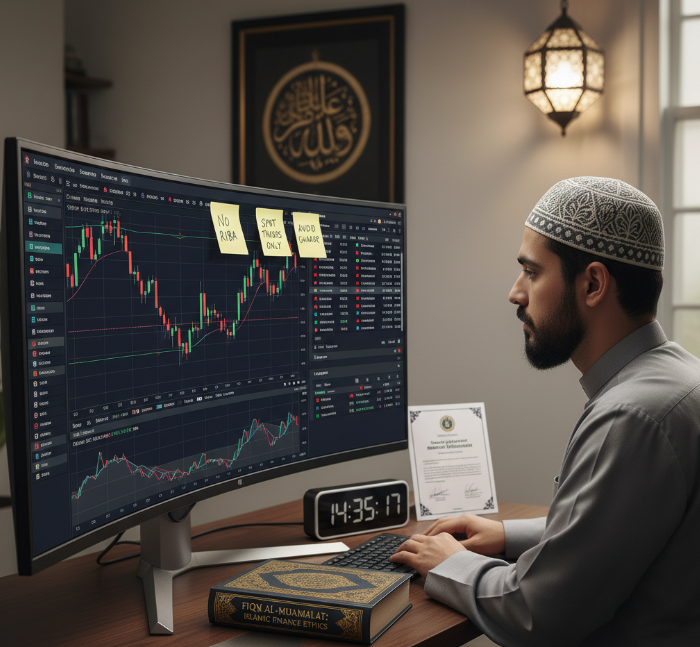
The Islamic View on Currency Trading
Riba is a big red flag — any form of interest makes a trade void under Sharia law.
Trades must be settled immediately; delayed settlements fall under Gharar, or uncertainty.
Speculative behavior like gambling (Maysir) is strictly off-limits.
Only real-time, hand-to-hand style exchanges are considered valid.
The goal? Fairness, transparency, and mutual consent — the backbone of ethical trading.
The idea isn’t to kill profit but to keep it clean and spiritually sound according to Fiqh principles, reflected in contemporary standards from bodies like AAOIFI and resolutions of the International Islamic Fiqh Academy on currency exchange (bay‘ al-ṣarf).
Key Differences Between Conventional and Halal Trading
| Feature | Conventional Trading | Halal Trading | Sharia Compliance |
|---|---|---|---|
| Interest-based Accounts | Common | Prohibited | ❌ |
| Use of Leverage | Widely used | Limited or avoided | ⚠️ |
| Spot Transactions | Optional | Mandatory | ✅ |
| Ethical Screening | Rare | Essential | ✅ |
Adapting Trading Strategies to Comply with Sharia Law
• Avoid overnight trades that incur interest; use intraday setups instead for pure Riba avoidance.
• Stick with spot trading, where currency pairs are exchanged instantly without delay or ambiguity (aligned with bay‘ al-ṣarf principles requiring immediate possession/settlement).
• Ditch high-risk gambles — strategies based on luck violate the ban on Maysir, which is all about reckless betting.
• Say no to excessive speculation; focus on technical analysis grounded in real-world data instead of chasing hype-driven moves, aligning with the spirit of Islamic finance principles.
EasyCashbackFx offers tools tailored for traders looking to stay within these boundaries while still staying sharp in the market game.
Summary:
Trading currencies the halal way isn’t about limiting ambition — it’s about aligning your hustle with your values using smart strategies that respect both market logic and spiritual ethics.
5 Key Features of Halal Forex Trading Platforms
Here’s what makes a halal forex trading platform tick—no fluff, just the essentials that keep it clean and Sharia-compliant.
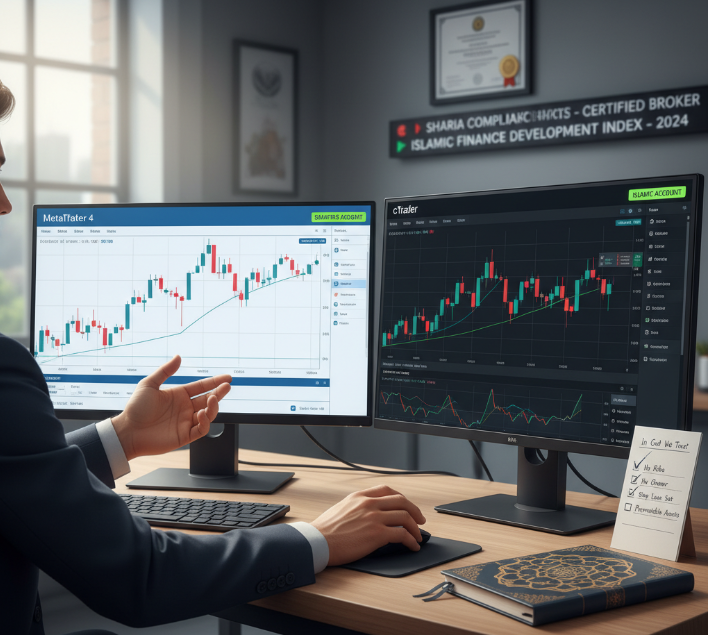
Compliance with Sharia Law: What It Means
To meet Sharia standards, platforms must ditch anything tied to Riba, Maysir, or Gharar. That means:
No interest-based swaps or overnight fees (use swap-free/Islamic accounts offered by regulated brokers).
Transparent transactions without hidden conditions.
Zero tolerance for gambling-like behavior.
A recent report by the Islamic Finance Development Indicator (2024) found that over 67% of Muslim traders prioritize platforms with full Islamic finance compliance. If you're serious about ethical investing, this is your starting point.
Currency Pairs Allowed in Halal Trading: EUR/USD, GBP/JPY
Not all currency pairs are fair game. In halal trading, only specific ones pass the test:
Major pairs like EUR/USD and GBP/JPY are preferred due to high liquidity.
These trades must settle immediately—no delays allowed under spot trading rules. (This mirrors the bay‘ al-ṣarf requirement for hand-to-hand exchange.)
Avoid exotic pairs with volatile spreads and unclear pricing structures.
The idea is simple: stick to clear-cut exchanges where both sides know what they’re getting—no funny business.
Trading Platforms That Support Halal Practices: MetaTrader 4, cTrader
Some brokers talk the talk but don’t walk the walk. These two platforms actually support halal forex trading through real features:
• MetaTrader 4 – Offers swap-free accounts tailored for Muslim traders via supporting brokers; user-friendly interface.
• cTrader – Known for transparency and fast execution; supports Islamic account options via certified brokers.
Both platforms eliminate interest-bearing fees while still giving you access to advanced charting tools and automated strategies—minus any violations of Islamic law.
| Platform | Swap-Free Option | Interface Type | Broker Integration |
|---|---|---|---|
| MetaTrader 4 | Yes | Classic | Widely Supported |
| cTrader | Yes | Modern | Select Brokers Only |
Risk Management Tools for Halal Trading: Stop Loss & Take Profit
Risk control isn’t just smart—it’s part of staying compliant. Here’s why tools like Stop Loss and Take Profit matter:
• They help prevent emotional decision-making during market swings. • You can define acceptable loss levels up front—keeping greed out of play. • They align with Sharia principles by promoting responsible risk exposure rather than wild speculation (avoiding Maysir).
The Financial Markets Authority noted in their April 2024 bulletin that "risk management tools have become essential safeguards for ethical retail traders." For those practicing halal investing, they're more than helpful—they're necessary safeguards against non-compliant behavior.
By using these built-in order types properly, you protect both your capital and your conscience when navigating the fast-paced world of currency exchange through halal channels like EasyCashbackFx or other certified brokers.
The Role of Riba in Forex Trading: A Critical Insight
This guide breaks down the nitty-gritty of halal forex trading, focusing on how riba and risk management play into Sharia-compliant investing.
Understanding Riba and Its Implications in Trading
You can’t talk about halal forex trading without tackling riba. It’s not just about avoiding interest—it's about upholding fairness in every deal.
Riba, often translated as usury or unjust gain, is strictly banned under Sharia law.
Any form of guaranteed return—especially from loans—is considered a violation.
In forex, this includes overnight swaps or rollover interest, which are common in standard accounts (hence the need for swap-free Islamic accounts).
? Islamic scholars argue that such practices exploit uncertainty and imbalance, violating the principle of ethical exchange. So if your broker charges or pays you interest on held positions, that’s a red flag for non-compliance with Islamic finance rules.
To keep your trades clean:
Use swap-free accounts specifically designed for Muslim traders.
Ensure all financial transactions are free from hidden fees that act like disguised interest.
Here's a quick table comparing typical forex features with their Sharia-compliant alternatives:
| Feature | Conventional Forex | Halal Forex Alternative | Sharia Compliance |
|---|---|---|---|
| Overnight Interest | Charged/Paid | None | ✅ |
| Leverage | High | Limited/None | ⚠️ |
| Speculative Trading | Common | Avoided | ❌ |
| Transparent Contracts | Optional | Required | ✅ |
How Hedging Can Align with Halal Principles
Some folks think hedging is just another name for gambling. But when done right—and ethically—it can be totally legit under Islamic finance principles.
Let’s break it down:
? What makes it halal?
The purpose must be genuine risk management, not chasing speculative profits.
It should use approved instruments like forward agreements or wa‘ad-based structures when backed by real economic activity—not just betting on price swings.
✅ Acceptable forms:
Hedging currency exposure due to international trade.
Protecting investment portfolios using structured Islamic contracts.
Using wa'ad-based agreements to lock future prices without violating rules against uncertainty (gharar).
? What's off-limits?
Derivatives used purely for speculative gain.
Agreements lacking transparency or involving excessive ambiguity.
Short bursts of clarity: • Hedging is okay if it reduces harm—not increases risk. • Speculation = haram; protection = halal. • Always check if the contract aligns with Sharia compliance standards before signing anything.
So yeah, you can hedge and still stay faithful to your beliefs—but only if you’re crystal clear on why you’re doing it and what tools you’re using. For those navigating the world of halal forex trading, this distinction could make or break your strategy.
Can Forex Trading Ever Be Truly Halal?
Exploring how different trading methods and market conditions stack up against Islamic principles.
Comparing Different Trading Strategies: Scalping vs. Swing Trading
Scalping involves rapid-fire trades, often within minutes or seconds, aiming to profit from small price changes. This high-speed method flirts with speculation, which is a red flag under Sharia law.
In contrast, swing trading holds positions for days or weeks, focusing more on trends than quick flips. This longer-term approach can better align with Halal compliance, especially when it avoids interest and excessive risk-taking.
Swing trading isn't automatically "Islamic-friendly," though—it still depends on avoiding leverage, ensuring spot transactions, and managing risk responsibly.
The Debate on Market Orders and Sharia Compliance
Market orders and limit orders both serve as tools to execute trades at desired prices—but are they clean under Islamic finance rules?
A market order executes instantly at the best available price—fine if there's no delay or deferred settlement that might introduce Riba.
A limit order, while more controlled, can flirt with uncertainty (Gharar) if not executed immediately or transparently.
Traders need to ensure their brokers offer real-time execution with transparent pricing to stay within the boundaries of Islamic finance.
Impact of Market Conditions: Volatile vs. Ranging Markets on Halal Trading
Riding the ups and downs of the forex market isn’t just about timing—it’s also about ethics.
• In highly volatile markets, price swings can get wild fast. That kind of unpredictability edges into gambling (Maysir) territory—definitely not Halal forex trading behavior.
• On the flip side, ranging markets, where prices move within a stable band, allow for more calculated decisions based on technical analysis and sound judgment—not pure speculation.
Short-term chaos often tempts traders into risky bets; long-term consistency keeps things grounded—and Halal.
Scalping vs Swing: Which Strategy Respects Risk Management?
Both scalping and swing trading require smart thinking—but they differ big time when it comes to risk control:
Scalpers rely heavily on tight stop-losses but may overtrade due to frequent entries—raising concerns around impulsiveness rather than calculated decisions rooted in faith-based principles.
Swing traders typically use broader stop-losses combined with trend-following techniques. This allows room for proper analysis using tools like economic indicators or support/resistance levels—often aligning better with ethical guidelines set by Islamic scholars familiar with financial markets.
In short? If you're looking to practice responsible halal forex trading without compromising your values, swing might be your safer bet.
How Spot Trading Supports Sharia Law Principles
Spot trading is often praised as compliant because there’s no delay—the transaction happens right away, reducing both uncertainty (Gharar) and interest-based gains (Riba).
• Immediate settlement = No delayed contracts • Transparent pricing = Less ambiguity • Real asset exchange = Avoids synthetic speculation
This makes spot trades a go-to choice for those trying to stick closely to the ethics of Islamic finance while navigating global currency markets through platforms like EasyCashbackFx—where transparency meets opportunity without stepping outside what's permissible under Sharia law.
When Market Analysis Meets Faith-Based Risk Assessment
Analyzing market behavior through an Islamic lens means balancing data-driven logic with spiritual accountability:
Use technical indicators only if they support informed decision-making—not blind speculation
Avoid high-frequency news-based trades that capitalize purely on chaos
Stick with currency pairs that offer low volatility during predictable hours
By combining smart analysis with ethical restraint, halal forex trading becomes less about chasing every pip—and more about building consistent returns that respect your values as much as your wallet.
References
AAOIFI – Financial Accounting Standard 38: Wa‘ad, Khiyar and Tahawwut (Hedging) – https://aaoifi.com/announcement/aaoifi-issues-financial-accounting-standard-38-waad-khiyar-and-tahawwut/
International Islamic Fiqh Academy (OIC) – Resolutions and Recommendations (includes rulings on currency exchange / bay‘ al-ṣarf) – https://iifa-aifi.org/wp-content/uploads/2024/12/IIFA-Resolutions-2024.pdf
Investopedia – What Is Riba in Islam, and Why Is It Forbidden? – https://www.investopedia.com/terms/r/riba.asp
Investopedia – Gharar: Meaning, Definition, Islamic Perspective – https://www.investopedia.com/terms/g/gharar.asp
Islamic Finance Guru – What is Gharar? (includes discussion of Maysir) – https://www.islamicfinanceguru.com/articles/what-is-gharar-islamic-finance-definitions-series
Investing.com – Islamic Forex Accounts: Exploring the World of Sharia-Compliant Forex – https://www.investing.com/brokers/guides/forex/islamic-forex-accounts-exploring-the-world-of-sharia-compliant-forex/
MetaQuotes – MetaTrader 4 Platform for Forex Trading and Technical Analysis – https://www.metatrader4.com/en
Spotware Systems – cTrader – Premium trading platform for FX/CFD – https://www.spotware.com/ctrader/
FAQ
What devices can I use to watch IPTV in Canada?
Smart TVs (like Samsung, LG, or Android TV)
Set-top boxes and Android TV boxes
Streaming sticks like Fire Stick or Roku
Media players such as VLC or Kodi
Tablets and smartphones
How do I know if I'm choosing the best IPTV service for my home?
A good service gives you the shows and channels you actually watch, runs well on your devices, and offers handy features like pause, record, or kid-safe settings.
Which features should I expect from the best IPTV service under $15?
Watch shows later with Catch-up TV
Share across screens with Simultaneous Connections
Record with Cloud DVR
Auto-refresh channel lists
Built-in Anti-freeze for stable streaming
Can cheap IPTV services offer 4K and smooth playback?
Yes. Some budget-friendly options support 4K, but smooth streaming depends on your internet speed and how the service handles video quality on slower connections.
What makes a best IPTV service safer than free ones?
Uses a VPN or secure tunnel to hide your data
Clear privacy policy
Encrypts your connection
Hides your IP with masking
Has real support and safe payments
Is buffering a common problem with budget IPTV?
It can happen, but a strong router, wired internet, and services that adjust video quality smartly can keep things running smoothly most of the time.
How do I compare the best IPTV service options for live sports?
Look for high frame rate and low delay
Catch-up TV helps if you miss games
Check for real-time streaming support
Make sure sports channels are included
Do IPTV services work well on phones and tablets?
Yes. Many apps stream well on mobile, especially if they use modern formats that adjust to your internet speed.
What are signs of a reliable IPTV provider?
Uses tech that adjusts to slow connections
Has anti-freeze built-in
Lists speed requirements clearly
Supports 4K and newer video formats
Good reviews about smooth playback
Does a best IPTV service include a guide or just channels?
Many include a program guide (EPG), so you can see what’s playing now and what’s coming next. It's even better when you can pause or record shows too.