


Table of contents
Ever nailed a trade entry, only to fumble the exit and watch your profits vanish? You’re not alone. “3 Trading Exit Strategies – How to Exit a Profitable Trade” is here to help you stop leaving money on the table. Getting into a trade is easy—getting out with your gains intact? That’s where most folks trip up.

A bad exit plan is like leaving a hot pizza in the oven too long—burned and wasted. Traders often panic-sell too soon or hold on ‘til it’s too late. As Paul Tudor Jones once said, “Don’t focus on making money; focus on protecting what you have.”
In this guide, you’ll learn three proven ways to exit smart: basic stops, adaptive trailing exits, and timing techniques that cut through the noise. No fluff—just real tools to help you lock in wins and trade with confidence.
Why is a trading exit strategy essential
A good entry grabs attention—but it's the exit that seals the deal. Without a solid plan, you’re gambling with your gains.

Missed profits from unclear exit plans
Lack of a clear exit strategy can quietly kill your profits. You think you’ll know the right time to bail—but then hesitation creeps in, and boom: your winning trade fizzles out.
Unclear strategy leads to delayed exits.
Opportunity cost rises when gains vanish.
Poor trade management increases profit loss risk.
A strong exit plan isn’t optional—it’s essential for capital preservation and maximizing investment returns.
Risk of emotional decisions without structure
Emotional trading is like driving blindfolded—you’re not in control.
Without a structured approach, you’re vulnerable to impulsive decisions and unnecessary risk exposure.
Solid behavioral finance principles promote better risk mitigation.
“Discipline beats emotion every time in the market,” says Linda Raschke, veteran trader.
When markets move fast, your brain wants to react. That’s where a predefined decision framework saves the day.
Exit plans vs. gut feeling trades
Some folks fly by the seat of their pants—gut feeling and all. But let’s be real: that approach won’t get you far.
| Exit Method | Profit Consistency | Risk Control |
|---|---|---|
| Rule-based trading | High | Strong |
| Gut-feeling trades | Low | Weak |
| Systematic trading | Very High | Very Strong |
Systematic trading beats discretionary trading over time because it's built for consistent profit taking and risk control.
Stop-loss and take-profit setup
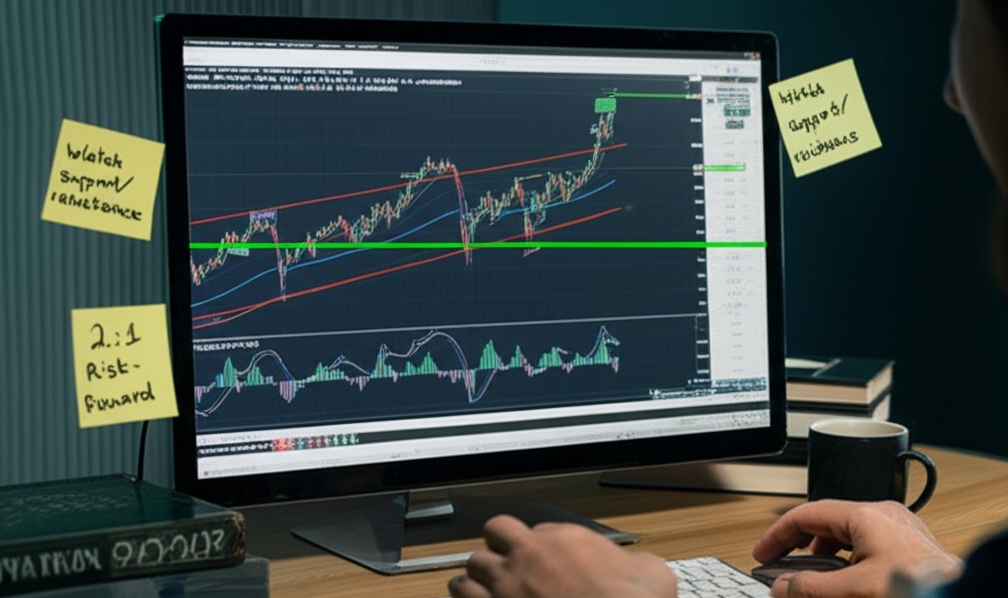
A solid exit plan starts with knowing where you’ll call it quits—both in profit and in loss. This cluster dives into precise stop-loss and take-profit strategies
.
How to set precise stop-loss points
Placing a stop-loss isn’t about guessing—it’s about capital protection and reading the chart like a pro. Use technical analysis tools like support zones, recent lows, or volatility measures (like ATR) to find logical exit points. A stop that’s too tight gets hit easily; too wide, and you’re risking too much. Strike that sweet spot with balance and precision.
“Risk comes from not knowing what you're doing.” – Warren Buffett
Choosing logical take-profit targets
Start with a clear risk-reward ratio—at least 2:1 is smart.
Identify key price levels or Fibonacci extensions as likely reversal zones.
Match your trading goals to market conditions: swing trades target higher, scalps aim small but quick.
Logical profit targets come from combining trade management with smart market analysis.
Support and resistance in exits
Exit plans shine when tied to key levels. Strong resistance zones are great take-profit markers, while reliable support zones help shape safer stop-loss placements. Price stalls or breaks near these levels give solid signals for action. Always scan for chart patterns and trend lines—they’re your early warnings for trend changes and potential breakouts.
Stop-loss placement for volatile markets
Use Average True Range (ATR) to calculate stop width.
Avoid clustering stops too close to obvious swing highs/lows.
Factor in slippage and gap risk, especially on news events.
When chaos hits, tight stops get wiped out fast. Adapt with dynamic stops and room to breathe.

Trailing stop strategies
Trailing stops let you ride the trend and grab more profits—without babysitting every tick. Here's how to use them smartly.
Fixed vs. dynamic trailing stop setups
There’s no one-size-fits-all when it comes to trailing stops. A fixed stop moves at a steady clip—like a 1% or $1 trail—simple and mechanical. A dynamic stop, on the other hand, adapts to market volatility, often using tools like ATR (Average True Range) or price action.
Fixed stops = easier to manage, good for tight control.
Dynamic stops = smarter in fast-moving or unpredictable markets.
“Dynamic stops offer flexibility—but only if you understand the flow,” says trader and author Kathy Lien.
Used right, both methods help lock in gains and reduce exit stress.
Using moving averages as trailing guides
Moving averages aren’t just trend indicators—they’re killer tools for trailing your exits too. The idea? Let the MA (like a 20 EMA) act as your support zone, nudging your stop loss upward as the price climbs.
Identify the dominant trend using a simple or exponential moving average.
Set your trailing stop just under the MA line—it’s your floating safety net.
If the price crosses below it? Boom—you’re out, with your profits intact.
This technical indicator is like your trade's best friend—it won’t sugarcoat reversals and helps keep emotion out of your exit game.
Volatility-based exit rules
Volatility can be your best friend or your worst enemy. Mastering it means knowing how to ride the waves—without getting wiped out.

What is ATR and how to use it
The Average True Range (ATR) measures market volatility by showing how much price typically moves over a set period. It doesn’t predict direction—just the range. Traders use ATR to set dynamic stop losses or to trail stops more intelligently.
For example, if ATR = 1.5, and you're long, a stop 1.5 below your entry adjusts for expected price wiggle without cutting you out too early.
Volatility filters for uncertain markets
Use volatility filters to avoid trading during choppy or erratic market conditions.
Combine price action with tools like Bollinger Bands or the VIX to assess market fluctuations.
A rising ATR + inconsistent trend? That’s a red flag for many trading strategies.
A good filter reduces false signals and keeps you out when the market uncertainty is too high to justify risk.
Adapting exits during news events
Check economic calendars before entering trades.
Tighten stops or exit early when major market news is approaching.
Sometimes, no trade is the smartest exit—especially during high-volatility reports like NFP or Fed announcements.
As one trader put it: “News can move the market faster than logic can catch up.” Stay nimble.
When volatility invalidates your target
Sometimes, the market throws a curveball. Your price target looked great—until volatility blew past it or reversed hard. That’s your cue to reassess:
Was your risk assessment based on outdated market conditions?
Are you chasing a target in a fast-changing market environment?
High volatility often means it's safer to take partial profits early and adjust expectations.
Combining volatility with support zones
Incorporating support zones with volatility gives you a sweet spot for exits:
If ATR is rising, give price more room beyond nearby support.
In low-volatility zones, tighter exits around technical levels often work better.
You're not just looking for movement—you're looking for meaningful confluence. That’s where solid trading signals happen.
| Volatility Level | Support Zone Strength | Exit Strategy Type |
|---|---|---|
| High | Strong | Loose trailing stop |
| Low | Weak | Tight stop near support |
| Medium | Moderate | ATR-based flexible stop |
When Should Time Dictate Your Exit
"Timing out of a trade can be just as critical as price," says Charles Bennett, a futures trader with over 15 years of experience. "If you do not respect the clock, the clock will punish your profits."
Many professional traders build exit strategies around the holding period, session end, or pre-set durations. These time-based exits are not based on price alone—they rely on calendar trading cues, expiration dates, or market close deadlines. For example, day traders often close positions by the end of day to avoid overnight risk. Swing traders may use a time limit to avoid being trapped in sideways markets.
Why time-based exits matter:
Reduce exposure to late-session volatility.
Avoid theta burn in options due to time decay.
Lock in profits before scheduled events like earnings or FOMC announcements.
John Morgan, a senior analyst at FXStreet, puts it simply: "Sometimes, the best signal to exit is not a chart pattern—it is the calendar." Trading platforms like Thinkorswim and MetaTrader even allow auto-closure on session timers, proving how standard these methods have become.
Key uses:
End of day cut-offs for risk control.
Expiration exits for options and futures.
Pre-defined duration holds to reduce emotional bias.
Time is not just money—it is a stop-loss in disguise.
Emotional exit triggers
Even solid exit strategies fall apart when emotions hijack the wheel. Here’s how common psychological traps can ruin your timing—and what to do instead.

Fear of missing out (FOMO)
FOMO is the ultimate profit killer. You see the market ripping, your phone buzzes with gains from others, and suddenly you're chasing candles like it's a lottery ticket. This anxiety-driven behavior often leads to impulsivity and regret. > “FOMO is the single most destructive emotion for retail traders,” says behavioral finance expert Dr. Brett Steenbarger.
Instead of buying because others are, ask: Is this part of my plan? Stay grounded by pre-setting entry/exit rules and avoiding social media hype during trades.
Revenge trading after missed exits
You exit a trade too early.
The price explodes... without you.
Boom—you jump back in emotionally, trying to “get back what’s yours.”
That’s revenge trading in action. It's not strategy, it’s emotional trading that leads to overtrading and risk mismanagement. Discipline is your best defense. Step away, review the setup, and ask: “Would I take this trade without the loss baggage?”
How discipline improves exit timing
Let’s face it—discipline isn’t flashy, but it’s your ticket to long-term gains. A consistent exit strategy grounded in timing and rules minimizes guesswork and protects profits.
| Trading Habit | Impact on Timing | Risk Level |
|---|---|---|
| Emotional exits | Poor | High |
| Rule-based exits | Predictable | Moderate |
| Disciplined reviews | Sharpened timing | Lowered |
Traders who follow a plan are less likely to panic-sell or overstay. Patience + rules = consistent results.
Which strategy suits your market condition
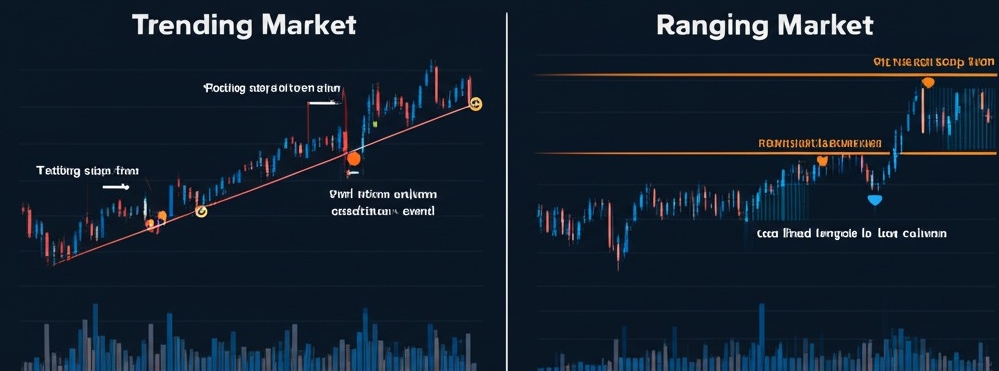
When it comes to exiting trades, understanding market conditions is everything. Whether the market is trending or ranging, using the right exit strategy can mean the difference between a profitable trade and a missed opportunity.
Trending vs. ranging market exits
In a trending market, you're riding the wave—using strategies like trailing stops that follow price movement. But in a ranging market, prices move sideways, so fixed exits based on support and resistance levels work better.
Trending Market:
Use trailing stops to lock in profits as price moves.
Take advantage of momentum, exit only when the trend shows signs of reversal.
Ranging Market:
Focus on fixed stop-loss and take-profit targets.
Exits should be based on clear support and resistance levels.
Volume clues for strategy selection
Volume plays a key role in deciding your exit strategy. In strong trends, volume typically confirms the move. If the volume is weak or low, it suggests a range-bound market, so you may need a different exit approach.
High Volume:
In trending markets, volume confirms price direction.
Trail your stops, but be ready to act when volume drops off.
Low Volume:
Signals range-bound behavior—use fixed exits and tighter risk management.

Exit Checklist Before Closing a Trade
Exiting a trade can be a nerve-wracking decision, but it does not have to be. Before you close any position, it is crucial to ensure that every aspect of your trade is in alignment with your strategy. A well-structured exit checklist helps you make decisions based on analysis, not emotion. Here are the essential elements to consider:
Risk Assessment
Before making any move, double-check your risk-reward ratio. If your potential reward still outweighs the risk, holding the position might be worth it. Conversely, if the trade has reached a point where losses exceed your predetermined limits, it might be time to exit.Profit Targets
Review your profit targets to see if they are realistic or if market conditions have changed. Are you nearing your set target? If so, think about locking in profits before the market shifts unexpectedly.Stop-Loss Levels
Reevaluate your stop-loss levels. Are they placed effectively to protect your position while allowing for market fluctuations? Tightening or adjusting the stop-loss can ensure you do not give back your hard-earned gains.Market Analysis
A final check of the market analysis is essential. Are current market conditions still aligned with your trading strategy? Does technical analysis show signs of reversal or continuation?News Impact
Stay alert to news impact that could influence your trade. Economic reports, geopolitical events, or company-specific news can drastically affect your position, so stay updated and adjust your trade accordingly.Trading Plan Adherence
Stick to your trading plan adherence. Does this trade still fit the plan you laid out? Avoid straying from your strategy due to impulses or market noise.Position Management
Reassess your position management. Are you overexposed in any one trade or sector? Diversifying your positions can reduce risk.Technical Indicators
Take a moment to review any technical indicators that influenced your entry. Do these indicators suggest a continuation or reversal? Consider exiting if technical signals indicate the trend has run its course.Emotional Discipline
Emotional discipline is key. If emotions such as fear or greed are creeping in, take a step back. Clear-headed decisions lead to better exits.Post-Trade Review
Lastly, plan your post-trade review. Reflect on your exit strategy after closing the trade. Understanding what worked and what did not can help you refine your approach for future trades.
By systematically following these steps, you increase the likelihood of making calculated, informed decisions that align with your broader trading strategy. Each of these elements works in tandem to ensure you are closing the trade with the utmost precision and confidence.
Conclusion
A solid exit strategy is your ticket to consistent trading success. Without one, you’re gambling—hoping the market moves in your favor without a clear plan to protect your gains. As trading legend Jesse Livermore said, "It’s not the right entry, but the right exit that makes a trader successful."
Mastering exits lets you lock in profits and minimize losses. Stop-losses, trailing stops, and volatility-based exits all give you control, but the key is using them wisely.
Now, it’s time to take action. Start building your exit strategy today, and you’ll see how much smoother trading can be.
A trading exit strategy is a plan that defines when and how you will exit a trade. It helps prevent emotional decisions, reduces risk, and locks in profits. Without a solid exit plan, traders often let emotions take control, leading to missed opportunities or losses.
A stop-loss order is an automatic order to sell a security when it reaches a certain price. It’s designed to limit an investor’s loss on a trade. The idea is to set it at a price level where you’re comfortable with the amount of loss you’re willing to accept.
Stops help limit losses without constant monitoring.
It can prevent you from losing more than you’re willing to risk.
A well-set stop-loss allows for peace of mind when trading volatile assets.
While a stop-loss limits your potential loss, a take-profit order locks in profits once the asset reaches a specific price. Both are essential for risk management, but they focus on different ends of the spectrum—avoiding losses and securing gains.
A trailing stop automatically adjusts the stop-loss order to lock in profits as the price moves in your favor. It's perfect for trend-following strategies where you want to maximize gains but protect profits as the price continues to move up or down.
Yes, volatility plays a significant role in your exit strategy. In high volatility, you may want to use wider stop-loss orders or volatility-based strategies like Average True Range (ATR). This way, your trade isn’t closed prematurely due to temporary price fluctuations.
Wider stop-losses: Reduce the chance of being stopped out during volatility.
Volatility-based tools: Help set more adaptive exit levels based on market conditions.
In trending markets, a trailing stop strategy is often the best exit strategy. This allows you to stay in a trade longer while the market moves in your favor, and it automatically protects profits when the trend reverses. The key is knowing when to let the market “run” and when to lock in profits.
Emotions like fear, greed, and overconfidence can lead to bad exit decisions. For example, fear of missing out (FOMO) might make you hold onto a trade too long, while panic selling might force you to exit too early. It’s crucial to have a plan that removes emotions from the equation.
For range-bound markets, using support and resistance levels is essential. In these conditions, your exit strategy should involve setting take-profit orders near resistance and stop-loss orders near support. This approach helps you capture small price movements within the range.
Creating an exit checklist helps ensure you’re sticking to your plan. Your checklist should include things like:
By reviewing your checklist before exiting, you can keep your trading decisions rational and consistent.
Profit targets: Have specific price levels in mind.
Stop-loss rules: Set clear risk thresholds.
Market conditions: Ensure the market is behaving as expected.
Psychological check: Make sure you’re not being influenced by emotions.