


Table of contents
Most traders dive into the market like it’s a Vegas casino—big hopes, little prep. That’s a recipe for blown accounts and burnout. "How to Create a Trading Plan in 7 Steps" is here to give you structure, clarity, and the kind of calm confidence that comes from knowing exactly what your next move is—win or lose.
Think of a trading plan like GPS for your money. Without it, you're just guessing turns in the dark. Legendary trader Alexander Elder put it best: “The goal of a successful trader is to make the best trades. Money is secondary.”
This guide walks you through setting goals, picking a style that fits your life, managing risk like a pro, and building discipline into your daily flow. It’s designed for traders who are tired of winging it—and ready to start thinking like a strategist.
Why do you need a trading plan
“You cannot manage what you do not measure,” said Linda Raschke, a veteran trader with over 30 years of market experience. Her words resonate with anyone who has felt the sting of a rushed decision during market volatility. A trading plan is not just paperwork—it is the backbone of discipline, the defense against impulsive trades, and the foundation for performance tracking.
In real-world terms, a trading plan sets the tone for consistency. It defines your trading goals, entry and exit rules, risk management strategy, and how to handle emotional reactions. Traders who operate without one often fall victim to poor decision making, especially during emotional spikes triggered by unexpected news or fast price swings.
Risk management clarity – Prevents overexposure and protects capital
Emotional control structure – Reduces fear, greed, and hesitation
Performance accountability – Enables better tracking of results and improvement
Consistency under pressure – Maintains discipline through market chaos
According to the Chartered Market Technician (CMT) Association, a structured plan improves trading longevity by over 60 percent. Experienced traders and fund managers rarely skip this step—because skipping it means playing blindfolded.
Without a trading plan, you are not trading. You are guessing.
Trading goals and expectations
You can’t hit a target you haven’t set. Lock in your goals, or you’ll trade like you’re throwing darts in the dark.
Defining your personal trading mission
Your trading strategy should reflect your financial objectives and the lifestyle you're building—not someone else’s hustle. A solid mission statement helps align your risk tolerance with your investment goals, keeping you focused when market noise creeps in.
Think of it like your personal “why” in the world of trading. No fluff. Just clarity and direction for your entire trading plan.
Profit targets vs. realistic outcomes
Many new traders chase profits like they’re chasing lottery numbers—but seasoned pros stick to numbers that make sense. Let’s look at what profit targets should look like next to realistic expectations:
| Metric | Ambitious Target (%) | Realistic Target (%) | Notes |
|---|---|---|---|
| Monthly ROI | 20% | 3–7% | Accounts for drawdowns and fees |
| Win Rate | 80% | 50–60% | Depends on strategy risk profile |
| Risk-Reward Ratio | 1:5+ | 1:2 or 1:3 | Higher reward = lower win rate |
| Trade Frequency (per week) | 50+ | 5–15 | Overtrading can kill performance |
“If your goals don’t survive a spreadsheet, they won’t survive the market.”
Planning for wins and learning from losses
Take a breath after a winning trade. Celebrate, but don’t get cocky.
After a loss? That’s your goldmine. Use failure analysis and post-trade analysis to find the lesson.
Keep a trading journal like it’s your training diary—it’s where real improvement lives.
Real pros evolve. Every trade feeds the loop of continuous improvement and trading psychology growth.
You’re not just trading dollars—you’re trading behavior patterns. Own them.
Which trading style suits you best
Your trading style isn’t one-size-fits-all. It should match your time, mindset, and lifestyle like a glove—without burning you out or blowing your goals.
Time commitment and lifestyle alignment
Trying to force day trading into a busy 9–5 life? That’s a recipe for stress. Your daily routine, financial goals, and mental bandwidth should guide your style. Are you a parent juggling school pickups? A swing style may give more flexibility. Got free mornings and thrive on routine? Intraday setups could suit you. Find the rhythm that supports your work-life balance, not wrecks it.
Day trading vs. swing trading basics
“Trade your strengths, not your ego. Time is your most valuable asset.” — Steve Burns, market educator
| Style | Holding Period | Key Features |
|---|---|---|
| Day Trading | Intraday only | Fast pace, quick profits, high screen time |
| Swing Trading | Days to weeks | More relaxed, technical & fundamental analysis |
Day traders ride short-term volatility for daily wins. They need full attention and quick entry/exit moves.
Swing traders look for larger setups over a longer holding period, giving space to breathe.
Choosing between manual or automated trading
Manual trading gives you direct control. You spot the setup, make the decision, and learn the ropes with every move. But it also means emotional control is a must.
Automated trading uses trading bots or algorithms to act fast and emotion-free. Great for those into strategy development and backtesting, especially when coding is your thing.
Feeling torn? Start manual. Once your strategy shows results, add some automation to scale your edge.
Understanding scalping, momentum, and trend styles
Scalping is for speed demons. You're chasing small gains from tight spreads and rapid executions. You'll need liquidity, precision, and nerves of steel.
Momentum trading grabs setups when prices accelerate quickly—usually after a breakout or volume spike. Short-term, high energy.
Trend trading is about zooming out. You follow long-term market direction, riding support and resistance levels and letting the trend do the heavy lifting.
Choose the style that fits your temperament: adrenaline, focus, or patience.
Market analysis methods
Charts tell you what happened. News tells you why it happened. Together, they give you the full picture before placing your next trade.
Using technical indicators for setups
Technical analysis isn’t magic—it’s just pattern recognition with some handy tools. Want to ride a trend or spot a reversal before it happens? Here's where indicators step in:
Moving Average: smooths out price data, showing the trend.
MACD & RSI: momentum tools to measure if a stock’s hot—or way overheated.
Bollinger Bands: show volatility and potential breakouts.
Volume confirms strength behind a move.
Support and Resistance are like emotional thresholds for the market.
Candlestick Patterns (like dojis and hammers) hint at sentiment shifts.
Chart Patterns such as Triangles or Double Tops = possible trend reversals.
“The trend is your friend—until it bends,” says Linda Raschke, professional trader and author.
News, earnings, and fundamental drivers
The market doesn't move in a vacuum. Behind every price spike or dip is a reason, often found in news feeds, economic data, or earnings reports. Here's how key events shake up the market:
| Event Type | Market Impact | Typical Reaction Time |
|---|---|---|
| Economic Data | Shifts in inflation, GDP, jobs | Within minutes |
| Central Bank Announcements | Adjust interest rate forecasts | Immediate to short-term |
| Earnings Reports | Surprises in EPS or revenue | Overnight or pre-market |
| Geopolitical Events | Affects investor sentiment | Real-time |
| Breaking News | Causes volatility and gaps | Seconds to minutes |
Earnings season? Traders look for Earnings Per Share, Profit Margins, and especially Guidance—because future outlook often matters more than past results. A single Earnings Call can flip the market’s mood.
Stay alert. Fundamentals are the fuel, technicals are the map. Smart traders check both before hitting “Buy.”
How do you build a working strategy
Building a trading strategy isn’t just charts and numbers—it’s about turning messy ideas into a clear playbook that works in the real world.

Identifying repeatable chart patterns
Recognizing chart patterns like double tops, triangles, and head-and-shoulders can help predict future price moves. Traders use technical analysis to track candlestick patterns, trend lines, and price action across different market cycles. Mastering pattern recognition lets you spot support and resistance levels before they play out. Over time, these formations act like a map, pointing toward where price might head next.
Entry and exit rule development
Solid strategies need entry points that make sense—not gut feelings.
Use trade triggers like moving average crossovers or support bounces.
Define exit points ahead of time, including stop-loss orders and take-profit targets.
Every trading rule should factor in position sizing and risk exposure.
Pro tip: Keep it rule-based, but flexible enough for real-world changes.
Journaling test trades on paper
Old-school but gold—paper trading helps you stress-test strategies without risking real cash.
“A trading journal reveals more than a balance sheet. It reveals your mindset.” — Mark Douglas
Use a trade log to track simulated trades, log wins/losses, and spot what’s working. Over time, your record keeping becomes a blueprint for smarter decisions.
Building strategies around market conditions
Trending markets → Use breakout or trend-following setups.
Sideways markets → Lean into range trading and mean-reversion.
High volatility → Reduce position size and tighten stops.
Successful traders adapt their strategy building to match the market regime. Keep tabs on economic data, news events, and intermarket correlation to know what environment you’re trading in.
Turning ideas into actionable playbooks
Got a solid idea? Cool. Now make it tradeable.
Create a simple trading checklist that turns your strategy into a clear execution plan. Add backtesting steps, include risk controls, and wrap it into a systemized playbook. Then keep refining.
| Strategy Idea | Rule Trigger | Execution Method |
|---|---|---|
| RSI Oversold | RSI < 30 | Buy, tight SL |
| EMA Crossover | 9 EMA > 21 | Buy, trail SL |
| Breakout Buy | Price > High | Buy + TP |
Test everything. Then test again.
Risk and money management rules
Risk management ain’t flashy—but it’s what keeps you trading next week.

Setting stop-losses and take-profits
A solid exit strategy isn't optional—it’s survival. A stop-loss order caps your downside, while a take-profit order locks in wins without second-guessing. Setting clear price targets aligned with your trading strategy removes emotion and keeps things mechanical. Use limit orders to automate exits, and update them as market conditions shift. Smart traders let systems, not feelings, control exits.
Risk-per-trade vs. portfolio allocation
Think of your capital allocation like a pizza—don’t bet the whole pie on one slice.
| Trade Size (%) | Portfolio Impact | Risk Level |
|---|---|---|
| 1–2% | Low | Safe, scalable |
| 3–5% | Medium | Balanced risk |
| 6–10%+ | High | Aggressive, risky |
Using proper position sizing keeps your risk tolerance in check and helps with capital preservation—even during a cold streak.
Avoiding overleveraging and revenge trades
We’ve all been there—market smacks you, and you’re itching to “win it back.” That’s revenge trading, and it’s a fast track to a blown account. Overleveraging adds fuel to that fire—piling on margin trades can balloon losses faster than you can blink.
“A trader’s worst enemy isn’t the market. It’s the trader.” – Brett Steenbarger, trading psychologist
Stay cool. Respect your risk rules. And never trade just to feel better. You’re not a gambler—you’re running a business.
When to enter and exit trades
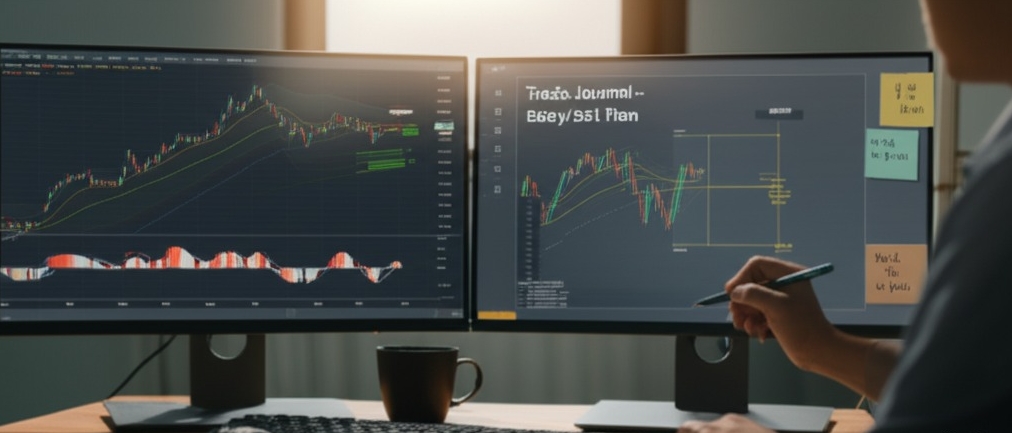
“I never enter a trade without knowing exactly where I will get out.” That was the first rule I learned from Marcus Raymond, a seasoned trader and mentor at the Austin Trading Collective. Sitting across from me, sipping black coffee, he pulled up a chart on his screen. “This is not guessing. It is trade management.”
Knowing when to enter and exit trades is the beating heart of successful trading. Traders lean heavily on entry signals generated by technical indicators, like RSI or MACD, alongside support levels and resistance levels to gauge ideal timing. Entry is precision—no second-guessing.
When it comes to exits, two things matter: stop-loss levels and take-profit targets. These define the trade’s boundaries before the market moves. Marcus emphasized a risk-reward ratio of at least 1:2. “If I am risking $100, I better see $200 on the other side. That is the only way to survive long term.”
Technical signals (RSI, MACD, moving averages)
Market structure zones (support/resistance)
News catalysts and volatility spikes
Trade journaling for entry/exit pattern review
Professional traders like Linda Raschke have taught this principle for years: “The exit is more important than the entry.” This advice holds across forex, futures, and crypto alike.
Perfect entries and exits do not exist, but managing your trades with clear, tested rules keeps emotions out and control in.
Plan review and improvement
A trading plan isn’t “set it and forget it.” If you want to stay sharp, reviewing and adjusting is just part of the game.
Tracking trades with performance journals
Think of your trading journal as your GPS history—it shows where you’ve been and how smooth (or bumpy) the ride was. Use trade tracking and performance metrics to review what worked, what tanked, and what to tweak. Journals aren’t just for logging wins—they’re your blueprint for growth. The best traders track every move, note every emotion, and never trade blind.

Learning from losing and winning streaks
Streaks aren’t just luck—they’re clues. Streak analysis helps identify performance patterns that reflect both market behavior and your emotional state.
“Success in trading doesn’t come from being right—it comes from managing the wrong,” says Brett Steenbarger, PhD, a trading psychology expert.
By reviewing both winning strategies and losing lessons, you stay self-aware and reduce repeat mistakes. That’s emotional discipline in action.
Adjusting strategies with market changes
Watch for market shifts in volatility or trend direction
Rebalance risk or change position size
Build in flexibility for changing conditions
Markets change. Fast. And if your plan’s stuck in last season’s logic, it’ll get wrecked. Use market analysis to spot when strategic adjustments are needed. Staying rigid in a dynamic market? That’s how plans fail.
Scheduling regular plan reviews
Set a review schedule like a doctor’s checkup—don’t wait for something to break. Block time monthly (or after a streak) for strategic planning and progress monitoring. Use this table to schedule and focus your sessions:
| Review Type | Frequency | Key Metrics to Monitor |
|---|---|---|
| Quick Check-in | Weekly | Win/loss ratio, entry quality |
| Mid-Term Review | Monthly | Trade volume, mistake patterns |
| Deep Dive Assessment | Quarterly | Goal progress, emotional control |
Systematic review keeps your edge sharp. Skipping it? That's like flying blind.
Conclusion
Trading without a plan is like jumping into traffic blindfolded—chaotic, stressful, and usually ends the same way. The steps you’ve just walked through are your roadmap to making smarter, calmer moves in the market.
As trading coach Brett Steenbarger says, “Discipline isn’t just about control—it’s about consistency.” A good plan lets you show up steady, not scattered.
Now’s the time to put pen to paper. Sketch your strategy, test it small, and trust the process. Small edges, stacked over time, lead to big wins.
A trading plan is more than just a list of buy-and-sell rules—it’s your personal blueprint for how you operate in the market. It lays out your goals, risk tolerance, preferred trading style, entry/exit rules, and how you’ll track progress. It helps you stay cool when emotions flare and prevents you from trading on impulse.
Great question. Think about how much time you can commit daily, and how fast you want results. For example:
Try demo accounts before you commit.
Day trading: Active, fast-paced, requires lots of screen time.
Swing trading: A few trades a week, more flexible.
Position trading: Longer-term holds, less stress.
Scalping: Ultra-fast trades, not for the faint of heart.
Risk management is what separates hobbyists from serious traders. It’s how you protect your account from a few bad trades wiping you out. Key components include:
Only risking 1–2% of your capital per trade
Setting consistent stop-loss and take-profit levels
Diversifying trades and avoiding overleveraging
Sticking to the plan—no revenge trading
Absolutely. Backtesting is like rehearsal before a performance—you need to know your moves before stepping on stage. By testing your setup on historical data, you learn if your idea holds water before you risk real money. It won’t predict the future, but it will reveal if your logic is sound.
There’s no one-size-fits-all answer, but a solid habit is to review your plan monthly—or after a major market shift. Think of it like tuning up your car: you don’t wait until something breaks. Look for patterns in your trades, spot what's working, and toss what’s not.
Starting out, you don’t need a million fancy tools. A few strong indicators go a long way:
Stick to 1–2 tools and learn them well.
Moving Averages (SMA, EMA) – for trend direction
RSI – for spotting overbought/oversold zones
MACD – for momentum and crossovers
Support & Resistance levels – for finding entry/exit points
Yes, but you’ll need patience and discipline. Small accounts mean you can’t take big risks, but that can be a blessing in disguise. Start with tight risk rules, build consistency, and grow your account over time. Plenty of pros started with a few hundred bucks and scaled up. It’s not about size—it’s about skill.