


Table of contents
Ask any seasoned trader and they’ll tell you—the London session is where the real action kicks off. In fact, it moves more money than New York and Tokyo combined. In this Trading the London Session: Guide for Forex Traders, we’re breaking down what makes this window of time the market’s heartbeat—and how you can ride the waves instead of getting caught in the chop.

They say “timing is everything,” and that’s never more true than in forex. London opens the floodgates with sharp liquidity spikes, juicy breakouts, and lightning-fast momentum. If you’ve ever felt stuck trading slow, sleepy charts, this guide is for you. As Kathy Lien puts it: “The London session is the most active and liquid period of the trading day.”
So, if you’re tired of chasing trades that never take off—or getting blindsided by moves you didn’t see coming—stick around. We’ll help you tap into the London edge with clear strategies, real talk, and tools that actually work.
London Session Time
The London session isn’t just about the clock—it’s about precision, momentum, and knowing when to hit “buy” or “sell” like a pro.

Global time zone conversion made easy
Struggling to sync your trades across time zones? You’re not alone. Every trader has cursed the clock at some point. Use the world clock, compare UTC, GMT, and your local standard time, and don’t forget daylight saving time (DST) shifts twice a year. The goal? Smooth synchronization across the globe.
| City | Standard Time (GMT) | Daylight Saving | Market Open (Local) |
|---|---|---|---|
| London | GMT+0 | GMT+1 (Mar–Oct) | 08:00 |
| New York | GMT-5 | GMT-4 (Mar–Nov) | 08:00 |
| Tokyo | GMT+9 | No DST | 09:00 |
Opening hours vs. active hours
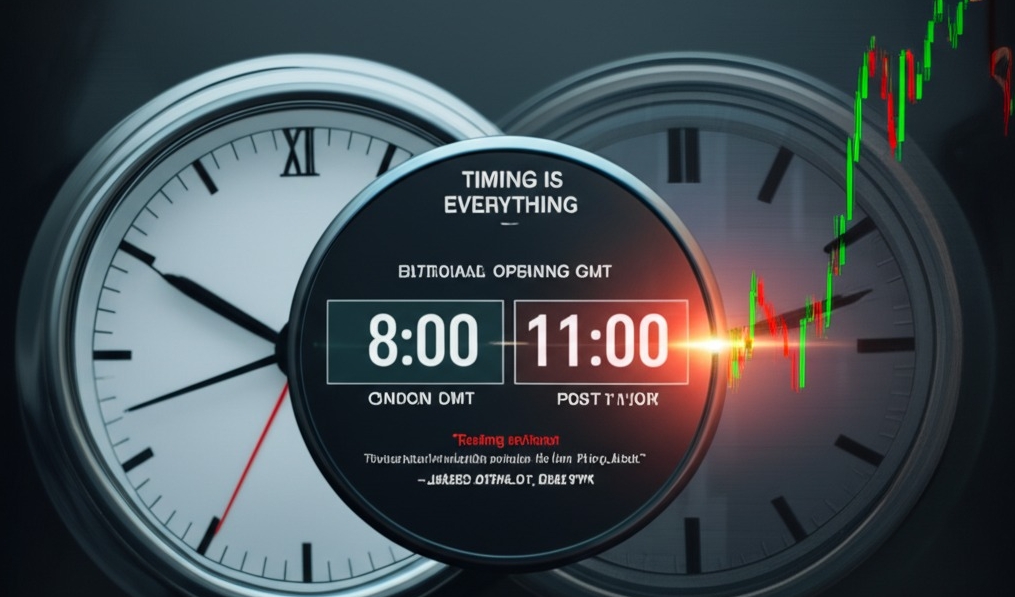
Opening hours: London kicks off at 8:00 AM GMT.
Active hours: The real juice flows from 9:00–11:00 AM GMT—peak times when markets buzz and spreads tighten.
Off-peak: After lunch? It’s like trading in slow motion. Save your ammo.
Impact of daylight savings on trading
When DST kicks in, traders can get thrown off like a rookie at a rodeo. Trading hours shift, volatility patterns move, and suddenly your go-to setup misses the mark. If you’re trading forex or stock market opens, time shift awareness is key. Mark those calendar changes—twice a year makes a big difference.
"Trading without adjusting for daylight savings is like flying blind." – James Stanley, DailyFX
Why timing shapes trading outcomes
Great entry points = better results. Catch the wave early.
News drops? High volatility can boost or break your trade.
Technical setups often align with predictable timing zones.
So if your timing’s off, even the best strategy can fall flat. Time it right, and the market starts playing your tune.

Liquidity and Volatility Peaks
Timing the market is tough, but knowing when it gets wild during the London session? That’s your edge. Let’s break down where the juice is.
When price action hits its peak
Price action often goes into overdrive as the London session hits mid-morning, especially around major economic data drops.
Look for swing highs and price ceilings to anticipate reversals.
Technical analysis tools like RSI help spot overbought conditions.
A parabolic move near a resistance level often signals trend exhaustion—great time to tighten stops or take profit.
Institutions and market-moving volume
Ever wonder why things get crazy fast? That’s institutional trading doing its thing.
Smart money—like hedge funds and pension funds—move big.
These whales drop block trades, spike order flow, and sometimes fake out retail traders.
Keep an eye on volume analysis tools to track liquidity zones they can’t hide from.
"Institutions shape the battlefield—retail just reacts." — Linda Raschke, veteran trader.

Why volatility creates profit windows
When market volatility kicks in, profits don’t tiptoe—they leap.
Wild price swings open up explosive profit opportunities, especially in short-term strategies.
Options traders love this window for delta-neutral plays like straddles and strangles.
In spot forex, tight spreads + high movement = prime time for scalping.
| Strategy Type | Volatility Tool Used | Ideal London Hour |
|---|---|---|
| Scalping | ATR, RSI | 8:00–10:00 GMT |
| Breakout Trading | Bollinger Bands | 7:30–9:00 GMT |
| Options Straddling | Implied Volatility | Pre–News Events |

Best Currency Pairs to Trade
“When I first started trading the London session,” says veteran trader Marcus Holland of FXPrimeEdge, “I stuck with EUR/USD and GBP/USD because they moved clean, had deep liquidity, and reacted well to key European news. Years later, I still do.”
The London session, often described as the heartbeat of forex, commands the highest trading volume worldwide. This is not by accident. Major currency pairs like EUR/USD, GBP/USD, and USD/CHF thrive in this window. Liquidity is strong, volatility is timely, and spreads are often tighter.
Traders watching the London bell ring at 8:00 AM GMT often gravitate toward these pairs:
EUR/USD – Known for tight spreads, this pair reacts sharply to EU and US economic data.
GBP/USD – Dubbed “Cable,” it shows higher volatility, ideal for breakout traders.
EUR/GBP – Offers range-based opportunities as both currencies share the same regional session.
Cross pairs like GBP/JPY – Move fast and wide, but need disciplined risk management.
According to the Bank for International Settlements (BIS), more than 39% of global forex turnover involves the euro, while the British pound accounts for 13%. These figures support the strategic focus on major and cross pairs during London hours.
As London opens, smart traders prioritize pairs with volume, momentum, and event-driven potential. Trade what moves. Avoid what drags. Every session is a race—your currency pair is your vehicle. Choose wisely.
London–New York Overlap

This is the golden window for many traders. When London and New York overlap, market hours merge, and trading conditions heat up. Let’s break down why it matters.
Trade volume spikes during overlap
When the London and New York sessions collide (typically between 8 AM–12 PM EST), trading volume goes through the roof. This isn't just a little uptick—it’s a liquidity surge. Institutions jump in, forex and stock markets buzz, and price moves with intensity. This overlap brings the most reliable market hours for executing high-volume strategies and scalping.
| Time Window (EST) | Avg. Volume ($ trillion) | Volatility Index |
|---|---|---|
| 8 AM – 9 AM | 1.9 | 7.2 |
| 9 AM – 10 AM | 2.3 | 8.5 |
| 10 AM – 11 AM | 2.1 | 7.9 |

Using the overlap for breakout setups
Spot the setup: Use the early overlap window to monitor key price levels—support, resistance, or pre-Asian range.
Wait for the pop: A solid breakout often follows the volume spike around major news releases or price cluster breaks.
Confirm your entry: Look for a clean candle close above/below the range, then enter with conviction.
Don’t get faked out: Use confirmation tools like RSI or volume spikes to avoid being trapped by false moves.
“The overlap is where breakout setups become breakout realities,” says trader and author John Kicklighter. “It’s all about timing and patience.”
What Is the London Breakout Strategy
This breakout strategy thrives on London’s fast pace. Nail your setup, protect your capital, and catch the early momentum before it leaves you in the dust.

Setup timeframes and key price levels
A solid London breakout starts with the right chart setup. Focus on 15-min and 1-hour timeframes to define clear support and resistance zones. Pre-London ranges help spot consolidation areas—prime targets for breakouts. Identify key price levels using recent highs/lows and use these as entry/exit targets. Don’t guess—let the chart analysis draw the plan.
Entry triggers before volatility kicks in
You’ve gotta be sharp—entry timing is everything. Look for clean candlestick signals (like bullish engulfing or pin bars) near a breakout edge. Add momentum indicators like RSI or MACD to confirm strength before the volatility explodes. Think of it like revving your engine right before the green light—catch it too late, and you’re stuck in traffic.
Stop loss placement that protects capital
Placing a Stop Loss isn't just smart—it's survival. Set stops just beyond key support or resistance to dodge random whipsaws. Use a trailing stop strategy to lock in gains as price moves in your favor. Keep your position size in check to avoid a meltdown if things go sideways.
Using indicators for confirmation
Mixing in indicators helps avoid emotional trades. Use RSI to spot overbought/oversold zones, MACD for crossover momentum, and moving averages for trend direction. No single signal should rule your trade—combine volume, trend, and confirmation indicators to back up your breakout entries.
Common traps in false breakouts
Breakouts lie—not all moves are real. False breakouts often bait traders, only to reverse and wreck stops. Look out for low volume breakouts, lack of retest confirmation, or sharp reversals near resistance. As trader John Carter says, “If it looks too clean, it’s probably a trap.” Watch your back, or the market will teach you the hard way.
How to Manage Risk in Fast Markets
Markets during the London session move fast and furious. If you’re not watching your risk, you’re just gambling with your account. Let’s fix that.

Risk-per-trade vs. account balance
Your risk-per-trade should never be a wild guess.
Keep it between 1–2% of your account equity, no more.
Use position sizing to fit your trade into your risk comfort zone.
Don’t stretch your margin just to “make it back” faster—that’s how traders blow up.
Capital preservation beats flashy wins. Every time.
Managing news events during London
Check the calendar — Look for high-impact economic data releases (NFP, CPI, interest rate decisions).
Plan entry/exit zones — Volatility can whipsaw you if you're unprepared.
Avoid trading minutes before release — Unless you're a pro at fundamental analysis, you’re better off waiting for the dust to settle.
“News creates noise; discipline creates traders.” — Marc Walton, pro forex mentor
Setting realistic profit targets
Let’s be real: you're not going to double your account every week.
Use a risk-reward ratio of at least 1:2
Let technical analysis guide your take profit zones
Stick to your trading plan, not your emotions
Chasing big wins leads to overtrading and unnecessary drawdowns. Secure small, consistent profits and let compounding do its thing.
Which Mistakes Cost Traders the Most
Even veteran traders slip up during the London session. Here are the classic slip-ups that drain accounts faster than a leaky bucket.
Chasing price without confirmation
Jumping into a trade just because the candles are moving fast? That’s impulsive trading—and it’s a surefire way to get whipsawed. Always wait for confirmation signals before hitting that “Buy” or “Sell” button. Think: confluence between trend analysis, price action, and actual market signals. No signal? No trade.
Ignoring session-based volatility
Each session—London, New York, Tokyo—has its own volatility fingerprint. London is where liquidity meets price swings. If you’re trading without session analysis, you’re flying blind through turbulence.
Know your trading hours
Time entries when volatility levels make sense
Avoid overlapping sessions unless you're prepared for the ride
Overleveraging during high-volume hours
Too much leverage during a high-volume window is like racing a Ferrari on bald tires.
| Leverage Ratio | Risk Exposure (%) | Margin Call Risk |
|---|---|---|
| 10:1 | Low | Minimal |
| 50:1 | Medium | Moderate |
| 100:1 | High | High |
Stick with smart position sizing and avoid margin calls when market activity spikes.
Trading against key market sentiment
Read the room – Market sentiment indicators don’t lie.
Avoid fighting the trend – Contrarian trades during strong market bias? Risky business.
Check the news – Big headlines shift investor psychology fast.
As John Murphy (author of Technical Analysis of the Financial Markets) once said: “The trend is your friend—until it ends.”
Stay aligned with the broader market mood unless your strategy really calls for a bold play.

How to Build Your London Session Plan
When I sat down with Brian T., a London-based prop trader with fifteen years of screen time, he shared one piece of advice: “The best traders do not chase setups—they wait for their moment, every single day.” That mindset shaped how serious traders build a London session trading strategy—consistent, precise, and personalized.
To create a solid plan, traders often work from a fixed pre-market checklist. It includes setting the correct session timing, confirming liquidity windows, reviewing news releases, and narrowing down currency pairs based on volatility expectations.
Your Core Trading Plan Should Include:
Entry criteria: Breakout of pre-London range, confirmed with volume or candle close
Exit criteria: Clean target level based on market structure
Stop loss placement: 5–10 pips below breakout level, adjusted for pair volatility
Take profit levels: Defined using prior highs/lows or session ADR
Risk per trade: Fixed, ideally 1% of account size per position
Experts like Kathy Lien and John Kicklighter repeatedly emphasize one thing: “Preparation beats prediction.” After trades are closed, traders document results in a plan review log—highlighting mistakes, setups missed, and alignment with strategy.
Building a routine this clear turns the chaos of fast-moving markets into something manageable—and ultimately, profitable.
Conclusion
Trading the London session is like showing up to the market’s main event—it’s loud, it’s fast, and if you know what you’re doing, it can pay off big. You’ve now got the timing, the tools, and the strategies to stop guessing and start trading with purpose.
As veteran trader Kathy Lien puts it, “Liquidity is king in forex, and London wears the crown.”
So don’t just watch the action—get in the game. Start small, stay sharp, and let consistency do the heavy lifting.
The London session officially kicks off at 8:00 AM GMT (3:00 AM EST). But real volume usually starts building around 7:00 AM GMT, as European markets warm up. You’ll want to be chart-ready before that if you’re looking to catch early momentum.
Because it’s the time when:
Volatility here isn’t random—it’s a byproduct of volume, information, and reaction all converging.
Major European banks, funds, and institutions are active
News from both Asia and Europe hits the market
Traders reposition after the Asian session’s slow pace
The overlap with New York adds extra fuel later on
You’ll get the most action out of:
Just make sure you understand the pair's behavior and don’t trade it just because it’s “popular.”
EUR/USD – tight spreads, heavy volume
GBP/USD – sharp movements, especially post-news
EUR/JPY – combines Eurozone and Asian flow
GBP/JPY – very volatile; great for experienced scalpers
It’s a method that targets the first major move after the London open. Traders mark the high and low of the pre-London range (usually from 2:00–5:00 AM GMT), then enter trades on a breakout from that zone—expecting a strong push in one direction.
It's fast-paced, so timing and discipline matter.
Here are a few ways to stay out of trouble:
False breakouts are common, but avoidable with patience and structure.
Wait for candle close outside the range
Use confirmation indicators like RSI or volume
Avoid trading right at news release times
Always set a stop—no matter how confident you are
Yes, but it’s not the chillest place to start. The London session can be a bit like rush hour traffic—fast, aggressive, and unpredictable. If you’re new:
Stick to major pairs with tighter spreads
Use demo accounts to build timing skills
Focus on just one strategy (e.g., range or breakout)
Avoid trading during big news until you're more experienced
That’s the sweet spot. From 8:00 AM to 12:00 PM EST, both London and New York are open—meaning two of the world’s largest markets are live. This is when:
Think of it as the “prime time” for intraday forex traders.
Volatility reaches peak levels
Trade volume is at its highest
Reversals and fakeouts are more common
Day traders find their most profitable setups