


The top 1 name in Forex Trading isn’t a rockstar with a lucky streak—it’s a machine built on discipline, data, and cold nerves.
The Bank for International Settlements reports average daily FX turnover above $9.6 trillion in its latest global survey, confirming a market where scale, liquidity, and infrastructure—not hype—separate leaders from amateurs.
That’s why the real winner isn’t flashy; it’s the operation with tight risk control and institutional-grade execution under pressure daily.
5 Secrets Behind Top Forex Trading Performance
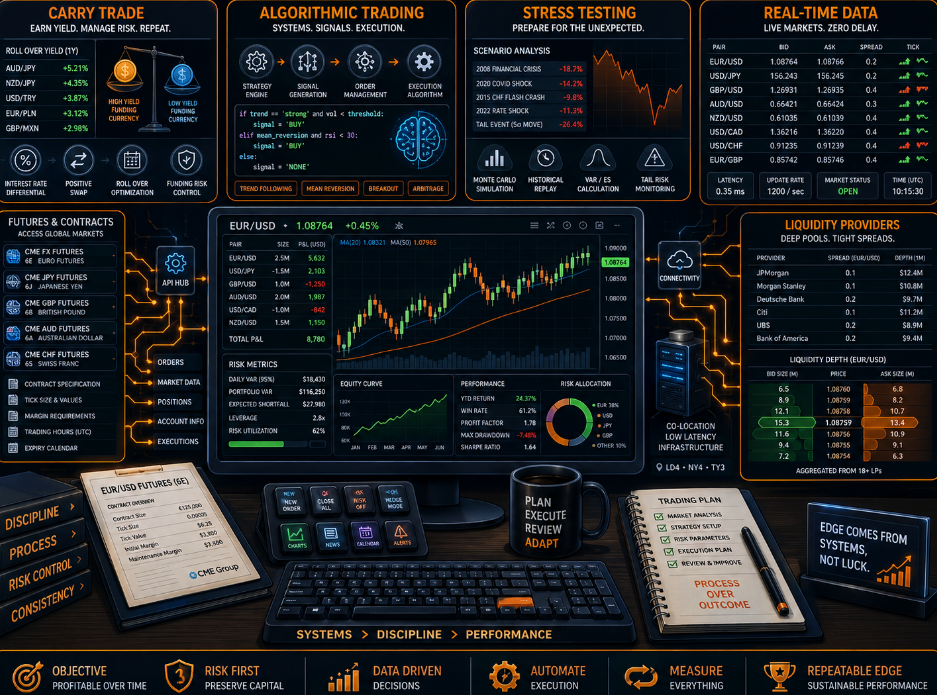
Forex Trading sounds flashy, but real performance comes from structure, patience, and smart execution. In today’s fast FX market, currency trading isn’t guesswork—it’s discipline plus data. Let’s break down what actually drives consistent results in forex, without the hype, just practical insight.
Shocking truth: How carry trade boosts currency futures profitability
Serious Forex Trading pros treat the carry trade as a calculated trading strategy, not a gamble.
Core idea
Borrow low-interest currency
Buy higher-yield currency
Capture rate differential through currency futures
Where it works best
Stable macro backdrop
Predictable central bank policy
Clear market analysis
Risk controls
Defined position sizing
Stop-loss aligned with volatility
Ongoing review of investment performance
The edge comes from pairing the yield pickup with structured exposure in a financial instrument like futures. In FX trading, profitability isn’t only price appreciation; it’s the rollover yield stacked over time.
Traders using EasyCashBackFx often combine cashback rebates with carry positioning, quietly increasing net profitability. In Forex Trading, small cost reductions add up fast.
Algorithmic trading mastery with low-latency connectivity and API integration
In modern Forex Trading, speed matters. Not hype-speed. Execution-speed.
Infrastructure foundation
Co-located servers near liquidity hubs
Direct API integration with brokers
Optimized low-latency connectivity
Strategy automation
Rule-based algorithmic trading models
Structured system development cycles
Backtesting with realistic slippage
Execution refinement
Smart routing for better market execution
Monitoring fill ratios
Automated error handling
Under the hood, trading technology defines who gets filled first and who pays extra spread. In fast-moving FX trading sessions—think NFP or rate decisions—milliseconds shape outcomes.
Many currency trading desks plug their systems into EasyCashBackFx-supported brokers, reducing transactional friction while keeping their automated trading stack intact. In Forex Trading, cost efficiency plus speed equals edge.
Stress testing strategies to conquer market risk in spot forex
If Forex Trading feels smooth, you probably haven’t tested it hard enough.
Here’s how disciplined traders approach stress testing in spot forex:
Scenario Layer One: Macro Shock
Central bank surprise
Inflation spike
Geopolitical escalation
Scenario Layer Two: Liquidity Compression
Widening spreads
Slippage expansion
Reduced liquidity providers depth
Scenario Layer Three: Portfolio Impact
Recalculated market risk
Updated financial modeling assumptions
Fresh scenario analysis
Multi-step execution keeps it practical:
Define exposure across pairs.
Model volatility spikes beyond historical averages.
Recompute drawdown tolerance.
Adjust risk per trade.
Risk management in FX trading isn’t fear-driven. It’s math-driven. Strong trading strategies survive abnormal days, not just calm sessions.
Forex Trading veterans review stress models monthly. Retail traders should too. That’s how currency trading shifts from emotional to professional.
Real-time feeds and predictive analytics for trend following success
Trend following in Forex Trading thrives on clean inputs and disciplined output.
Start with real-time data. Without accurate market data, even the best logic fails.
Then layer in:
Historical pattern mining
Volatility-adjusted filters
Structured data analysis
Now bring in predictive analytics. Not crystal-ball stuff—probability weighting based on prior market trends.
Inside a serious FX trading workflow:
Data ingestion
Tick feeds
Economic releases
Signal generation
Momentum thresholds
Breakout confirmation
Execution alignment
Spread check
Position scaling
This becomes a repeatable trading methodology. Small edges repeated often.
Some traders even sync their trend systems with broker accounts connected via EasyCashBackFx, quietly improving net returns while maintaining systematic discipline. In Forex Trading, execution and rebates can coexist.
Capitalizing on liquidity providers via non-deliverable forwards arbitrage
Arbitrage in Forex Trading isn’t random clicking—it’s structural awareness.
Focus area: non-deliverable forwards (NDFs).
Key moving parts:
Pricing across liquidity providers
Rate discrepancies in currency derivatives
Swap curve distortions
Nested opportunity map:
Interbank Level
Forward points mispricing
Temporary basis gaps
Prime Broker Layer
Margin impact differences
Credit line constraints
Retail Access Channel
Broker spread variation
Execution timing gaps
When price differences appear between NDF quotes and spot-adjusted forward rates, short-lived arbitrage windows open. In efficient financial markets, these don’t last long.
Sharp traders monitor cross-venue pricing feeds, act fast, and size positions conservatively. FX trading profits here are slim per trade but scalable.
Forex Trading at a high level means understanding how market efficiency tightens spreads—and spotting the rare moments when it slips.
4 Traits Every Top Forex Trader Shares
Forex Trading looks flashy on social media, yet real success in the forex market comes down to habits. In currency trading and FX trading, consistency beats hype. The best in Forex Trading share traits that quietly shape long-term gains.
Unwavering Discipline in Carry Trade Execution
In Forex Trading, Discipline sits at the core of every Carry Trade.
Core mindset
Respect Trading Rules even when the market tempts shortcuts.
Maintain strict Strategy Adherence during volatile sessions.
Execution control
Apply structured Risk Management before entering any Trade Execution.
Monitor swap rates and rate spreads with steady Consistency.
Emotional balance
Practice Patience while positions mature.
Avoid overtrading in fast FX trading cycles.
Seasoned traders in Forex Trading treat carry setups like routines, not gambles. EasyCashBackFx supports that discipline by helping traders optimize transaction costs in the forex market.
Insatiable Curiosity for News Sentiment and Economic Indicators
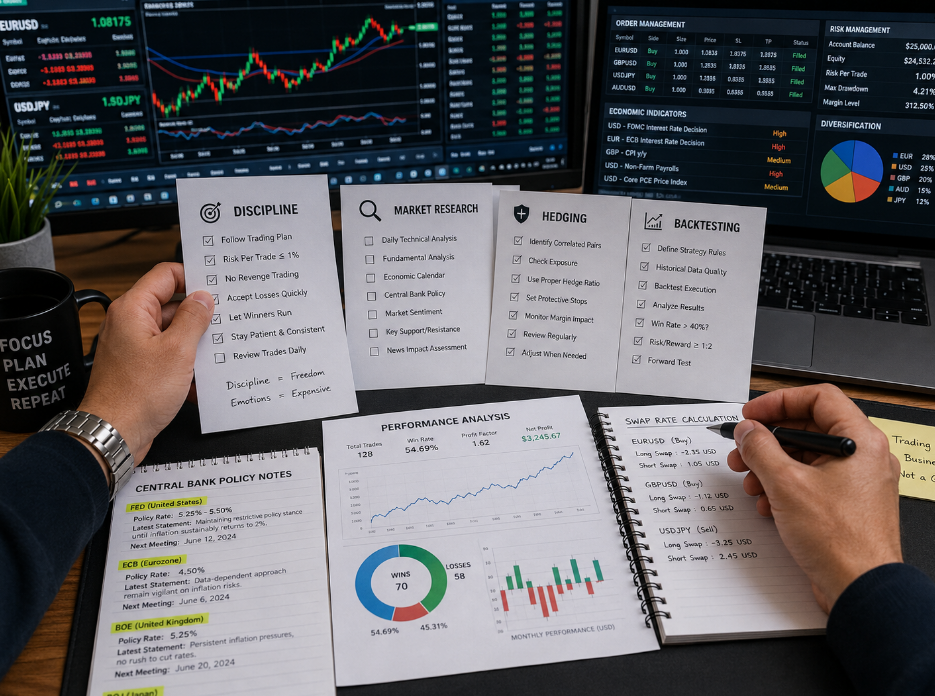
Great currency trading minds stay curious.
Track Economic Data releases and key Indicators.
Study Central Bank Policies and major Geopolitical Events.
Then connect the dots through:
News Analysis
Reading Market Sentiment
Applying Fundamental Analysis
This habit turns raw Market Research into sharper Forex Trading decisions.
Robust Hedging Strategies for Credit and Liquidity Risk
Smart Forex Trading is not just about entries; it’s about protection.
Risk layer one
Identify Credit Risk exposure per broker and counterparty.
Monitor Liquidity Risk during thin sessions.
Risk layer two
Deploy Derivatives and other Financial Instruments.
Use structured Hedging for active Risk Mitigation.
Portfolio layer
Apply Diversification across pairs.
Focus on steady Portfolio Protection.
EasyCashBackFx complements this by improving net returns while traders manage exposure in FX trading.
Proficiency with Order Management Systems and Backtesting Software
In modern Forex Trading, tech skills matter.
Infrastructure
Master Trading Platforms and advanced Order Management tools.
Strategy testing
Run detailed Backtesting with clean Data Analysis.
Review Performance Analysis metrics honestly.
Automation
Integrate Algorithmic Trading and Trade Automation carefully.
Strengthen overall Software Proficiency for smoother execution.
Forex Trading rewards those who blend skill, curiosity, and systems. With support tools like EasyCashBackFx, traders in the forex market can keep costs tight while refining their edge in Forex Trading.
Why Top Forex Traders Use Advanced Analytics
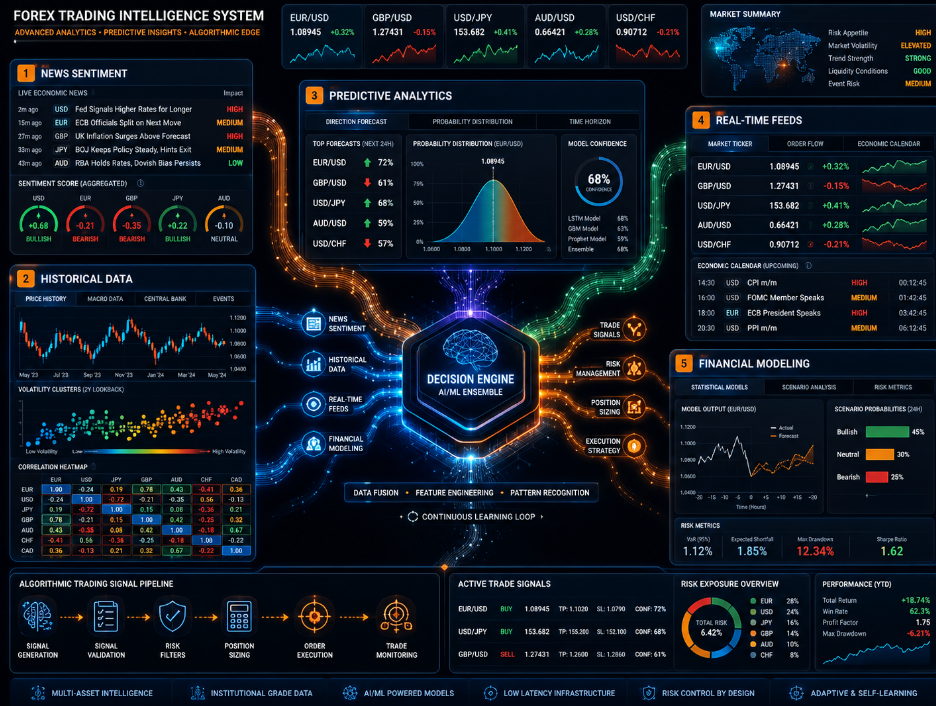
Smart traders know Forex Trading isn’t just charts and gut feeling. The edge today comes from data, speed, and smart interpretation. In Forex trading, every tick tells a story. From retail currency trading desks to institutional FX trading floors, analytics shapes decisions. If you're serious about foreign exchange trading, this is where the game changes.
1 Reason: News sentiment analysis transforms currency pairs forecasting
In active Forex Trading, price often reacts before charts catch up. That’s where news sentiment and advanced sentiment analysis tools step in.
Core Inputs Driving Sentiment Models
Inflation reports
Employment data
Economic news releases
Financial news headlines
Central bank speeches
Analytical Processing Layer
Natural language scoring of market sentiment
Real-time tagging of bullish or bearish tone
Correlation mapping to major currency pairs
Forecasting Impact on Forex Trading
Short-term forex forecasting adjustments
Volatility projections
Risk recalibration in FX trading portfolios
BIS survey data shows that global FX turnover can expand sharply during periods of elevated volatility and institutional hedging demand, reinforcing why serious traders track sentiment, liquidity, and macro catalysts together.
Retail traders using EasyCashBackFx can align their Forex trading setups with these shifts, capturing rebates while reacting faster to shifting market sentiment.
The hidden edge of historical data and predictive analytics
Behind steady profits in Forex Trading sits serious historical data crunching. Clean market data feeds allow deep data analysis, and that’s where patterns show up.
• Trend analysis highlights long-term bias in currency trading.
• Statistical models reveal mean reversion zones.
• Repeated data patterns expose volatility clusters.
Here’s how advanced FX trading desks approach it:
Collect multi-year tick-level market data.
Apply predictive analytics for probability mapping.
Stress-test models against past shocks.
Short bursts of insight follow.
Volatility spikes repeat.
Correlations shift.
Liquidity dries up before big moves.
Smart Forex trading pros don’t guess. They test. They refine. They repeat.
With EasyCashBackFx, active traders running data-driven Forex Trading strategies reduce cost drag, which compounds over hundreds of trades.
Quantitative strategies powered by real-time feeds and financial modeling
Modern Forex Trading runs on code as much as conviction. Clean real-time data from institutional market feeds feeds directly into structured financial modeling engines.
Infrastructure Layer
Low-latency data feeds
Direct ECN access
Automated execution bridges
Strategy Core
Entry logic refinement
Position sizing calibration
Risk-per-trade automation
Algorithmic rules within algorithmic trading systems
Backtested trading models
Continuous strategy development cycles
Performance Loop in Forex Trading
Monitor slippage
Adjust model sensitivity
Optimize based on fresh real-time data
In fast-moving foreign exchange trading, milliseconds matter. Quantitative FX trading strategies react instantly to order book shifts and liquidity gaps.
Pairing these approaches with EasyCashBackFx helps serious Forex trading participants keep transaction costs lean while scaling systematic exposure across multiple currency pairs.
That’s how advanced analytics quietly separates casual traders from consistent performers in Forex Trading.
Individual Vs. Institutional Forex Trading Titans
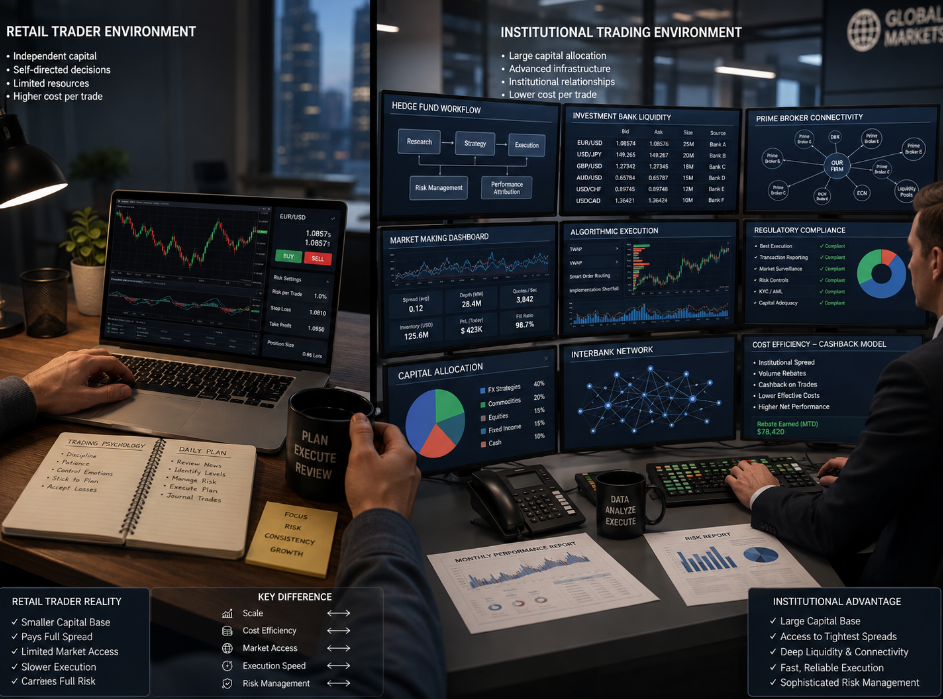
Forex Trading looks flashy from the outside, but the game shifts fast depending on who’s placing the trade. In the foreign exchange market, retail currency trading feels personal, while institutional currency trading runs on scale, systems, and serious capital.
Individual
In Forex Trading, the Retail trader stands alone, running on Personal capital and instinct shaped by wins and losses.
Core profile
Identity: Self-directed operator
Capital base: savings, side income
Focus: short-term currency trading swings
Skill stack
Market analysis through charts and news
Strategy development tested on demo accounts
Risk management to survive volatility
Psychological layer
Trading psychology decides discipline or tilt
Small spreads matter a lot
Execution speed can make or break a setup
Forex trading at this level feels hands-on. You click, you manage, you own the outcome. Tools like cashback models from EasyCashBackFx can trim transaction costs, which helps when margins are tight in active Forex Trading.
Institutional
Institutional Forex Trading moves differently.
Key players:
Hedge fund
Investment bank
Fund manager desks
Capital scale: Large capital pools
Operations: Proprietary trading, Algorithmic trading, Market making
Oversight: strict Regulatory compliance
Global FX turnover reached about $9.6 trillion per day in April 2025, according to the BIS Triennial Central Bank Survey.
Here, foreign exchange trading flows through prime brokers and interbank networks. A hedge fund may deploy algorithms within milliseconds. An investment bank manages liquidity across continents. Compared to a solo retail trader, institutional desks treat Forex Trading as infrastructure, not a side hustle.
For individuals aiming to stay competitive in currency trading, cost efficiency and disciplined execution matter—this is where platforms aligned with EasyCashBackFx quietly support long-term performance.
References
[OTC foreign exchange turnover in April 2025 - https://www.bis.org/statistics/rpfx25_fx.htm]
[OTC foreign exchange turnover in April 2022 - https://www.bis.org/statistics/rpfx22_fx.htm]
[Global currency trading closing in on $10 trillion a day - https://www.reuters.com/business/finance/global-currency-trading-closing-10-trillion-day-2025-09-30/]
[George Soros and Black Wednesday: How He Broke the Bank of England - https://www.investopedia.com/ask/answers/08/george-soros-bank-of-england.asp]
[Historically Famous Forex Traders - https://www.investopedia.com/articles/forex/100515/these-are-most-famous-forex-traders-ever.asp]
FAQ
How does carry trade influence profitability in large-scale Forex Trading operations?
Carry trade lives on the tension between interest rate spreads set by central banks.
Core mechanics: Traders buy higher-yield currency pairs and fund them through lower-yield ones, such as USD/JPY. Profit may come from rollover through spot forex, forward contracts, or FX swaps market exposure.
Institutional layer: Hedge funds and institutional investors often hedge with currency options or cross currency swaps, while Value at Risk models track market risk during rate shocks.
Execution discipline: Algorithmic trading plugged into order management systems helps control execution, while continuous stress testing prepares positions for sudden policy moves.
Profit flows slowly—until volatility tests conviction.
What technologies strengthen institutional Forex Trading infrastructure?
Speed and control decide who captures price and who chases it.
Low-latency connectivity and co-location services reduce delay between trading platforms and ECNs.
API integration links execution management systems with prime brokerage accounts.
Real-time feeds from liquidity providers refine pricing across the interbank market.
| Component | Purpose | Impact |
|---|---|---|
| Backtesting software | Analyze historical data | Sharper quantitative strategies |
| Market data engines | Stream economic indicators | Faster trend following |
| Reporting systems | Meet financial regulations | Proof of best execution |
Infrastructure shapes confidence; confidence shapes size.
Why is stress testing critical before deploying significant capital?
Capital attracts pressure. Stress testing prepares traders for it.
It simulates central bank shocks and liquidity risk freezes.
It measures credit risk across non-deliverable forwards and currency futures.
It tests operational risk within multilateral trading facilities.
Nested risk view: Market risk creates volatility spikes, liquidity risk creates thin order books, and counterparty exposure links portfolios to prime brokers and commercial banks.
When volatility surges, preparation decides survival.
How do liquidity providers impact pricing for large-volume FX executions?
Pricing is a negotiation between urgency and depth.
Liquidity providers stream quotes into ECNs and the interbank market.
High-frequency traders scan spreads for arbitrage windows.
Prime brokers aggregate flows from hedge funds and institutional investors.
In calm sessions, aggregated books can tighten spreads. During shocks, gaps widen across currency pairs.
Execution quality depends on best execution standards and market surveillance controls.
Behind every large ticket in spot forex or currency options lies a silent contest for milliseconds.