

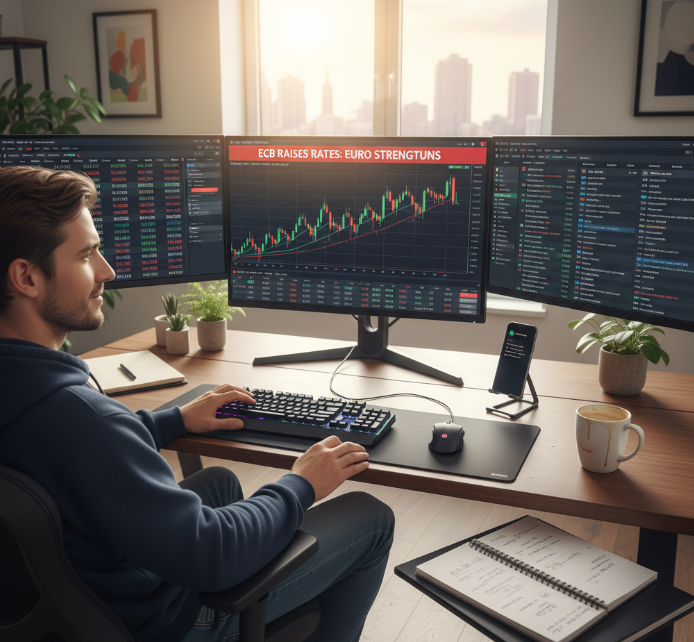
Every morning, the forex market hums to life like a high-stakes engine. Currencies rise and fall, driven by central bank moves, geopolitical surprises, and millions of traders reacting in real time. With over $7 trillion traded daily (BIS Triennial Survey), it’s not hype—it’s velocity.
You don’t need a finance degree or a yacht named “Liquidity”—just curiosity, grit, and the right tools. Plenty of people blow up their accounts not because forex is impossible, but because they enter the race without a map or a seatbelt—sometimes with the wrong broker, bad habits, or no risk plan at all.
Retail traders now represent a significant share of spot forex volume, with multiple industry reports highlighting steady growth in online retail FX participation. That means you're far from alone—and the big sharks are watching.
This guide? It’s your pit crew—cutting through jargon, walking you through the forex trading basics, and giving you a step-by-step map of day trading the forex market without burning rubber or blowing up your budget before lunch hits.
Key Requirements for Successful Forex Day Trading
Before you worry about entry signals or candlestick patterns, make sure your foundation isn’t made of sand. These are the non-negotiables for anyone who wants to day trade forex seriously in 2026:
Adequate Risk Capital: Only use money you can afford to lose. This doesn’t mean you expect to lose it, but day trading involves drawdowns and losing streaks. Rent money, tuition, and emergency funds are off-limits.
Regulated Broker: Choose a broker regulated by a reputable authority (FCA, ASIC, CySEC, etc.). Look for transparent spreads, no hidden fees, reliable execution, and fast withdrawals.
Robust Trading Plan: Your trading plan should define:
Which pairs you trade
What sessions you trade (e.g., London, New York)
Your setups (price action, patterns, indicators)
Risk per trade and daily loss limit
Risk Management Discipline: Apply practical risk management practices such as stop loss, take profit, and position sizing to safeguard your capital.
Essential Tools: Utilize advanced trading platforms like MT4/MT5, reliable charting software, and familiarize yourself with key technical indicators to enhance your trading strategy.
Chart Reading Skills: Learn to interpret candlestick patterns, chart structures, Fibonacci retracement, and moving averages to make informed trading decisions.
The Role of Technology: Embrace automated trading systems to execute trades efficiently, minimize emotional trading, and maintain consistency in strategy application.
Before you move on, consider bookmarking forex tools online like profit, margin, and rebate calculators to speed up your day-to-day decision-making.
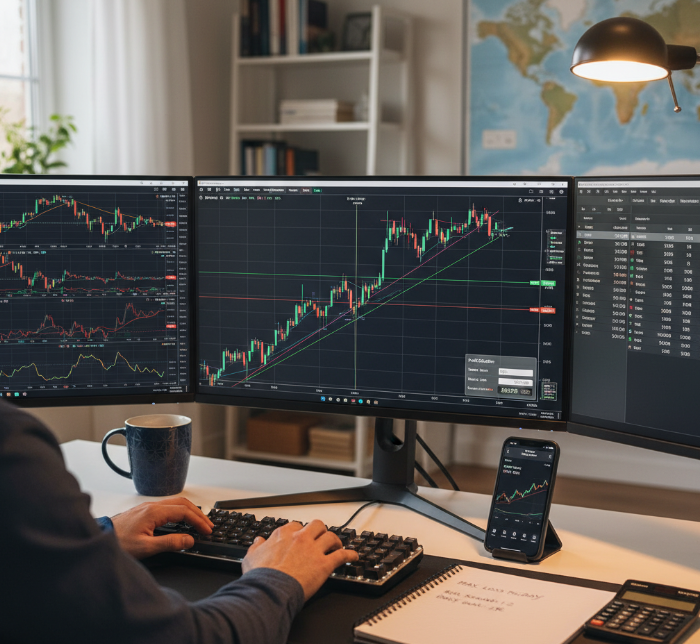
Introduction to Day Trading in the Forex Market
A quick dive into how day trading forex actually works—and why timeframes matter.
What Is Forex Day Trading?
Forex day trading means opening and closing trades within the same trading day, typically based on short-term price movements. You’re not holding positions for weeks or months—you’re aiming to capture intraday swings over minutes to hours.
Key characteristics of forex day trading:
Positions are usually closed before the daily session ends (no overnight swap risk).
Decisions rely heavily on intraday charts: M1, M5, M15, M30, H1, sometimes H4.
Success is rooted in a repeatable edge, not one-off “lucky” trades.
Spot Market vs Derivatives
Most retail day traders operate in the spot forex market, where currencies are traded at current market prices, even if settlement is technically T+2. Some brokers package exposure through CFDs, but your focus is still on spot movements.
Derivatives like futures and options exist, but for most beginners, sticking to spot pairs (EUR/USD, GBP/USD, USD/JPY, etc.) keeps things simpler and spreads tighter.
Understanding How Forex Prices Move
To trade forex intraday, you need to understand what pushes price around.
Major vs Minor vs Exotic Pairs
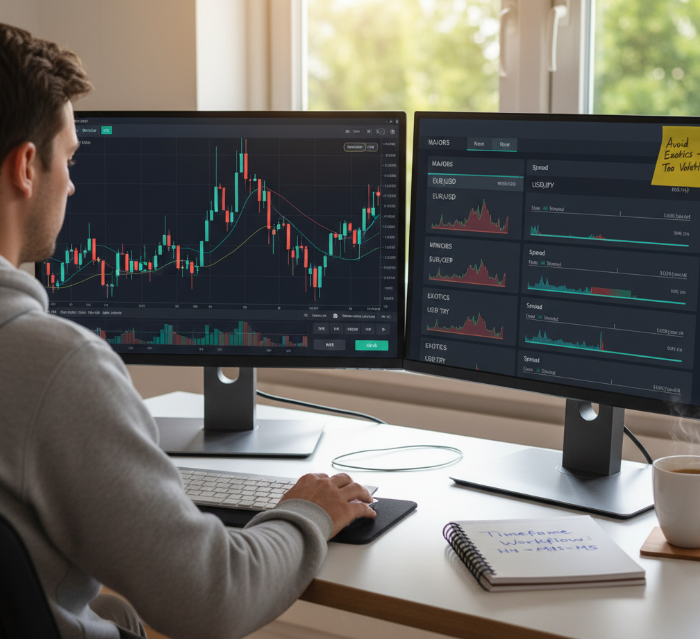
Major pairs (e.g., EUR/USD, GBP/USD, USD/JPY, USD/CHF, AUD/USD, USD/CAD) are heavily traded, usually tighter in spread, and highly liquid.
Minors and crosses (e.g., EUR/GBP, EUR/AUD, GBP/JPY) have decent liquidity but may show more volatility and wider spreads.
Exotics (e.g., USD/TRY, USD/ZAR, EUR/TRY) can look tempting with big swings, but they often come with:
Wider spreads
Slippage
More aggressive spikes around news
For beginners, stick mostly to majors and a few liquid crosses.
Why Timeframes Matter
Day trading is about balance: too low a timeframe, and you drown in noise; too high, and you miss intraday opportunities.
Common intraday charts:
M1 & M5: Good for scalpers, but noisy. You’ll see lots of fakeouts.
M15 & M30: Great for spotting structure and intraday swings.
H1 & H4: Used for higher-timeframe trend direction and key levels, even by day traders who enter on lower charts.
Many day traders build a multi-timeframe workflow:
H4/H1 → identify trend and major levels
M15/M30 → look for setups (patterns, breakouts, pullbacks)
M5 → refine entries and exits
Core Concepts: Pips, Lots, Leverage, Margin, Spread & Commission
You can’t manage risk if you don’t know this vocabulary cold.
What Is a Pip?
A pip is usually the 4th decimal place in most currency pairs (0.0001), or the 2nd decimal for JPY pairs (0.01).
If EUR/USD moves from 1.1000 to 1.1015, that’s a 15-pip move.
Lots & Position Size
Position size is how large your trade is:
| Lot Size | Units of Base Currency | Typical Pip Value (on EUR/USD) |
|---|---|---|
| Standard | 100,000 | ~$10 per pip |
| Mini | 10,000 | ~$1 per pip |
| Micro | 1,000 | ~$0.10 per pip |
Position size must be calculated to fit your risk per trade.
Leverage & Margin
Leverage lets you control a larger position with less capital.
If you have 1:30 leverage, you can control $30,000 with $1,000 margin.
If you have 1:100 leverage, $1,000 lets you control $100,000.
But:
Higher leverage magnifies both profits and losses.
You should ignore the maximum leverage your broker offers when calculating position size and think in terms of risk per trade instead.
Spread & Commission
Spread: difference between the bid and ask price.
Commission: some brokers charge a fixed fee per lot traded alongside tight spreads.
For day trading, spreads and commissions are crucial: small scalps can be eaten alive by costs. You want:
Tight spreads on your main pairs
Transparent commission structure
No hidden markups
Essential Tools & Platforms for Forex Day Trading
Your platform is your cockpit. It needs to be fast, stable, and flexible.
Popular Trading Platforms
MetaTrader 4 (MT4): Still widely used thanks to its simplicity and massive library of indicators and expert advisors (EAs).
MetaTrader 5 (MT5): Supports more timeframes, more order types, and often deeper market integration.
cTrader, TradingView, NinjaTrader: Alternative platforms known for advanced charting, DOM tools, and scripting flexibility.
Recent platform data from Finance Magnates shows that MetaTrader 4 (MT4) has historically held a majority share of retail forex trading volume, though MetaTrader 5 (MT5) has been rapidly catching up since 2023.
Order Types You Must Know
Market Order: Executes immediately at current price.
Limit Order: Executes at a specified price or better (buy limit below market, sell limit above).
Stop Order: Triggers once price hits a specified level (breakout entries).
Stop Loss: An order that closes a trade at a certain loss to prevent further damage.
Take Profit: Automatically closes a trade once price hits your target.
Risk Management Strategies for Forex Day Trading
Smart traders know that keeping your money safe is just as important as making more of it. Here's how to structure risk intelligently.
1. Risk Per Trade
A common guideline: risk 1–2% of your account per trade.
At 1%, a losing streak of 10 trades draws down ~9.6% (manageable).
At 5%, the same losing streak crashes you by over 40% (psychologically brutal).
The goal is to keep drawdowns survivable—emotionally and mathematically.
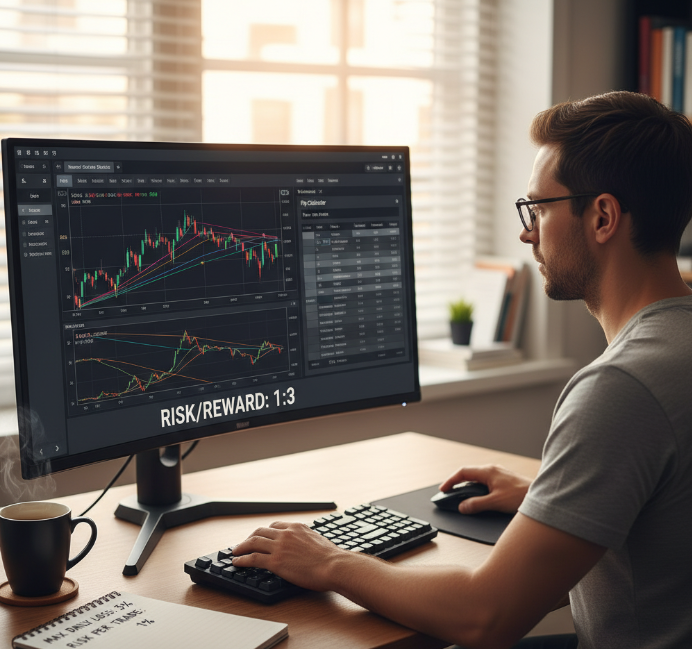
2. Risk-Reward Ratio
The risk-reward ratio tells you whether a setup is worth taking (e.g., risking $10 to make $30 = 1:3).
Examples:
Risk 20 pips, target 40 pips → 1:2 RR
Risk 15 pips, target 45 pips → 1:3 RR
Even with a win rate of only 40%, a consistent 1:2 or better RR can make you profitable.
3. Position Sizing Formula
A simple formula to calculate position size:
Position Size = (Account Balance × Risk %) ÷ Stop Loss (in pips).
You can use a forex profit calculator or a simple spreadsheet to double-check these numbers before each trade.
Let’s say you’ve got $10,000 and want to risk 1%. That’s $100 max loss per trade.
If your stop loss is 20 pips, each pip can be worth $5 ($100 ÷ 20).
On EUR/USD, that’s roughly a 0.50 lot position.
If your stop loss is 50 pips, each pip can be worth $2 → ~0.20 lot.
Keeping position size aligned with your equity ensures consistent risk control while day trading forex, even when markets throw curveballs.
4. Max Daily Loss
Set a daily loss limit (e.g., 3–4% of equity). Once hit, stop trading for the day.
This protects you from:
Revenge trading
Emotional overtrading
Digging a big hole on a bad day
Building a Forex Day Trading Strategy (Step-by-Step)
You don’t need a thousand indicators. You need one logical edge that you can repeat.
Step 1: Define Your Trading Sessions
Markets behave differently depending on the session:
Tokyo (Asian): Often quieter, tighter ranges, good for range-bound strategies.
London: High liquidity, big moves, frequent breakouts.
New York: Strong continuation from London, overlaps create volatility.
Pick 1–2 sessions that fit your schedule. For many traders, London + early New York offers the best mix of movement and liquidity.
Step 2: Choose Your Pairs
Select 2–4 main pairs to specialize in, such as:
EUR/USD
GBP/USD
USD/JPY
XAU/USD (Gold vs USD, if you’re comfortable with higher volatility)
Knowing how your chosen pairs behave around news, sessions, and technical levels is a hidden advantage.
Step 3: Mark Key Support & Resistance
Start each day by marking:
Daily and H4 swing highs and lows
Round numbers (1.0900, 1.1000, etc.)
Prior day’s high/low and session highs/lows
These levels often act as:
Reaction zones
Targets
Areas where fakeouts and traps occur
Candlestick Patterns & Market Structure
Price action isn’t about memorizing 200 patterns; it’s about understanding context.
Important Candlestick Signals for Day Traders
Bullish engulfing near support → potential long setup.
Bearish engulfing near resistance → potential short setup.
Pin bars (long wick, small body) → rejection of price at a level.
Doji candles → indecision; often precede breakouts or reversals when combined with other signals.
These signals are powerful when they occur at pre-marked support/resistance or Fibonacci levels, not randomly in the middle of nowhere.
Chart Patterns You Should Know
Head and Shoulders formation:
Left shoulder, head, right shoulder
Usually signals a reversal from bullish to bearish when neckline breaks
double top:
Price tests a resistance level twice and fails
Often indicates bearish reversal if neckline is broken
double bottom:
Price tests a support level twice and holds
Often indicates bullish reversal after breakout
Combine these with candlestick confirmation and volume where available.
Using Indicators Intelligently (MACD, RSI, Moving Averages)
Indicators are tools—not crystal balls. Use them to confirm your read, not replace it.
Trend & Momentum Indicators
You don’t need a mess of indicators crowding your screen. Just two solid ones can do wonders when you're out there grinding through charts every day:
The MACD shows when momentum is shifting—great for spotting when trends are about to flip.
The trusty old RSI helps you see overbought/oversold conditions and divergence (when price makes a new high but RSI doesn’t).
Moving Averages for Structure
Common moving averages for day trading:
EMA 9/20: Short-term trend and dynamic support/resistance.
EMA 50/100: Intraday trend anchors.
SMA 200: Big-picture line in the sand; price above = bullish bias, below = bearish bias (on that timeframe).
Many traders use combinations like the EMA(9) crossing above EMA(20) for bullish momentum or price retesting EMA(20) in a trend as a pullback entry area.
Indicator Combos
Mixing tools gives better clarity than relying on one method alone:
Use candlestick signals near key Fibonacci levels for high-probability entries.
Confirm double tops/bottoms with volume spikes or RSI divergence before pulling triggers.
Overlay moving averages to see if you’re trading with the broader trend or against it.
“Many active traders combine MACD and RSI to refine entries and exits; broker analytics generally show that using multiple confirming signals can improve consistency when paired with disciplined risk management.”
Trading With Volatility (And Not Getting Destroyed by It)
Volatility is your paycheck—but unmanaged, it’s also your margin call.
What Drives Volatility in Forex?
Central bank rate decisions (Fed, ECB, BoE, BoJ)
Inflation data (CPI)
Labor data (non-farm payrolls)
Geopolitical events (wars, elections, unexpected headlines)
Volatility around major economic releases like CPI, non-farm payrolls (NFP), and central bank rate decisions often spikes sharply across major pairs—a reminder that speed can kill if you’re unprepared.
Strategies for Trading in a Volatile Market
Widen Stops Slightly, Reduce Size
Instead of a 10-pip stop on EUR/USD, you might go 20 pips with half the lot size. That gives the trade breathing room without raising your dollar risk.Avoid Entering Right on News Release
The first seconds after major news can be chaos: slippage, spread spikes, and fake moves. Let the dust settle for a few minutes unless you’re experienced with news straddles.Use Limit Orders for Precision
During volatile periods, using limit orders at pre-planned levels can prevent emotional chasing at poor prices.Respect Circuit Breakers
Have a daily max loss in place. If volatility blows through your plan, step aside. There will always be another day to trade—there is never another account if you blow this one.
While you're actively trading forex intraday, don’t just react to volatility—adapt fast or step aside entirely until things cool down again.
And remember, platforms like EasyCashbackFX offer forex cashback on every trade—even during wild swings—which can soften drawdowns over time without altering strategy fundamentals.
How to Use Fibonacci Retracements in Day Trading
Fibonacci retracement tools help you identify logical pullback zones within a trend.
Using Fibonacci Retracement Levels for Trade Entries
Fibonacci levels help traders pinpoint where price might bounce or reverse during pullbacks. Here's how they fit into your strategy:
Identify the swing high and low of a recent move.
Plot Fibonacci retracement from top to bottom in downtrends or vice versa.
Look out for reactions near key levels like 38.2%, 50%, and 61.8%—these often become battlefields between buyers and sellers.
Combining Fibonacci With Price Action
Fibonacci works best when it aligns with:
Prior support/resistance
Moving averages
Candlestick confirmation
Example workflow:
Trend is up on H1.
On M15, price pulls back to the 50% retracement.
That area lines up with a prior resistance turned support.
A bullish engulfing candle forms at that level.
Now you’re not just taking a random Fibonacci level—you’re stacking confluences.
From Theory to Execution: A Sample Day Trading Playbook
Here’s how all of this can come together in practice:
Pre-Market Prep
Check the day’s main economic events.
Mark key H4/H1 support and resistance levels.
Identify trending vs ranging pairs.
Session Open (London or New York)
Watch how price reacts to marked levels.
Note where liquidity grabs (fakeouts) may be happening above/below obvious highs/lows.
Setup Identification
Break-and-retest at key levels
Candlestick confirmation (engulfing, pin bar)
Confluence with moving averages and Fibonacci levels
Look for:
Entry & Risk Management
Enter on candle close or limit order at retest.
Place stop loss beyond structure (not randomly).
Set a realistic take profit (1:2 or better RR).
Trade Management
Consider moving stop to breakeven once price reaches 1R.
Avoid micro-managing every pip; let the plan play out.
Don’t add to losers—scale into winners only if it fits your strategy.
Post-Session Review
Why you entered
Whether you followed your plan
Emotions felt during trade
Screenshot key trades.
Record:
Adjust rules only based on a sample of trades, not one outcome.
Practice Makes Perfect With Live Charts
Learning theory only gets you halfway there—the real magic happens when you apply this stuff live:
Start by marking support/resistance manually each morning before London.
Watch how price reacts at those zones across pairs like EUR/USD or USD/JPY.
Then test everything you've learned—from candlesticks to chart patterns and Fibonacci levels—until reading charts feels as natural as checking your phone screen each morning.
The Role of Technology in Modern Forex Trading
New tools are giving traders sharper edges and faster reactions in the fast-moving world of forex. That includes better charting platforms, mobile order management, and integrated resources like an economic calendar to flag high-impact news before it hits your positions.
How TradingView Transforms Your Analytical Approach
TradingView isn’t just pretty charts—it’s:
Browser-based, syncs across devices, lightning-fast, and doesn't need clunky installations.
Its advanced charting tools support dozens of timeframes, custom indicators, and one-click strategy backtesting.
Alerts can notify you when price reaches key levels, so you’re not chained to the screen for every pip during their sessions of day trading the forex market.
Automation, Alerts, and Scripting
Use alerts for level breaks, indicator crosses, or candlestick patterns.
Consider semi-automation: scripts or EAs to execute parts of your plan while you oversee risk and context.
Never fully automate a strategy you don’t understand—automation magnifies both good and bad logic.
Bringing It All Together
Day trading forex in 2026 isn’t about predicting every tick; it’s about stacking small edges:
Understanding sessions and volatility
Respecting risk and position sizing
Reading price action at key levels
Using indicators like MACD and RSI intelligently
Leveraging tools, platforms, and resources (including cashback programs) to reduce friction and cost
You will have losing days and losing streaks. That’s not failure—it’s data. The difference between gamblers and traders is that traders measure, adapt, and survive long enough for their edge to play out.
Stay curious, stay disciplined, and treat every trading day as a chance to refine your process—not to “prove you’re right” to the market.
References
BIS Triennial Central Bank Survey 2022 – Foreign Exchange Turnover - https://www.bis.org/press/p221027.htm
Relative Strength Index (RSI): Definition, Calculation and Uses – FOREX.com - https://www.forex.com/en/market-analysis/latest-research/relative-strength-index-rsi/
What Is MACD? Trading with the MACD Indicator – FOREX.com - https://www.forex.com/en/market-analysis/latest-research/what-is-macd/
How to Trade the Head and Shoulders Pattern – Investopedia - https://www.investopedia.com/articles/technical/121201.asp
Double Top and Bottom Patterns: Definition and Trading – Investopedia - https://www.investopedia.com/terms/d/double-top-and-bottom.asp
Fibonacci Retracement Definition – Investopedia - https://www.investopedia.com/terms/f/fibonacciretracement.asp
Understanding the Risk/Reward Ratio – Investopedia - https://www.investopedia.com/terms/r/riskrewardratio.asp
FAQ
What is day trading the forex market and why do traders gravitate toward it?
Day trading in currencies means entering and exiting positions within one session—EUR/USD’s tight spreads or GBP/JPY’s electrifying swings tempt those hunting quick outcomes. The appeal lies in feeling the pulse of a volatile market, making decisions as prices dance intraday.
Which currency pairs offer the most action for day traders?
EUR/USD: Fast execution with minimal spread friction
GBP/JPY: Bold movements that reward confident timing
USD/JPY: Predictable flows suited for trend following rhythms
Each pair carries its own heartbeat, shaping strategy choice from Scalping bursts to Breakout Trading surges.
How can reading market conditions sharpen trade timing?
Spotting a Trending Market invites Trend Following; catching a Ranging Market points to Range Trading near support/resistance lines. In a Volatile Market like AUD/USD during news hours, patience mixed with precise MACD or RSI cues makes all the difference between riding momentum or being caught off guard.
Why are technical indicators such vital companions on fast charts?
MACD unveils momentum shifts before price fully commits; RSI whispers of overbought drama or oversold fatigue; Moving Averages smooth chaos into recognizable paths. Traders in USD/CAD might stitch these signals together, confirming setups around Double Tops or Fibonacci Retracements while avoiding false entries when Bollinger Bands pinch before breakout release.
What risk controls preserve capital amid unpredictable moves?
The discipline lies in:
Setting Stop Loss just beyond Head and Shoulders warning lines
Using Take Profit where Flags and Pennants lose steam
Adjusting Position Sizing so one misstep doesn’t wipe confidence
Balancing Risk Reward Ratio ensures survival through both Sideways Markets and wild surges when cTrader pings your orders across MetaTrader 4 screens faster than hesitation can take hold.