


Cashback forex sounds like free money, but the catch sneaks in through spreads, slippage, and fees that quietly eat your edge.
High-volume traders know the game isn’t about flashy rebates; it’s about what’s left after execution, latency, and infrastructure costs take their cut.
In 2025 materials, EasyCashBackFx engineering and execution teams stress that savings come from tighter pricing models and verified payout systems aligned with institutional standards.
Cashback Forex Key Takeaways
Compare average spreads and volume rebates to gauge net trading costs across execution venues.
Map tiered commission structures against institutional volumes to unlock optimal spread discounts and rebates.
Factor in liquidity aggregation fees and execution latency (ECN/STP) when calculating true rebate value.
Verify rebate statements via FIX API data feeds and broker reporting to ensure accuracy and compliance.
Balance instant withdrawal options against delayed payout terms to optimize cash flow and capital allocation.
5 Key Metrics For Cashback Forex Programs
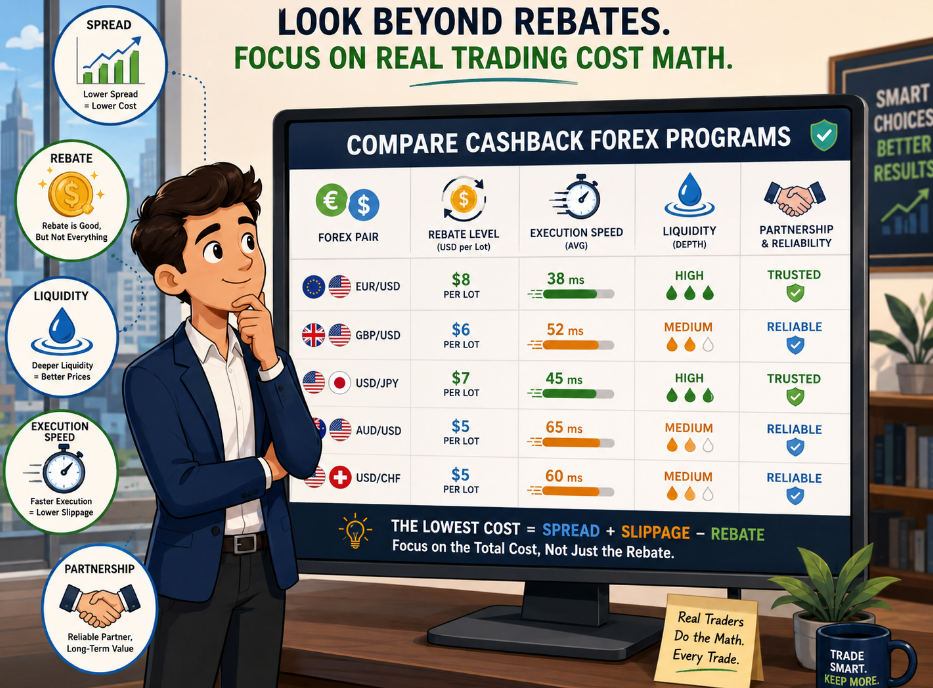
Cashback forex sounds simple—trade, earn rebates, cut costs. But real gains come from reading the fine print. Below are the metrics that separate average forex cashback offers from serious, cost-efficient cashback forex programs.
Average Spread Relative to Volume Rebates
When judging Average Spread against Volume Rebates, focus on net Trading Cost, not headline promises. A tight Spread Comparison only matters if the Rebate Structure offsets commission drag across Volume Tiers.
Check EUR/USD average spread
Compare rebate per lot
Calculate net cost after rebate
Sample Net Cost Model (Institutional Volume)
| Pair | Avg Spread (pips) | Commission ($/lot) | Volume Rebates ($/lot) | Net Cost ($/lot) |
|---|---|---|---|---|
| EUR/USD | 0.8 | 7 | 5 | 2 |
| GBP/USD | 1.1 | 7 | 5 | 3.5 |
| USD/JPY | 0.9 | 7 | 4.5 | 2.8 |
| AUD/USD | 1.0 | 7 | 4.8 | 3.2 |
| USD/CAD | 1.2 | 7 | 5 | 3.9 |
Measure raw spread.
Add commission.
Subtract rebate.
Review consistency across sessions.
Platforms like EasyCashBackFx highlight this clearly, making cashback forex evaluation less guesswork and more math.
Tiered Commission Thresholds and Volume Rebates
Commission Thresholds shape profitability fast. Higher Trading Volume should unlock better Rebate Levels without inflating Commission Rates.
Entry tier
Mid-tier
Institutional tier
Look at the Tiered Structure like this:
0–500 lots → base rebate
500–2000 lots → boosted incentive
2000+ lots → premium rebate
The smartest cashback forex setups align Incentive Program logic with scale. If costs rise faster than rebates, the forex cashback model breaks down. A good Program Benefit keeps margins steady even as trade frequency increases.
Liquidity Aggregation & Deep Liquidity Access
True Liquidity Aggregation impacts rebate-adjusted returns. Thin books widen spreads, killing the value of cash back forex rewards.
Key factors:
Depth of Order Book
Diversity of Liquidity Providers
Stability of Pricing Quality
Nested evaluation model:
Market Access
Interbank streams
Prime broker feeds
Execution Environment
Slippage control
Fill ratio
Deep Liquidity
Large ticket tolerance
News-event resilience
Strong Deep Liquidity protects the math behind cashback forex, especially for high-frequency systems.
Execution Speed: ECN/STP Latency Metrics
Slow fills eat rebates alive. Execution Speed and measurable Latency Metrics define real rebate value.
Multi-layer review:
Broker Type
ECN Broker routing
STP Broker processing
Infrastructure
Data center proximity
FIX API stability
Trade Handling
Order Execution time
Trade Processing consistency
Short bursts of delay during volatility can erase forex cashback gains. Tight Market Latency keeps the edge intact.
Quality of Partnership Programs & Revenue Share
Not all Partnership Programs are equal. A serious Revenue Share model supports transparency and long-term alignment.
Look for:
Clear Affiliate Structure
Real-time reporting
Consistent payout cycles
Then review deeper layers:
Partner Incentives
Volume-based upgrades
Bonus rebate campaigns
Broker Partnership
Dedicated manager
Audit-friendly statements
Referral Program
Tracking accuracy
Scalable payout terms
A mature cashback forex ecosystem feels stable, not promotional. EasyCashBackFx positions its Program Quality around clarity and steady rebate flows, which is exactly what active traders need when scaling forex cashback strategies.
5-Step Guide To Calculate Your True Rebate
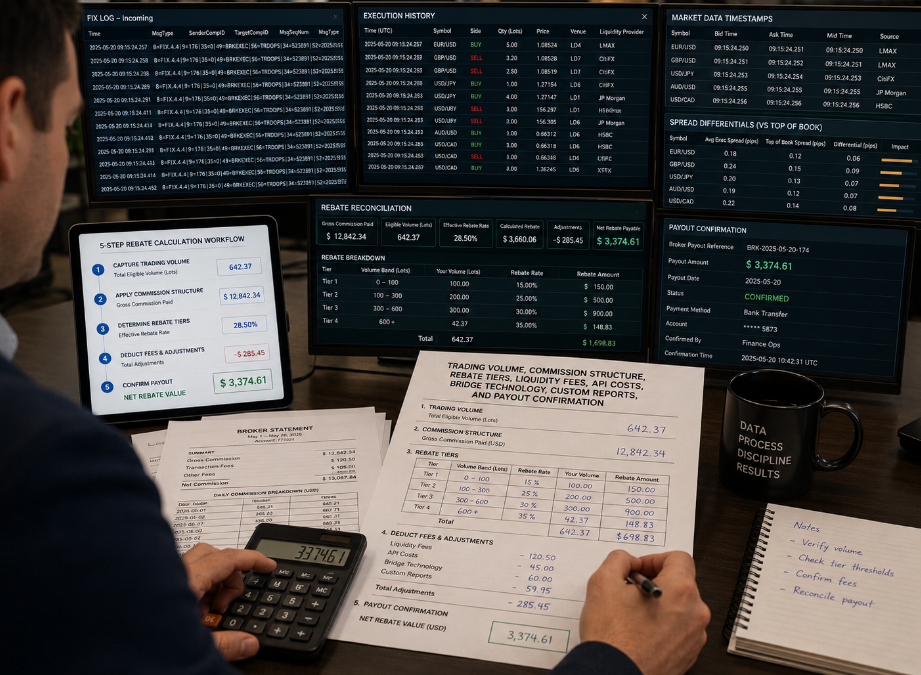
Getting the real math behind cashback forex isn’t just about glancing at a rebate rate. You need clean data, clear cost mapping, and solid reconciliation. When traders talk about forex cashback, cashback trading, or FX rebates, the goal is simple: keep more from every lot traded.
Step 1: Gather Institutional Trading Volume Data
Break your Trading volume down with precision.
Pull raw Execution data from platform analytics.
Cross-check Transaction flow against broker statements.
Separate Client activity by major, minor, and exotic pairs.
Then go deeper:
Extract FIX logs for institutional accounts.
Match Market data timestamps with filled orders.
Archive Historical records for quarterly comparison.
Accurate volume tracking drives accurate cashback forex projections. Miss a batch of trades, and your forex cashback math slips.
Step 2: Map Tiered Commissions and Spread Discounts
Your rebate depends on the broker’s Commission structure and Tiered pricing.
Review the Fee schedule.
Identify Rebate tiers.
Calculate Spread differentials per lot.
Nest it properly:
Volume Band
0–100 lots → standard Trading costs
100–500 lots → mid Discount levels
Institutional Tier
Custom commission
Extra spread discount
The BIS Triennial Central Bank Survey 2025 reported that OTC FX turnover reached $9.6 trillion per day in April 2025, up 28% from $7.5 trillion three years earlier.
This market scale directly affects cashback forex returns.
Step 3: Adjust for Liquidity Aggregation Fees
Net rebate equals gross rebate minus access costs.
Liquidity providers charge embedded markups.
Aggregation costs apply per million traded.
Order routing and Connectivity charges add friction.
Layer review:
Prime access
Execution fees
Market access surcharges
Data infrastructure
Premium Data feeds
Cross-connect fees
Your forex cashback only shines after these cuts.
Step 4: Factor in API Trading and Bridge Solutions Costs
Algorithmic desks must count infrastructure.
API integration expenses
Bridge technology licensing
Platform connectivity hosting
Under that umbrella:
Software solutions maintenance
System development updates
Ongoing Infrastructure expenses
Cashback trading without tech cost control? That’s wishful thinking.
Step 5: Verify Direct Cashback via Custom Reporting
Final check—always reconcile.
Compare expected Cashback payments with actual deposits.
Review Rebate statements line by line.
Confirm via Transaction audit tools.
Process flow:
Generate Custom reports
Match lot size vs payout
Complete Financial reconciliation
Secure Payout confirmation
Platforms like EasyCashBackFx streamline this with transparent dashboards, making cashback forex tracking less of a headache. Many traders using EasyCashBackFx rely on detailed reporting tools to confirm every cent of their forex cashback and FX rebates.
Spread Cost Vs. Rebate Value Comparison
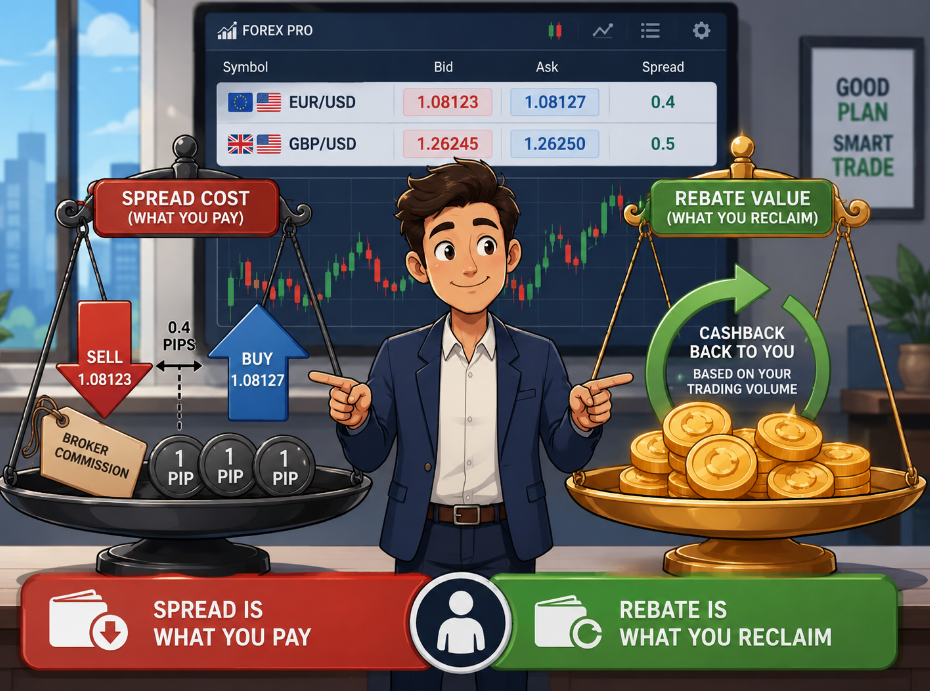
Forex traders often obsess over entry signals but ignore the silent profit killer: trading costs. In the cashback forex world, understanding how spreads eat into gains—and how rebates give some of it back—can shift your net outcome from average to impressive.
Spread Cost
The Bid-ask spread is the visible gap between buy and sell prices. That gap is your instant Trading expense. Add Broker commission, and the real Execution cost becomes clear.
Here’s how spread cost typically behaves:
• Tight during high liquidity
• Wider under strong Volatility factor
• Sensitive to Liquidity impact
Major pairs = lower Market spread
Exotic pairs = higher pip risk
News hours = fluctuating Pip value effect
Cost Components Breakdown
| Pair Type | Avg Spread (pips) | Commission ($/lot) | Total Est. Cost ($) |
|---|---|---|---|
| EUR/USD | 0.8 | 7 | 15 |
| GBP/USD | 1.2 | 7 | 19 |
| USD/JPY | 0.9 | 7 | 16 |
| XAU/USD | 2.5 | 8 | 33 |
When traders talk about cashback forex, forex cashback programs aim to offset part of this structure. The higher your lot size, the more these tiny gaps matter.
Rebate Value
Now flip the script. Rebate Value reflects earnings returned through Cashback rate systems tied to Trading volume.
At its core, rebate math follows layered logic:
Level A: Base Earnings
Cashback rate × Standard lots
Level B: Incentive Boost
Higher Incentive level
Tiered Reward structure
Level C: Program Conditions
Eligibility terms
Payout schedule
Long-term Earning potential
Quick snapshot of how traders think about forex cashback:
Small volume → modest Program benefits
Institutional flow → scalable rebate
Consistent trading → stable payout rhythm
Many traders using EasyCashBackFx treat cashback forex not as a bonus, but as cost engineering. Forex cashback turns spread pressure into partial recovery. Done right, cashback forex aligns with high-frequency or high-volume styles, especially where raw spreads dominate.
In simple terms: spread is what you pay. Rebate is what you reclaim. The difference? That’s your edge.
Can You Trust Your Rebate Statements?
Rebate reports can look neat, yet numbers don’t always tell the full story. If you trade cashback forex, you need to know your forex cashback is calculated fairly. Let’s break down how to check compliance, data accuracy, and real fund safety without getting lost in jargon.
Licensing & Compliance Officer Verification
Trust in cashback forex starts with proper license control and visible compliance checks. No shortcuts here.
Core verification points:
Valid regulatory framework
Named officer responsible for reporting
Public audit disclosures
Clear oversight chain
Confirm the broker’s registration number.
Match it with the regulator’s database.
Review latest verification filings.
Check documented legal adherence to AML/KYC.
When digging deeper, organize findings like this:
Regulatory Status
Limited oversight
Reduced investor protection
Active license
Annual audit filed
Tier-1 jurisdiction
Offshore jurisdiction
Quick rule: if rebate math feels fuzzy, question the compliance trail behind that forex cashback promise.
Reconciling Statements with FIX API Data Feeds
Numbers should line up. Your cashback forex earnings must match raw trading data.
Compare:
Broker statements
FIX protocol logs
Independent data feeds
Step-by-step check:
Export execution history.
Pull FIX protocol logs.
Run volume reconciliation.
Test spread and commission accuracy.
Complete final validation.
Deeper breakdown:
Data Collection
Timestamp match
Ticket ID cross-check
API integration
Calculation Review
Lot size accuracy
Rebate rate applied
Exception Handling
Missing trades
Pricing gaps
If totals drift, your cashback may be off. Tight validation keeps forex cashback transparent and fair.
Counterparty Risk and Client Fund Protection
Even perfect math fails if the counterparty collapses. That’s where risk assessment matters.
Look for:
Clear fund segregation
Stated protection mechanisms
Published capital ratios
Evaluation flow:
Identify the legal entity holding client funds.
Confirm segregation at top-tier banks.
Review insolvency procedures.
Assess overall financial security.
Layered safeguard view:
Financial Structure
External audit
Segregated accounts
Crisis Scenario
Insolvency trigger rules
Client fund safeguarding hierarchy
A solid protection setup means your cashback forex payouts don’t vanish when markets get wild. In the end, steady protection beats flashy rebate rates every time.
Instant Withdrawals Vs. Delayed Payouts

Cash flow can make or break a trading week. In cashback forex programs, how fast you receive rebates shapes margin strategy, reinvestment timing, and overall confidence. Let’s break down what instant and delayed payouts really mean in day-to-day trading.
Instant Withdrawals
With instant withdrawals, the vibe is simple: speed meets liquidity. For traders stacking cashback forex rebates, that immediate access changes how positions are managed.
Quick recap benefits:
Faster cash flow
Real-time balance updates
Greater flexibility for scaling trades
Execution flow
Automated approval
Funds released in real-time
Reflected in dashboard
Ready for transfer
Broker confirms spread/commission
cashback forex rebate calculated
Trade closes
System posts reward
Withdrawal request
At EasyCashBackFx, the convenience feels practical, not flashy. You earn cashback forex rewards, convert them into usable capital, and rotate back into the market without a drawn-out waiting period.
Short and sweet:
More control.
Cleaner capital rotation.
FX cashback that actually works when you need it.
For active traders juggling margin, that kind of immediate access supports sharper allocation decisions.
Delayed Payouts
Delayed models introduce processing time and structured waiting periods. In some cashback forex setups, rebates accumulate before release through scheduled payments.
Common triggers
Compliance review
Minimum thresholds
Batch-based periodic distribution
Operational layers
Trade verification
Volume aggregation
Administrative approval (administrative overhead)
Below is a simplified comparison model:
| Model Type | Avg Processing Time | Minimum Threshold | Payment Frequency | Impact on Cash Flow |
|---|---|---|---|---|
| Instant FX cashback | 0–24 hours | None/Low | On demand | High liquidity |
| Weekly batch | 5–7 days | Medium | Weekly | Moderate delay |
| Monthly cycle | 30 days | High | Monthly | Tight rotation |
| Volume-based release | Variable | High | Triggered | Unpredictable |
| Compliance hold | 3–10 days | None | Case-by-case | Restricted access |
The difference shows up in reinvestment timing. With cash back forex tied up in accumulation cycles, capital feels heavier.
EasyCashBackFx keeps the focus on smoother access, so cashback forex earnings support active strategies instead of slowing them down.
References
[Bank for International Settlements – OTC foreign exchange turnover in April 2025 - https://www.bis.org/statistics/rpfx25_fx.htm]
[FIX Trading Community – What is FIX? - https://www.fixtrading.org/what-is-fix/]
[European Securities and Markets Authority – MiFID II Article 27 Obligation to execute orders - https://www.esma.europa.eu/publications-and-data/interactive-single-rulebook/mifid-ii/article-27-obligation-execute-orders]
[FCA Handbook – COBS 11.2A Best execution, MiFID provisions - https://handbook.fca.org.uk/handbook/cobs11/cobs11s9]
[National Futures Association – Forex Transactions: Regulatory Guide - https://www.nfa.futures.org/members/member-resources/files/forex-regulatory-guide.html]
[National Futures Association – Investors and BASIC - https://www.nfa.futures.org/investors/index.html]
[Commodity Futures Trading Commission – Foreign Currency Trading - https://www.cftc.gov/LearnAndProtect/AdvisoriesAndArticles/ForeignCurrencyTrading/index.htm]
[FCA Handbook – CASS 7 Client money rules - https://handbook.fca.org.uk/handbook/cass7]
[Australian Securities & Investments Commission – Complying with the ASIC Client Money Reporting Rules 2017 - https://www.asic.gov.au/regulatory-resources/financial-services/complying-with-the-asic-client-money-reporting-rules-2017/]