


Blink once and it’s all gone. That sweet EUR/USD setup you spotted on the 15-minute chart just… evaporated. Welcome to the battle between Forex Swing Trading and Day Trading—both exciting, both risky, but wildly different in how you win.
Most folks jump into Forex like it's a Vegas slot machine—heart pounding, charts flashing, fingers hovering over the buy button. But if you’re serious about turning this into a consistent edge instead of a lucky streak, you need more than hype. You need a structured way to choose between swing trading and day trading before your account balance starts writing checks your patience can't cash.
Essential Insights for Mastering Forex Swing Trading
1. Understanding Timeframes:
Swing trading focuses on longer-term price swings, typically on 4H or Daily charts, while day trading relies on short-term charts like 1-hour for rapid profits.
2. Market Adaptation:
Swing traders thrive in trending markets and calmer environments. Day traders find opportunities in volatile or sideways conditions.
3. Currency Pair Selection:
Choose EUR/USD for day trading liquidity, GBP/JPY for volatility, or AUD/USD for swing trading to leverage their specific market behaviors effectively.
4. Profitability Analysis:
Volatile markets may benefit day traders looking for quick gains, while swing traders could capitalize on extended price movements for sustained profits.
The Ultimate Showdown: Forex Swing Trading vs. Day Trading
Quick intro—Swing or day trading? Both have their perks, but choosing the right style depends on your rhythm, goals, and how you handle fast-moving markets.
Key Differences in Trading Timeframes
Let’s break down the time game between these two styles:
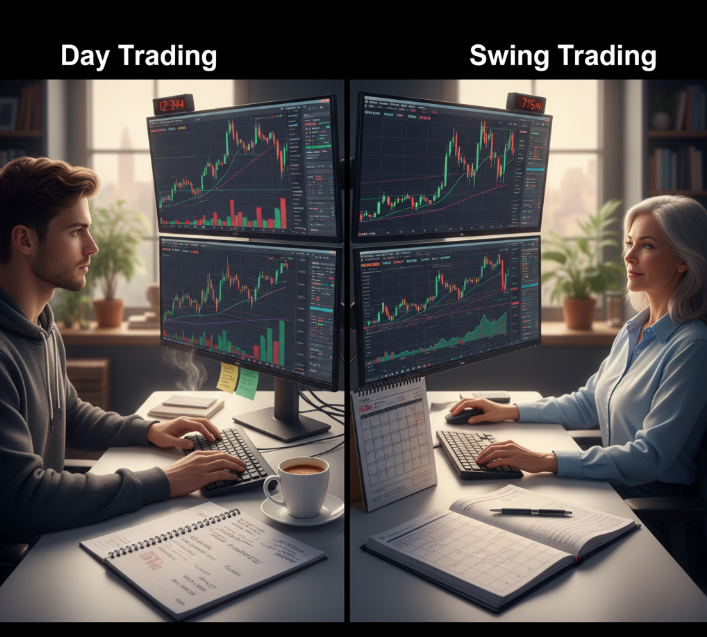
Day trading focuses on short-term price movements using tight timeframe analysis, typically within a single day.
Swing trading, on the other hand, holds positions for several days or even weeks, riding broader market waves.
This isn’t just about charts—it’s about lifestyle:
◼ Day Trading
Best if you can monitor charts for several hours a day.
Requires faster reactions and tighter execution.
You end the day flat—no overnight positions, no waking up to surprise gaps.
◼ Swing Trading
Designed for traders who have jobs, commitments, or don’t want to stare at screens all day.
You analyze on higher timeframes (4H, Daily) and let trades develop.
You’re comfortable with overnight and weekend risk.
If your schedule is tight or you hate intense intraday stress, swing trading often makes more sense than scalp-heavy day trading.
Analyzing Market Conditions: When Does Each Style Shine?
Different market moods favour different approaches.
1. Trending Markets
Swing traders love clean trends—higher highs/higher lows in a bullish trend, or lower highs/lower lows in a bearish one.
They hold through noise and look for major swings with tools like Moving Averages and Fibonacci retracements.
2. Ranging or Choppy Markets
Day traders and scalpers often thrive here.
Quick intraday bounces from support and resistance zones offer multiple intraday entries.
3. News-Driven Conditions
• Economic releases shake things up fast—news events can create instant volatility spikes.
Swing traders often sit before news and hold through them; day traders often avoid them or scalp around them.
Put simply:
Day trading = maximum flexibility during high volatility.
Swing trading = strategic positioning through macro or multi-day sentiment shifts.
Choosing the Right Currency Pairs for Swing vs Day Trading
Not all pairs are created equal. Some dance. Some crawl.
For Day Trading:
EUR/USD – High liquidity, tight spreads; ideal for intraday scalping strategies.
GBP/USD – Volatile and energetic, perfect for those who can handle abrupt moves.
USD/JPY – Responds well to risk sentiment and macro flows; great for intraday momentum setups.
For Swing Trading:
GBP/JPY – Known as the “Beast”; wide ATR, ideal if you can stomach bigger swings.
AUD/USD – Moves smoothly with commodities and risk sentiment; great for technical swing setups.
EUR/JPY – Blends Euro sentiment with risk flows in JPY for clean swing trends.
Matching your pair with your style is like choosing the right weapon for the mission: you don’t bring a sniper rifle to a knife fight.
Comparison: Profitability during Volatile Markets
Here’s where things get spicy.
When volatility spikes (think big candles, long wicks, giant daily ranges), who usually has the edge?
✦ Day traders can exploit rapid intraday moves, closing out positions before overnight gaps. A sudden spike in the VIX or a major news event can create multiple intraday opportunities.
✦ Swing traders position themselves ahead of the curve, but volatility can knock them out of trades prematurely if stops are too tight.
✦ Research on volatility and market performance has shown that periods of elevated volatility (often measured by the VIX) are frequently followed by above-average returns for active strategies and even broad indices, underscoring how nimble positioning can sometimes benefit from turbulent conditions.
✦ Still, some seasoned swing pros thrive by widening stops and zooming out to Daily/Weekly structures—trading the big picture instead of chasing intraday noise—a reminder that profitability isn’t just about speed but also about structure.
Bottom line: Volatility can favor both camps—if risk is controlled. Without disciplined exits, it will destroy both equally fast.
Pros and Cons of Forex Day Trading vs Swing Trading
Let’s break this into something concrete.
Pros of Day Trading
✅ No Overnight Risk
You close all your trades before the session ends. That means:
No surprise gaps from overnight news.
You sleep without worrying about charts.
✅ More Trade Opportunities
Day traders may see multiple setups per day across pairs:
Scalpers chase small, repeated moves.
You can take advantage of intraday reversals and breakouts.
✅ Faster Feedback Loop
You learn quickly:
Strategies are tested daily.
Wins and losses come faster, helping you refine your system sooner.
Cons of Day Trading
❌ Time-Intensive & Stressful
You must monitor charts for hours.
Rapid decisions and trade management can cause burnout.
❌ Higher Transaction Costs
Frequent trades mean more:
Spread costs
Commission charges (depending on your broker)
Slippage during volatile moments
Over time, this can eat heavily into your profit margin.
❌ Psychological Pressure
Constant decision-making.
Emotional swings from rapid win/loss cycles.
Increased temptation to revenge trade or overtrade.
Pros of Swing Trading
✅ Less Screen Time
You can analyze charts in the evening or morning.
Ideal if you have a day job or other commitments.
✅ Catching Bigger Market Moves
Swing traders aim for larger price swings.
A single good trade can deliver what 10–20 scalps might.
✅ More Time to Think
Entries and exits are less rushed.
Decisions can be planned calmly rather than made in seconds.
Cons of Swing Trading
❌ Overnight & Weekend Risk
You hold trades while:
Markets react to news you can’t see in real time.
Gaps can open your trade much higher or lower than your stop.
❌ Requires Emotional Patience
• You’ll need serious patience—perfect setups don’t show up every day.
• Longer holding periods may test your conviction in your analysis and signals, impacting your overall capital allocation strategy.
❌ Swap/Financing Costs
If you’re holding positions for days or weeks, overnight swap charges (positive or negative) will add up and must be factored into your profitability.
Tools & Indicators: Swing Trading vs. Day Trading
Regardless of style, your chart is your battlefield. Here’s how tools differ between the two approaches.
Timeframes & Chart Analysis
Day Traders Typically Use:
1-Min, 5-Min, 15-Min, and 1-Hour charts
Short-term Moving Averages (e.g., 9 EMA, 21 EMA)
High-frequency support and resistance levels
Swing Traders Typically Use:
4-Hour, Daily, and Weekly charts
Medium/long-term Moving Averages (50, 100, 200)
Macro trendlines and key structure zones
Key Technical Indicators
This table sums up popular tools for both:
| Indicator | Main Use Case | Best For… | Caution Point |
|---|---|---|---|
| Moving Average (MA, EMA) | Trend direction & dynamic support | Both | Lagging in chop |
| RSI (Relative Strength Index) | Overbought/oversold signals | 4H/Daily | Using it standalone |
| MACD | Momentum shifts & crossovers | Swing entries | Late entries in fast markets |
| Bollinger Bands | Volatility squeeze & expansion | Day & Swing | False breakouts in news spikes |
| ATR (Average True Range) | Stop loss distance & volatility measure | Both | Misused without context |
Swing traders often blend these indicators with solid chart patterns like channels, trendline breaks, and certain reliable candlestick patterns. Day traders might combine order flow or breakout patterns with volume spikes for intraday confirmation.
The big takeaway: tools are neutral. Your timeframe and rules determine whether these tools pack serious punch without overcomplicating things.
Risk-Reward Ratio: Maximizing Your Gains
No matter how good your setup looks, your Risk-Reward Ratio (RRR) decides if the trade makes sense long-term.
For Day Traders:
Common RRR: 1:1 to 1:2 (quick in-and-out)
Often rely on high win-rate setups.
Risk per trade still needs to be capped—usually 0.5–1% per trade.
For Swing Traders:
Common RRR: 1:2, 1:3, or even more.
Win rate can be lower, but big winners compensate.
Wider stops require careful position sizing.
A practical guideline used by many traders is to risk between 1–2% of total account balance per trade, whether day trading or swinging a position. This keeps you alive through inevitable losing streaks.
Managing Risk: Optimal Stop Loss Placement
You can’t talk about survival in Forex without talking about your stop loss.
For Day Trading:
Stops are often placed just beyond recent intraday highs/lows.
Tight stops demand precise entries.
Volatile spikes can trigger stops prematurely if placed too close.
For Swing Trading:
Stops sit beyond key structure—such as previous swing high/low or major support/resistance.
ATR-based stops help align risk with market volatility.
Wider stops mean smaller lot sizes to keep risk % constant.
Multiple industry studies and broker analytics show that a large majority of active day traders lose money or take on more risk than they realise, often because they misunderstand how position sizing interacts with volatility and leverage.
Risk management isn’t optional. It’s the only thing between “temporary drawdown” and “blown account”.
Understanding Position Sizing for Day Trading
Position sizing is where many traders silently sabotage themselves.
Core Formula:
Decide how much you’re willing to lose per trade (e.g., $100 on a $10,000 account = 1%).
Measure the distance between entry and stop loss (in pips).
Calculate lot size so that if your stop is hit, you lose only that fixed dollar amount.
This is critical for day traders, who trade more frequently:
More trades = more chances to mismanage risk.
Leverage can magnify both your mistakes and your wins.
Swing traders use fewer trades but larger stop distances—so if they ignore position sizing, a single badly sized trade can damage weeks’ worth of gains.
Insights into Profit Patterns: Day vs Swing
Let’s look at how profit tends to “feel” for each approach.
Day trading strategies focus on speed, timing, and precision. Think scalping with tight spreads and rapid entries.
Swing trading focuses on catching the “chunk” of a move, not every tick.
For Day Traders:
Many small wins and losses.
Equity curve can look noisy.
Consistency comes from discipline, not big jackpots.
For Swing Traders:
Fewer but larger trades.
Equity curve can stair-step upward, then pause.
Emotionally easier for some, harder for others (because of the waiting).
Most traders overestimate how much they can handle intraday noise. If you find yourself constantly second-guessing trades, you may be built for swing trading, even if the idea of fast profits seduces you at first.
Which is More Beginner-Friendly?
It depends on your personality more than your skill level.
Day Trading May Suit You If:
You can dedicate several hours a day to charts.
You thrive on rapid feedback.
You are comfortable executing a structured plan under pressure.
Swing Trading May Suit You If:
You have a full-time job or other commitments.
You prefer slow, deliberate decision-making.
You like focusing on macro swings rather than one-minute candles.
For many beginners, swing trading offers a safer and more forgiving learning curve.
When to Switch Between Day Trading and Swing Trading
You don’t have to marry one style forever.
You can:
Swing trade your primary bias on Daily/4H.
Day trade in the direction of that bias on lower timeframes.
Reduce day trading when life gets busy and lean on swing positions instead.
Use one style as your “core” and the other as a tactical extension when conditions line up.
Final Comparison: Day Trading vs Swing Trading at a Glance
Time Commitment
Day trading – High time commitment; best if you can treat it like a job.
Swing trading – Moderate time; ideal if you want trading to fit around your life.
Frequency & Stress
Day trading – Many decisions, higher stress, faster feedback.
Swing trading – Fewer decisions, more waiting, lower screen stress but higher patience stress.
Trade Duration
Day trading – Minutes to hours; all closed by session end.
Swing trading – Days to weeks; positions may span across weekends.
Comparing Profitability: Which Style Wins?
There is no universal winner—only what fits you.
Day trading has the potential for rapid compounding, but most traders fail due to overtrading, fees, and emotional mistakes.
Swing trading offers more breathing room and often better alignment with real-world schedules, but profits come slower and require patience.
Here’s how it shakes out for many traders in practice:
Day traders who succeed often run laser-focused systems, strict risk controls, and treat trading as a high-performance job.
Swing traders who win tend to combine sound technical structure, a solid macro view, and strong risk management—then let time work in their favour.
How Market Conditions Shape Profit Opportunities
Different environments naturally tilt toward one approach.
● In highly volatile markets, quick price swings make ideal hunting grounds for day traders who thrive on micro-movements and fast exits.
● In calm, strongly trending markets, swing traders who pyramid positions or trail stops appropriately can outperform hyperactive day traders who constantly jump in and out.
■ News Environment:
High-impact news = better for nimble intraday scalpers.
Gradual macro shifts = better for swing entries aligned with bigger trends.
■ Liquidity:
Major pairs during London/NY sessions offer best conditions for both styles.
Exotic pairs with wide spreads are usually better avoided by day traders.
■ Technical Conditions:
Strong chart patterns favor swing setups
Intraday volatility suits scalping-style entries
■ Trader Resources:
More available capital allows larger position sizing
Better tools improve execution speed for intraday plays
At the end of the day, your success hinges not just on whether you’re day trading or swing trading—but on how precisely you define your risk, your rules, and your expectations.
Turning Your Style into a Real Edge (and Not Just a Hobby)
Pick one primary style to start—day trading or swing trading.
Build a written plan: entries, exits, risk per trade, max daily/weekly loss.
Use tools that match your style: intraday scanners for day traders, higher timeframe alerts for swing traders.
Treat risk management as your first strategy—not your backup plan.
Day trading strategies are about speed—think rapid-fire trades within a single day aiming to capitalize on small price moves.
Swing setups are about catching the “meat” of the move and letting time do some of the work for you.
No matter which path you pick in your journey through day trades or longer swing campaigns, platforms like EasyCashBackFx offer cashback perks that help boost your bottom line while you learn what works best.
If you're diving into Forex Swing Trading, understanding these moving parts can seriously boost your edge.
References
Day Trading vs. Swing Trading: What's the Difference? - https://www.investopedia.com/articles/active-trading/052815/pros-cons-day-trading-vs-swing-trading.asp
What Is Swing Trading & How Does It Work? - https://www.home.saxo/learn/guides/trading-strategies/what-is-swing-trading
Day Trading vs. Swing Trading: Comparing the Pros and Cons - https://www.nadex.com/blog/day-trading-vs-swing-trading/
Day Trading Strategies for Beginners - https://www.ig.com/en/trading-strategies/day-trading-tips-for-beginners-170905
Trading Mistakes: Using a Stop-Loss - https://www.ig.com/en/news-and-trade-ideas/trading-mistakes--using-a-stop-loss-231009
The 1% Risk Rule for Day Trading and Swing Trading - https://tradethatswing.com/the-1-risk-rule-for-day-trading-and-swing-trading/
Why Most Day Traders Lose Money—and What the Winners Do Differently - https://bookmap.com/blog/why-most-day-traders-lose-money-and-what-the-winners-do-differently
30 Day Trading Statistics Every Day Trader Should Know - https://highstrike.com/day-trading-statistics/
Why Does Volatility Often Lead to Strong Emerging Equity Returns? - https://www.alliancebernstein.com/us/en-us/investments/insights/investment-insights/why-does-volatility-often-lead-to-strong-emerging-equity-returns.html
High Volatility Has Historically Been Followed by Higher-Than-Normal Returns - https://www.ubs.com/global/en/wealth-management/insights/marketnews/article.2111735.html
How Does the Stock Market Perform When the VIX 'Fear Gauge' Surges? - https://www.schroders.com/en-us/us/individual/insights/how-does-the-stock-market-perform-when-the-vix-fear-gauge-surges/
FAQ
What makes Forex Swing Trading different from day trading?
Swing traders live in the rhythm of longer moves—typically holding pairs like EUR/USD or GBP/JPY for several days or more on the Daily Chart. They patiently watch patterns such as Head and Shoulders or channels play out over time.
Day traders, on the other hand, ride intraday volatility on the 1-Hour or 30-Minute Chart, often closing positions before the session ends. Decisions are made in seconds or minutes, and exposure to overnight gaps is usually avoided.
How does market volatility influence swing trades?
In a calm trending market, swing traders can hold positions longer and let trends develop. Tools like Moving Averages and Fibonacci Retracement on the Daily or Weekly Charts help define pullback zones and trend continuation areas.
In a sudden volatile market, price often whipsaws into ranging zones, making it easier to get stopped out. Swing traders may respond by tightening stop loss placement, reducing position size, or waiting for clearer structure before entering.
Even a typically steady pair like AUD/USD can become aggressive when major news hits. In those moments, volatility tests your discipline and risk plan as much as your technical strategy.
Which currency pairs feel most natural for beginners in swing trading?
GBP/JPY: Known for energetic swings and wide ranges. It can offer big reward potential around Triangles, Wedges, and breakouts, but demands careful position sizing due to higher volatility.
AUD/USD: Often moves with a softer cadence, making it friendlier for newer swing traders. Many use indicators like MACD and basic trendlines to learn timing and risk management at a more forgiving pace.
EUR/USD: Has a balanced "heartbeat" and deep liquidity. It’s ideal for practicing reading Relative Strength Index (RSI) trends, divergences, and pullbacks without feeling overwhelmed by extreme spikes.
When should I use Buy Limit Orders versus Market Orders?
A Buy Limit Order fits when you are willing to wait for price to pull back into a key support zone, such as a Double Bottom or a prior demand area. This is common when pairs like NZD/USD are drifting in consolidating markets and you want a better entry price than the current market.
A Market Order is better during clear breakout moments, for example when USD/CHF explodes out of a well-defined range or pattern. In those situations, hesitation or waiting for a pullback can mean missing the move entirely.