


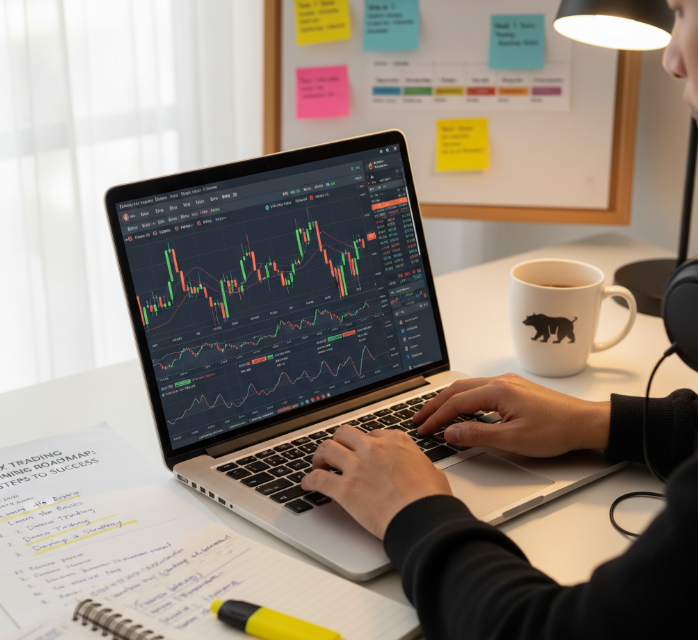
Thinking about jumping into Forex but wondering, “How long’s it gonna take me to really get it?” You’re not alone. A lot of folks who want to Learn Forex Trading hit that same wall. Time’s money, and nobody wants to waste either.
Truth is, it’s not just about the hours — it’s about how you learn. Some folks binge YouTube for months, others take structured courses and see results faster. We’ll walk you through both routes, the trade-offs, and what makes the difference.
EasyCashBackForex training lead Marcus Bell says, “Most people don’t fail because they’re slow — they fail because they follow the wrong map.” So let’s give you the right one.
We’ll cover a clean 5-step game plan, the trade-offs, and what makes the difference.
We’ll cover a clean 5-step game plan, real timelines for beginners vs. pros, and a checklist to help you not burn your money while you're still learning.
5-step roadmap: How to Learn Forex Trading efficiently
Not sure where to kick off your Forex journey? This roadmap breaks it down into five digestible milestones so you can stop guessing and start trading smart.
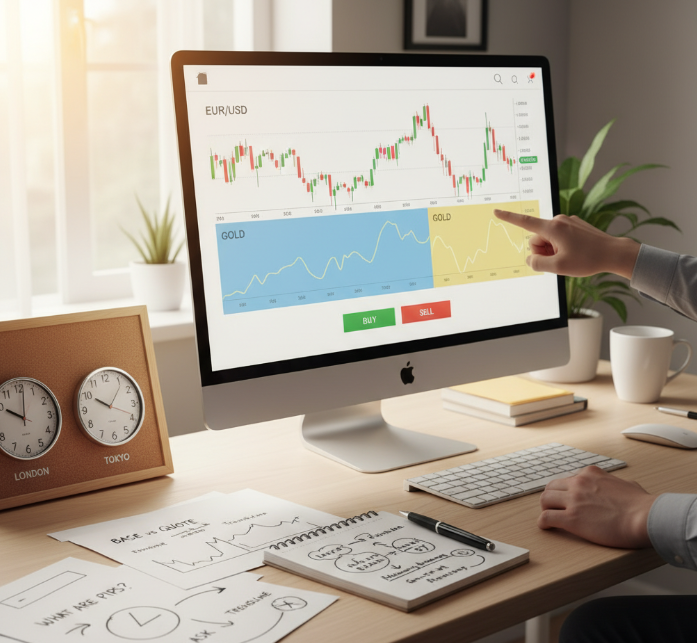
Understand the Basics: EUR/USD and Gold in Focus
The EUR/USD pair is the most liquid in the Forex game — perfect for new traders.
Gold isn’t a currency, but it’s a beast in safe-haven trading.
Learn what currency pairs mean — base vs quote, bid vs ask.
The Forex market runs 24/5, with key sessions (London, New York, Tokyo).
Understand what a pip is, and why spreads matter for beginners.
Use demo accounts to practice without risking cash.
Don't skip the basics — they’re your safety net when charts get crazy.
Choose Your Trading Strategy: From Scalping to Swing Trading
Scalping: Think speed chess — in and out in minutes. Not for the faint of heart.
Day Trading: You’ll wrap up all trades by bedtime. Clean, fast, and exciting.
Swing Trading: A sweet spot for 9-to-5ers — trades last days to weeks.
Position Trading: The marathon of the Forex Market — hold positions for months based on macro trends.
Match your strategy to your lifestyle, risk comfort, and focus level.
? “Jumping into scalping without a strategy is like racing blindfolded.” — Tyler Gray, Trading Education Lead, EasyCashBackForex
Master Key Indicators: RSI, MACD, and Fibonacci Retracement
Technical indicators can feel like a maze, but three stand out for rookies: RSI, MACD, and Fibonacci Retracement. The RSI tells you when a currency’s overbought or oversold — a mood ring for price action. MACD spots momentum shifts using signal lines, while Fibonacci Retracement helps predict where price might reverse after a swing. These aren’t magic wands, but they give your market analysis some serious structure and improve the quality of your trading signals.
Navigate Market Conditions: Bullish, Bearish, and Sideways Explained
Bullish Market
When prices are rising consistently. Use trend-following strategies like riding moving averages.
Bearish Market
Prices dropping? Short trades shine. Watch for breakdowns from support levels.
Sideways Market
Flat or choppy. Focus on range trading or avoid it altogether — it’s where many get chopped up.
Volatility Note
Watch out! Big swings can create fakeouts in all three conditions.
Table: Market Condition Breakdown
| Market Type | Suggested Strategy | Risk Level | Indicator Example |
|---|---|---|---|
| Bullish | Trend Following | Medium | Moving Average |
| Bearish | Breakout Trading | High | MACD |
| Sideways | Range Trading | Low | Bollinger Bands |
Risk Management Fundamentals: Leverage, Stop Loss, and Risk Reward Ratio
Capital preservation matters more than big wins — protect your downside!
Leverage is a double-edged sword. 10x might sound cool but can wipe you out fast.
Use a Stop Loss on every trade. Period.
Calculate your Risk Reward Ratio before you even click buy — 1:2 is a healthy baseline.
3 Quick Tips:
Never risk more than 2% of your account per trade.
Tighten stops in high-volatility markets (like Gold or GBP/JPY).
Track your trades. Patterns of loss often reveal poor risk habits, not market failure.
“Control your risk, or the market will control you.” — Malia Chen, Senior Risk Officer, EasyCashBackForex
How long does it realistically take to Learn Forex Trading?
Let’s keep it real: how long it takes to Learn Forex Trading isn’t just about clock hours—it’s about how you study, what you’re trading, and the mistakes you dodge.
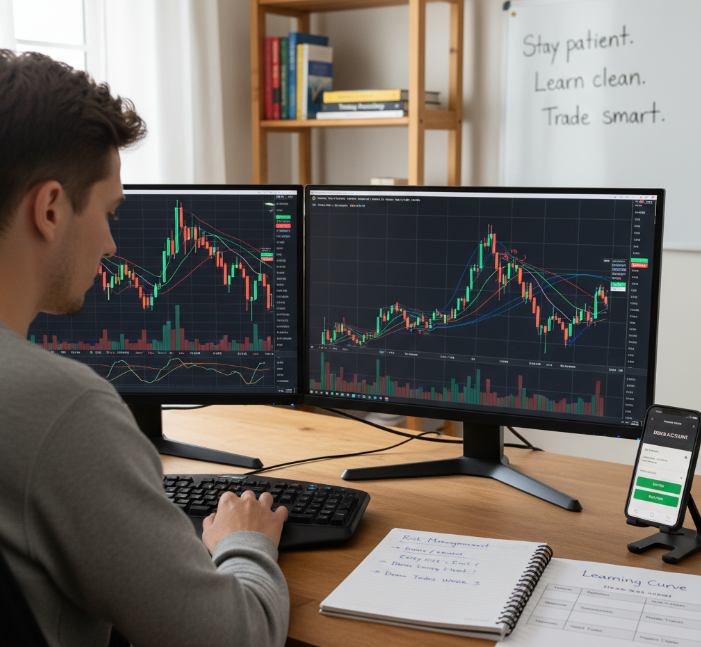
Fast Track with Day Trading vs Position Trading
Day Trading is quick and intense — you're analyzing markets non-stop and making moves in minutes.
Position Trading is slower, ideal for folks who can wait days or weeks for a trend to play out.
If your Time Commitment is daily and focused, Day Trading builds Learning Speed faster.
But if you’re juggling a job or school, Position Trading gives you breathing room.
Bottom line? Your Trading Style will shape how fast you actually get good.
Timeline Benchmarks Using AUD/USD and Crude Oil Case Studies
Week 1–2: Demo trading AUD/USD — focus on basic entry/exit rules
Week 3–5: Analyze Crude Oil volatility to train on risk exposure
Week 6–8: Start combining Market Data with personal Trading Performance logs
Month 3+: Begin small real-money trades with strict rules
? Example Learning Data Table:
| Trader Type | Instrument Focus | Avg. Demo Duration (weeks) | Profit Break-Even Time (months) |
|---|---|---|---|
| Beginner | AUD/USD | 3 | 6 |
| Intermediate | Crude Oil | 2 | 4 |
| Hybrid | Both | 4 | 5 |
How Technical Indicators Affect Learning Speed: Stochastic and Ichimoku Cloud
"Most beginners struggle not because of lack of will—but because they misuse indicators," says Anna L., Lead Analyst at EasyCashBackForex.
Quick takes:
• Stochastic Oscillator helps when the market’s ranging — super intuitive after a week of practice
• Ichimoku Cloud is visually cluttered, but once cracked, it gives solid Market Signals for Trading Strategies
• Use just one until you get confident — stacking too many slows down your Learning Speed
Learning to read one clean chart is faster than fighting with five.
Common Mistakes That Extend Your Learning Curve
Over-trading just because you’re bored? Classic rookie move.
Skipping Risk Management because “this trade looks good”? Dangerous.
Some Common Mistakes every beginner hits:
Emotional Trading after a win or a loss
Forgetting to test a strategy (hello, Lack of Strategy)
Using 100x Over-Leveraging on a hunch
Small habits add up fast. Stay patient. Learn clean. Trade smart.
Self-study vs Course: Which teaches Forex Trading faster?
Some folks learn faster solo, others thrive with a good mentor. This chapter helps you figure out what cuts your learning curve the most.

Learning Curve Using RSI, Moving Averages, and Bollinger Bands
Here’s what each tool means for your pace of learning in Forex Trading:
RSI: Simple but requires solid chart timing — good for self-learners.
Moving Averages: Easy entry-level trend tools, great for course tutorials.
Bollinger Bands: Slightly trickier; ideal when guided by a tutor.
Self-paced learning may take longer with advanced tools unless paired with smart backtesting tools.
Gold and GBP/JPY Practice Scenarios in Self-Study
Gold and GBP/JPY are spicy pairs — perfect for pushing your skills in self-study mode. Below is a quick reference for how they behave in practice scenarios.
| Currency Pair | Volatility | Reaction to News | Strategy Fit | Learning Curve |
|---|---|---|---|---|
| Gold | High | Very Sensitive | Swing Trading | Moderate |
| GBP/JPY | Very High | Fast Spike Moves | Day Trading | Steep |
| EUR/USD | Medium | Predictable | Trend Following | Shallow |
Use Gold to explore Bollinger Band squeezes.
Try GBP/JPY when testing reaction speed using RSI.
These practice scenarios mimic real stress — that’s gold for learning.
Impact of Instructor Feedback on Mastering Chart Patterns
Mastering patterns like Head and Shoulders or Pennants takes sharp eyes and repetition — but self-study only gets you so far.
Live instructor feedback often corrects tiny pattern mistakes most learners don’t even notice.
Chart Patterns feel easier to master when someone points out the psychology behind them in real time.
Recorded videos can't teach you the why behind the moves — that's where live insight wins.
“We’ve found that 70% of beginners identify chart patterns faster after three feedback cycles.”
— Leo Tan, Lead Education Manager at EasyCashBackForex
Quick tip: Don’t just rely on screen recordings — talk it through, get live eyes on your charts.
Stop losing money: A practical risk-control checklist
Trading without a plan? You’re basically handing money away. This guide gives you solid ways to stop the bleeding and protect your trades.
Use of Stop Loss and Take Profit in Volatile Markets
Keep your Stop Loss wide enough for breathing room — too tight in volatile markets and you’ll get kicked out early.
Take Profit levels shouldn’t be greedy — target zones where price historically stalls.
Adapt your Risk Management for spikes; volatility changes everything.
“If your SL or TP doesn’t adjust to volatility, you’re not trading — you’re guessing.” — Marcus T., Senior Analyst at EasyCashBackForex
Don’t treat all markets the same — during chaos, flexibility is your insurance policy. Lock it in before it locks you out.
Position Sizing for USD/CAD and NZD/USD Trades
Smart position sizing avoids blowing your account — especially when trading currency pairs like USD/CAD and NZD/USD that move differently.
Match your risk exposure to the pair’s volatility.
| Pair | Avg Daily Range | Suggested Risk % | Max Position Size |
|---|---|---|---|
| USD/CAD | 70 pips | 1% | 0.5 lot |
| NZD/USD | 50 pips | 1.5% | 0.6 lot |
| EUR/USD | 60 pips | 1% | 0.5 lot |
Don’t blindly size positions. Use data + common sense, not emotion. Overload the wrong pair, and you'll feel the burn fast.
Avoiding Over-Leverage in Carry Trade Scenarios
Here’s the deal — carry trades look juicy because of the interest you earn overnight. But folks get wrecked by over-leverage chasing those gains. If your leverage ratio is 1:100, and you’re risking more than 3% of your trading capital, you're on thin ice.
Think long-term. Let the swap earnings build slowly. Protect your downside with strong risk control and don’t get greedy. It’s a marathon, not a lotto ticket.
Hedging Techniques Using Silver and Crude Oil
Use Crude Oil to hedge USD exposure when trading energy-linked currencies like CAD.
Long on Silver? Hedge with short-term Gold or JPY to offset high market correlation.
In fast-moving markets, a hedge can stall losses — not erase them.
Only hedge when it aligns with your commodity trading goals, not just fear.
Don’t forget to close both sides — hedges left open too long can wreck your P/L.
Risk Reward Ratio Planning with Triangle and Wedge Patterns
Spot reliable Triangle Patterns or Wedge Patterns on 1H or 4H charts.
Use technical analysis tools to estimate breakout direction.
Set your Risk Reward Ratio to at least 1:2 — meaning for every $1 you risk, aim for $2 return.
Align your trading signals with volume confirmation before entering.
Exit clean. Don’t let greed eat your gains.
Charts don’t lie — but traders often do… to themselves. Plan smart, execute smarter.
Controlling Emotional Decisions in a Downtrend
Panic Selling
When the screen goes red, many panic. Let your rules, not your nerves, guide you.
Revenge Trading
Lost big? Don’t double down. That’s how you bury your account faster.
Cognitive Bias
You think the market “has to” bounce? That’s your bias talking — not market sentiment.
Trading Psychology Fix
Step away. Breathe. Stick to your risk aversion plan and come back with clarity.
Novice vs Pro: Learn Forex Trading timelines compared
Everyone wants to know: how fast can you go from newbie to profitable trader? Here’s a straight-up comparison between rookies and pros.
Side-by-side breakdown: From zero to steady profits
| Trader Type | Time to Learn Basics | Time to Consistent Trading | Key Focus Areas | Common Pitfalls |
|---|---|---|---|---|
| Novice | 1–2 months | 6–12 months | Learning curve, trading strategies, demo account | Overtrading, chasing profits |
| Intermediate | 2–4 weeks | 3–6 months | Market analysis, trading psychology, risk management | Strategy hopping, impatience |
| Pro (from stocks or crypto) | 1 week | 1–3 months | Time commitment, platform tools, risk control | Underestimating forex differences |
What the EasyCashBackForex team says
“Most new traders think more screen time equals faster success. It’s not about clocking hours, it’s about the right kind of practice.”
— Tyler V., Senior Training Advisor, EasyCashBackForex
“I’ve seen crypto pros blow up accounts in forex. The chart patterns may look similar, but the risk management side is way stricter here.”
— Erin G., Platform UX Engineer, EasyCashBackForex
“We always say: If you can’t grow a $1,000 demo account, don’t fund a live one.”
— Marcus L., Account Support Lead, EasyCashBackForex
Quick clues to know where you stand
If demo trading still feels random, you’re in the early stages of your learning curve. No shame—just keep logging trades and journaling outcomes.
If you’ve got a favorite trading strategy and follow a routine, you’re likely in the intermediate bracket.
If you’re tweaking trades based on market analysis and not emotion? That’s a pro move.
What speeds things up (or slows you down)
Helps big time:
Trading daily, even for 20 minutes
Using one trading platform only — stop hopping
Weekly check-ins with your financial goals
Studying 1–2 indicators deeply (MACD, RSI, etc.)
Keeping risk per trade under 2%
Slows you down:
Trading 7 pairs with 5 strategies at once
Ignoring your own emotional triggers (revenge trading)
Blowing up a demo account and still going live
Following random tips from Reddit without backtesting
Realistic profitability checkpoints
| Time Frame | Reasonable Profit Expectation (Monthly) | Notes |
|---|---|---|
| Month 1–3 | 0% (learning + demo phase) | Focus on not losing money |
| Month 4–6 | 1–3% on small live account | Prioritize capital safety |
| Month 7–12 | 2–5% on growing capital base | Stick to your plan, ignore FOMO |
Note: If someone’s promising you 10% monthly profits in month 2, run.
You’re not racing anyone. Whether it takes 3 months or a year, the traders who make it long-term are the ones who respect the process. Stay in the game. Profitability will follow.
Conclusion
Learning forex trading isn't about cramming overnight or finding a magic shortcut. It's a bit like learning to ride a bike—you’ll wobble, fall, but eventually, you’ll cruise. The time it takes to Learn Forex Trading really depends on how you approach it: structured training, the right strategy, and keeping your emotions in check can speed things up. Everyone’s pace is different, and that’s okay. The important thing is staying consistent and not jumping between shiny new tools or methods every week like a squirrel chasing snacks.
Here’s what you can do to keep your journey on track:
Start small—demo trade with EUR/USD or Gold until you're steady.
Pick one style that fits your life. Scalping ain’t great if you’ve got meetings all day.
Focus on learning a couple of indicators—RSI and MACD are solid starters.
Stick to a risk plan. Stop losses aren’t optional, they’re your seatbelt.
If you're short on time or need structure, a good course can beat weeks of DIY confusion.
As Warren Buffett once said, "Risk comes from not knowing what you're doing." Get to know what you're doing.
Forex isn’t just about charts and trades—it’s about patience and personal growth. It’ll test your discipline, your focus, and sometimes your nerves. But if you treat it like a skill, not a scheme, you’ll build something real. Take it day by day, and give yourself grace. You’re not just learning a market—you’re learning how to think like a trader.
References
EUR/USD (Euro/US Dollar) – Currency Pair – Investopedia - https://www.investopedia.com/terms/forex/e/eur-usd-euro-us-dollar-currency-pair.asp
Currency Pair Definition – Investopedia - https://www.investopedia.com/terms/c/currencypair.asp
What Are Pips in Forex Trading? – Investopedia - https://www.investopedia.com/terms/p/pip.asp
Forex Market Hours (Sessions) – BabyPips - https://www.babypips.com/tools/forex-market-hours
Relative Strength Index (RSI) – Investopedia - https://www.investopedia.com/terms/r/rsi.asp
What Is MACD? – Investopedia - https://www.investopedia.com/terms/m/macd.asp
Fibonacci Retracement Levels – Investopedia - https://www.investopedia.com/terms/f/fibonacciretracement.asp
Understanding Bollinger Bands – Investopedia - https://www.investopedia.com/terms/b/bollingerbands.asp
How To Profit From the Bollinger Squeeze – Investopedia - https://www.investopedia.com/articles/technical/04/030304.asp
Stochastic Oscillator – Investopedia - https://www.investopedia.com/terms/s/stochasticoscillator.asp
Ichimoku Cloud – Investopedia - https://www.investopedia.com/terms/i/ichimoku-cloud.asp
The 2% Rule (Risk Management) – CME Group - https://www.cmegroup.com/education/courses/trade-and-risk-management/the-2-percent-rule.html
2% Rule in Investing – Investopedia - https://www.investopedia.com/terms/t/two-percent-rule.asp
How & Why Oil Impacts the Canadian Dollar – Investopedia - https://www.investopedia.com/articles/investing/021315/how-why-oil-impacts-canadian-dollar-cad.asp
How Oil Moves with USD/CAD – BabyPips - https://www.babypips.com/learn/forex/black-crack
Currency Carry Trades – Investopedia - https://www.investopedia.com/terms/c/currencycarrytrade.asp
Is gold a safe haven for investors? – Economics Observatory - https://www.economicsobservatory.com/is-gold-a-safe-haven-for-investors
Complete Guide to Trading the GBP/JPY Pair – Saxo Bank - https://www.home.saxo/learn/guides/forex/how-to-trade-the-gbpjpy-forex-pair
Forex Trading FAQ
How long does it take to learn Forex Trading as a beginner?
Most people need 3–6 months to learn the basics.
Some learn faster with consistent daily practice.
Scalping usually takes longer than swing trading.
EUR/USD and Gold are good starter instruments.
Indicators like RSI and MACD help build confidence early.
What’s the fastest way to learn Forex Trading without formal courses?
Pick one strategy (e.g., Day Trading) and stick with it.
Practice with a demo account first.
Use simple tools like RSI or Fibonacci.
Trade only one pair (e.g., EUR/USD) until reading the chart becomes natural.
How does risk management affect my learning progress?
Without a stop loss, small mistakes can become costly.
Good position sizing keeps your account alive longer.
Too much leverage ruins confidence quickly.
A proper risk/reward ratio keeps you consistent.
Fast markets (like Gold) require tighter risk control.
Can I learn Forex Trading part-time while working?
Swing trading and position trading are ideal for part-time traders.
You only need to check charts once or twice a day.
Stick to slower pairs like AUD/USD and avoid short timeframes.
What indicators should I learn first to trade better?
RSI — helps find overbought/oversold zones
MACD — makes trend direction clearer
Bollinger Bands — shows volatility and price stretch
Fibonacci — great for entries/exits
Use only 1–2 indicators until you're fluent.
Should I use a demo account or go straight to real money?
Start with a demo account.
Then transition into small real positions with low risk.
Calmer pairs like USD/CAD or NZD/USD are easier for beginners.
How do I know when I'm ready for live trading?
You win more trades than you lose over time.
You no longer move your stop-loss mid-trade.
You’ve practiced both trending and ranging markets.
You can accept losses calmly.
You can trade volatile pairs (e.g., GBP/JPY) without panic.
What’s the biggest mistake that slows learning?
Jumping between strategies too often.
Using too many indicators too early.
It's better to master one setup than chase multiple signals.
Should I keep the same strategy in bullish and bearish markets?
Trend-following strategies work both ways.
Range strategies fail in fast markets.
Bollinger Bands help you adjust volatility expectations.
In choppy markets, consider hedging or staying out.
Let the chart dictate your approach.
Does the trading pair I choose affect learning?
Yes — some pairs are smoother and easier for beginners.
EUR/USD is generally the easiest to learn on.
Gold and Crude Oil move fast and require quicker decisions.
Start slow, then explore other instruments later.