


Free funded accounts in Forex Trading sound like free lunch at Wall Street’s cafeteria—tempting, flashy, and usually loaded with fine print. My take: truly free capital doesn’t exist; smart structures and profit splits do.
The Bank for International Settlements reports $9.6 trillion in daily FX turnover in April 2025.
Capital isn’t free; access has rules always.
Platform Selection
Compare ECNs, MTFs, and algo platforms for liquidity, latency, and execution quality.
Risk Management
Enforce drawdown limits, Value-at-Risk thresholds, proper leverage, and disciplined hedging.
Regulatory Costs
Account for MiFID II, CFTC regulations, and AML/KYC fees to avoid hidden compliance charges.
Liquidity Access
Choose between prime brokers and electronic pools to optimize spreads, slippage, and counterparty risk.
Can You Really Get a Free Funded Forex Trading Account?
Getting a free funded account in Forex Trading sounds like hitting the jackpot. But behind the hype, there’s platform tech, risk rules, liquidity access, and fee structures that shape real outcomes in currency trading.
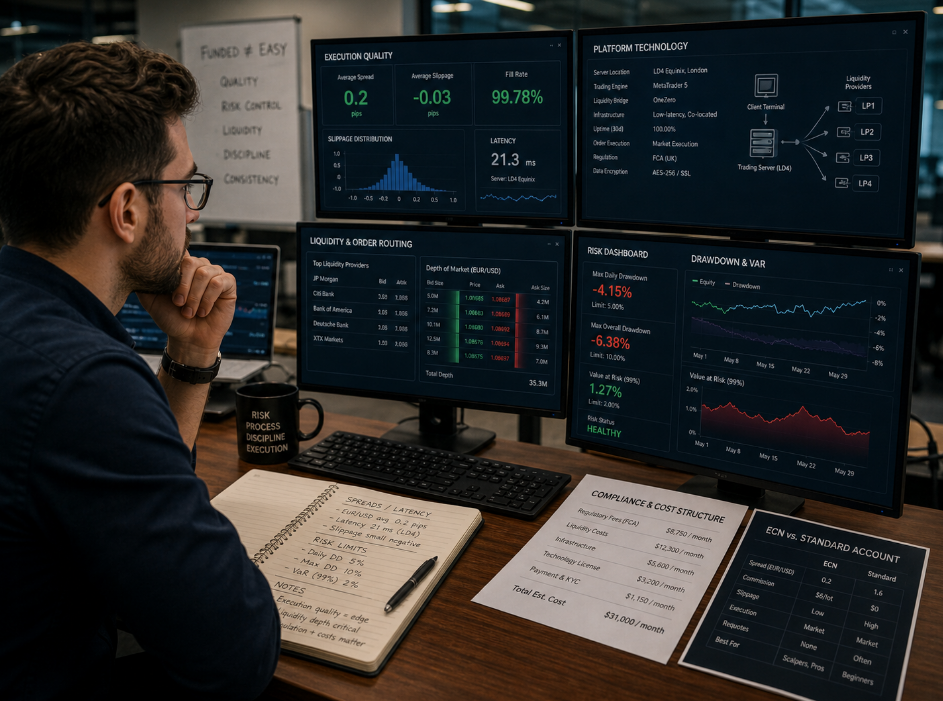
Assessing Trading Platforms: From ECNs to Algorithmic Trading Platforms
In Forex Trading, your edge often starts with the right trading platforms and clean market access. Not all systems handle execution the same way.
ECNs
Direct order routing to liquidity providers
Transparent spreads
Strong fit for high-frequency trading
MTFs and proprietary systems
Internalized flow
Variable latency
Limited external market depth
When comparing ECNs and Algorithmic Trading Platforms, break it down:
Technology stack
Server location
Latency in milliseconds
API stability
Execution quality
Slippage rates
Requote frequency
Fill ratios on major currency pairs
Algorithm compatibility
Support for automated FX trading
Backtesting environments
VPS integration
Serious Forex Trading setups demand tight spreads and stable data feeds. Platforms linked through EasyCashBackFx can also return part of your spread cost through forex rebates, which helps when you’re stacking trades in fast-moving foreign exchange markets.
Evaluating Risk Management Requirements and Value at Risk Metrics
Free funded accounts come with strict risk management rules. No way around it.
Key areas in risk assessment:
Market risk exposure per pair
Daily and maximum drawdown
News trading restrictions
Institutional-style controls usually include:
Value at Risk (VaR) thresholds
Fixed leverage caps
Portfolio-level exposure limits
Under deeper review:
Capital rules
Margin utilization ceiling
Overnight holding limits
Portfolio structure
Correlation between EUR/USD and GBP/USD
Hedge positions in USD/JPY
Strong VaR models measure potential loss over a defined period. In professional Forex Trading, blowing past exposure limits often means instant disqualification. Treat funded capital like it’s your own cash. That mindset changes everything.
Spotting Hidden Regulatory Fees under MiFID II and CFTC Regulations
Some costs hide in plain sight.
Watch for regulatory fees tied to MiFID II and CFTC Regulations:
Transaction reporting charges
Clearing and settlement add-ons
AML/KYC onboarding costs
Break them into layers:
Compliance overhead
Reporting infrastructure
Audit trails
Brokerage pass-through
Data feed subscriptions
Swap markups
In active FX trading, tiny fees compound fast. Transparency matters. EasyCashBackFx helps offset part of these trading expenses, and a forex rebate calculator can help estimate the impact on high-volume Forex Trading accounts.
Understanding Liquidity Management: Prime Brokers vs. Electronic Liquidity Pools
Liquidity drives spread. Spread drives profit.
Compare Prime Brokers and Electronic Liquidity Pools through:
Market depth visibility
Stability of the order book
Consistency of execution quality
Access models:
Prime broker route
Direct interbank pricing
Higher capital thresholds
Counterparty screening
Electronic pool sourcing
Aggregated quotes
Variable liquidity
Potential slippage during volatility
In the interbank space, sourcing quality liquidity means fewer nasty surprises during news spikes. For retail traders entering funded Forex Trading, understanding how orders hit the market can be the difference between smooth fills and painful slippage.
3 Steps to Secure Free Funded Forex Trading Accounts
Getting access to capital in Forex Trading is not luck. It’s a structured path. If you treat forex trading like a business—managing risk, tracking performance, and respecting market rules—you increase your odds of securing funded trading accounts without putting your own money on the line.

Step 1: Select the Right Demo Challenge for Major Currency Pairs
Choosing a demo challenge is about smart selection, not hype. In Forex Trading, especially when working with major currency pairs, details matter.
✅ Transparent rules
✅ Realistic spreads
✅ Accurate tick data
✅ Clear drawdown metrics
Under the hood, focus on:
Trading Environment
Spread averages on major pairs (EUR/USD, GBP/USD).
Execution speed in milliseconds.
News slippage policies.
Forex trading conditions must reflect live markets.
Compare:
Evaluation Rules
Daily drawdown cap.
Maximum total loss.
Minimum trading days.
Profit target realism (8–10% is common in forex evaluations).
Platform Integrity
Data feed quality.
Historical pricing accuracy.
Stability during volatility spikes.
A quick comparison snapshot:
| Provider Type | Profit Target (%) | Max Drawdown (%) | Min Trading Days | Avg Spread (EUR/USD pips) |
|---|---|---|---|---|
| Model A | 8 | 10 | 5 | 1.2 |
| Model B | 10 | 8 | 10 | 1.5 |
| Model C | 12 | 6 | 15 | 1.8 |
| Model D | 8 | 5 | 20 | 2.0 |
| Model E | 9 | 12 | 5 | 1.1 |
The tighter the risk limits, the more discipline your trading strategy must show. In foreign exchange markets, that discipline is everything.
Step 2: Meet Market Risk and Credit Risk Parameters in Your Evaluation
Passing an evaluation means proving management skills under pressure. In Forex Trading, firms care about market risk and credit risk control.
Core areas:
Market Risk Control
Position sizing per trade (often 0.5–1%).
Value at Risk thresholds.
Reaction to economic indicators.
Credit Risk Awareness
Avoid overexposure to correlated currency pairs.
Respect margin requirements.
Keep leverage within policy limits.
Performance tracking often breaks down like this:
Daily loss limit respected.
No single trade exceeding defined % risk.
Consistent risk-to-reward ratio above 1:1.5.
Stable equity curve.
Short bursts of profit won’t save sloppy forex trading habits. Firms look for steady execution. Clean logs. No gambling behavior.
In plain terms: trade like you already manage serious funding.
Step 3: Transition to Live Execution via Direct Market Access
After qualification, the transition to live execution changes the game. Real money. Real slippage. Real emotions.
Focus shifts to:
Direct Market Access (DMA)
Faster order routing.
Tighter spreads during liquid hours.
Reduced dealing-desk interference.
Execution Quality
Monitor slippage statistics.
Track fill ratios.
Adjust stop placement to volatility.
Ongoing Compliance
Respect firm-level risk parameters.
Maintain performance consistency.
Report metrics transparently.
In active Forex Trading, especially around major news releases, spreads widen fast. If your demo trading ignored that reality, live results will hurt.
The goal is simple: protect capital, scale gradually, and treat funded forex accounts like a privilege. Do that consistently, and long-term trading growth becomes possible.
Which Prop Firms Offer Free Funding?
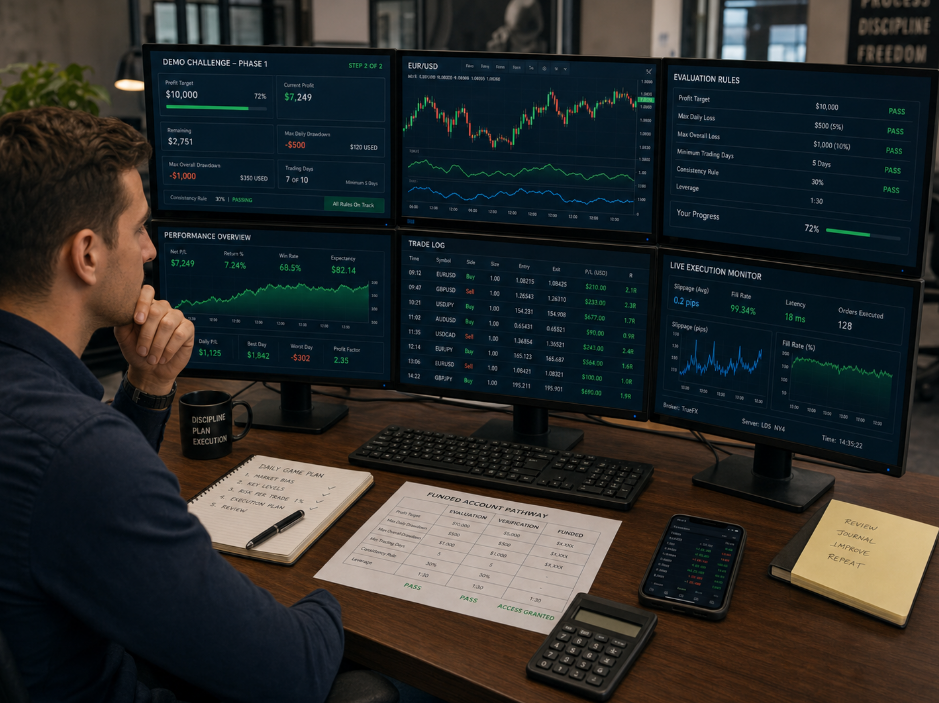
Getting into Forex Trading without risking your own cash sounds like a dream, right? In forex trading, prop firms step in with real capital after a solid evaluation. If you trade smart in the FX market, funded accounts can turn skill into serious profit.
The5ers
For traders deep into Forex Trading, The5ers focuses on steady growth over hype. Its funding model rewards controlled trading and clean risk metrics.
Core structure of their
evaluation
:
Risk Control
Fixed maximum drawdown on accounts
Clear daily loss caps to protect capital
Performance Metrics
Targeted profit goals
Consistent lot sizing in forex pairs
Scaling Plan
Gradual scaling once objectives are met
Higher funding tied to disciplined trading
This setup suits traders who treat FX trading like a business, not a gamble. Pairing that with forex cashback can reduce transaction costs while building long-term profit in currency trading.
FTMO
FTMO is known for structured challenges built around professional-grade risk rules in Forex Trading.
What stands out:
Two-phase evaluation
Strict daily loss limits
Clear profit objectives
Pass the initial challenge by hitting the target.
Confirm consistency in verification.
Receive funded accounts with firm capital.
Many retail traders in online forex say the pressure feels real, yet fair. Stick to your trading plan, manage drawdown, and your forex trading record becomes your resume. Add EasyCashBackFx rebates, and your net profit on funded accounts gets a subtle boost. FTMO’s current public model describes simulated challenge accounts, a 10% Challenge profit target, a 5% Maximum Daily Loss, a 10% Maximum Loss, and continued trading with simulated capital after passing.
Topstep
Topstep targets futures-based currency contracts, blending trading discipline with live market conditions.
Step-by-step path into funded accounts:
Join the evaluation and trade simulated capital.
Respect daily loss thresholds and performance rules.
Hit the profit objective without breaching limits.
Transition into live funding tied to measurable performance.
This appeals to traders who like structured rules in Forex Trading but want exposure to futures pricing. Clean execution matters more than flashy returns. Topstep’s current program states that traders first prove themselves in a simulated Trading Combine, then move to an Express Funded Account that still trades in a simulated environment while working toward payouts, before potentially advancing to a Live Funded Account.
Fidelcrest
Fidelcrest mixes aggressive scaling with layered evaluation phases in the forex space.
Program framework:
Phase-Based
Evaluation
Defined profit targets
Maximum drawdown ceilings
Risk Parameters
Controlled leverage
Strategy compliance across accounts
Growth Model
Rapid capital increases
Expanded funding after consistent performance
For active participants in Forex Trading, this model rewards bold yet controlled strategies. Keep your risk tight, compound gains steadily, and combine smart execution with cost savings from EasyCashBackFx to make every pip in currency trading count.
References
[OTC foreign exchange turnover in April 2025 - https://www.bis.org/statistics/rpfx25_fx.htm]
[Global FX trading hits $9.6 trillion per day in April 2025 and trading of OTC interest rate derivatives rises - https://www.bis.org/press/p250930.htm]
[MiFID II - https://www.esma.europa.eu/publications-and-data/interactive-single-rulebook/mifid-ii]
[Guidelines on transaction reporting, order record keeping and clock synchronisation under MiFID II - https://www.esma.europa.eu/document/guidelines-transaction-reporting-order-record-keeping-and-clock-synchronisation-under-mifid]
[Anti-Money Laundering | CFTC - https://www.cftc.gov/IndustryOversight/AntiMoneyLaundering/index.htm]
[Anti-Money Laundering | CFTC Customer Identification Program - https://www.cftc.gov/IndustryOversight/AntiMoneyLaundering/dsio_aml_cia.html]
[FTMO - How it works - https://ftmo.com/en/how-it-works/]
[The5ers - https://the5ers.com/]
[Topstep's Funded Futures Trading Program - https://www.topstep.com/our-program/]
FAQ
How do institutional investors evaluate Forex Trading platforms?
Institutional investors, hedge funds, and investment banks assess platforms with a sharp eye on execution quality and control. The review often flows across three layers:
Infrastructure & Access
Electronic Communication Networks and Multilateral Trading Facilities for interbank market reach
Prime brokerage platforms for credit lines and consolidated reporting
Direct Market Access to major currency pairs and spot contracts
Technology Stack
Integration with order management systems and execution management systems
Compatibility with algorithmic trading platforms for time-weighted average price or volume-weighted average price execution
Stability of proprietary trading systems under high volatility
Data & Transparency
Real-time data feeds, tick data, and order book data
Measured slippage, bid-ask spread behavior, and market depth consistency
In practice, asset managers want speed, clarity, and proof that performance holds up during economic indicator shocks.
What risk management standards matter most in Forex Trading?
For sovereign wealth funds, central banks, and proprietary trading firms, risk control is personal—it protects capital and reputation.
Core priorities include:
Market risk: monitored through Value at Risk and volatility data across futures contracts and options contracts.
Credit and counterparty risk: assessed when trading currency swaps or non-deliverable forwards via prime brokers.
Liquidity risk: tested by tracking market depth and slippage during stressed conditions.
Operational risk: reduced through strong compliance with Anti-Money Laundering and Know Your Customer rules.
Hedging strategies using forward contracts or options contracts often balance exposure when macro news feeds trigger sharp moves.
How do regulations shape Forex Trading participants?
Regulation defines the rhythm of global currency activity.
Dodd-Frank Act & CFTC regulations (U.S.): oversight of swaps, reporting duties, and margin controls.
MiFID II & EMIR (EU): transaction transparency, trade reporting, and clearing obligations.
FCA regulations (UK): conduct supervision and client asset protection.
For investment banks and hedge funds, compliance is embedded in execution management systems and reporting modules. Daily processes—recording streaming prices, archiving historical data, documenting Request for Quote activity—keep operations aligned with supervisory standards.
How does liquidity management differ between prime brokers and electronic pools?
Liquidity defines trading comfort.
Prime brokers connect institutional investors to the interbank market through curated liquidity providers. This route often offers:
Tighter oversight of counterparty risk
Aggregated access to spot contracts and forward contracts
Credit intermediation for larger ticket sizes
Electronic liquidity pools, by contrast, gather streaming prices from banks and non-bank firms inside Electronic Communication Networks. The appeal lies in competitive bid-ask spreads and fast algorithmic execution, though counterparty concentration requires close monitoring.
In volatile sessions, hedge funds and asset managers balance both channels—seeking depth, guarding against slippage, and preserving execution discipline.