


For many importers, exporters and high-value remitters, sbi forex rates feel like a black box — numbers jump, margins slip, and before you know it, a few thousand rupees have quietly walked out of the deal. One small difference in the bank’s rate or brokerage and poora profit ka hisaab bigad jaata hai.
Picture this: you agree with your supplier on 50,000 USD, rupee moves 40 paise, your SBI quote comes a bit off from what you saw online, and suddenly your landed cost is higher. The rate, the spread, the timing — sab mix ho kar real headache ban jata hai.
“For high-value deals, saving even 10–15 paise per dollar can feel like one extra invoice paid in a year,” says Rohan, senior FX engineer at easycashbackfx.
This guide cuts the noise: how SBI compares with other Indian banks, how quote types and brokerage actually work, quick steps to check live rates, plus simple hedging ideas when rupee keeps dancing.
How do SBI forex rates compare with other Indian banks?
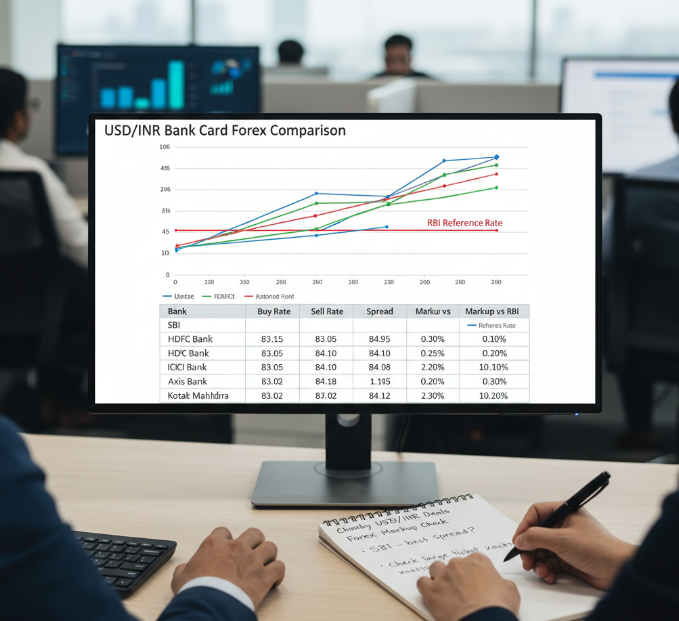
US Dollar spreads across major Indian banks
Handy for USD/INR buyers doing chunky deals.
Helps buyers spot Forex Markup tricks.
Compare SBI with HDFC Bank, ICICI Bank, Axis Bank and Kotak Mahindra.
Track deviations from RBI Reference Rate. SBI often stays aggressive for corporate flows, especially on high-volume USD/INR trades, though spreads may widen slightly during volatile windows.
Euro and British Pound card rates for import merchants
Useful for teams routing big Import Remittance payouts.
Great for anyone juggling Merchant Rates under tight margins.
Cross-check Bill Selling Rate across banks.
Consider Letter of Credit timing and SWIFT routing. SBI’s Trade Services wing usually gives decent buffers for heavy importers, keeping costs predictable when GBP/INR or EUR/INR bounce around unexpectedly.

Japanese Yen and Swiss Franc interbank gaps
Important for firms paying JPY/INR or CHF/INR invoices.
Great for spotting “hidden” markup patterns.
| Currency Pair | Interbank Rate Gap | Typical SBI Spread | Notes |
|---|---|---|---|
| JPY/INR | Low–Moderate | Narrow | Stable for exporters |
| CHF/INR | Moderate | Slightly Wider | Higher liquidity risk |
| CHF/JPY | Moderate–High | Wider | Vol-sensitive |
SBI generally stays more stable than most banks during swings, thanks to tighter internal quoting models.
Telegraphic Transfer margins on UAE Dirham and Saudi Riyal
Favoured by remittance businesses and NRI-focused operators.
Compare TT Buy/Sell with peers offering heavy GCC corridors.
Factor SWIFT and correspondent fees baked into the quote. SBI’s Nostro setups in Gulf hubs often let it offer smoother pricing, preventing random spikes that hit everyday business payments.
Travel card pricing for Individual Travelers and Overseas Students
SBI’s Multi-Currency Travel Card usually lands well on USD, EUR and GBP loads.
Perfect for agencies batching large travel or study loads.
Works well for parents sending quick fee payments.
Compare load/reload costs with peers.
Track cross-currency fees for smart budgeting.
“Small gaps in travel-card pricing pile up fast at scale,” notes an EasyCashbackFX product designer. SBI’s structured slabs often reward bulk issuers with better consistency and fewer surprise markups.
Exchange margin benchmarks for Corporate Exporters, Import Merchants and wholesale deals
Lets teams sanity-check whether a daily quote is fair.
Compare SBI’s Exchange Margin against typical wholesale tiers.
Match margin size to deal volume and tenor. SBI often sharpens rates for repeat corporate flows, especially when exporters also book forwards or use trade products, giving a smoother overall pricing ecosystem.
Types of forex rate quotes explained
Spot Exchange Rate, Ready Rate and Interbank Rate decoded
Spot rate is the price for immediate delivery in the current market, usually foreign exchange T+2 settlement for a currency pair at real-time levels.
Ready rate: what your bank actually quotes you for that same deal.
Interbank rate: wholesale market level used in bank transactions.
Think of interbank rate as the clean benchmark, ready rate as “interbank + margin”, and spot rate as the basic label for the immediate foreign exchange deal.
.png "Spot, Ready & Interbank Rate (Side-by-Side Comparison).png")
Telegraphic Transfer Buy and Telegraphic Transfer Sell for US Dollar remittances
TT Buy: bank’s exchange rate when it buys USD remittances coming in as electronic funds (inward remittance).
TT Sell: rate when it sells USD for outward remittance.
Corporate Exporters care about TT Buy, since that sets realised export value.
Import Merchants obsess over TT Sell, because that drives landed cost.
Small difference in telegraphic transfer spread can mean huge money on big-ticket USD remittances.
Bill Purchase Rate, Bill Selling Rate and Export Bill Discounting flows
Bill purchase is used when the bank takes over export bills under documentary credit and pays you upfront at a bank buying rate.
Bill purchase: export bills, trade finance, discounting for quick cash.
Bill selling: rate applied when bank converts import bills, a key bank selling rate.
Export bill discounting: post-shipment finance where the exporter passes risk and funding cost to the bank, against future foreign currency inflows.
Cash Buying Rate and Cash Selling Rate for Japanese Yen, Australian Dollar and Canadian Dollar
Cash buying: rate for taking physical currency off your hands, say JPY, AUD or CAD foreign currency notes.
Cash selling: rate for handing you travel money in those currencies.
Margins are fatter than telegraphic rates because handling physical currency is messy.
For big travel cash deals, push for better cash buying or cash selling spreads, especially when your overall wallet with the bank is chunky.
Forward Contract pricing, Exchange Margin and Interest Rate Differential
A Forward contract locks a forward rate today for future delivery, letting your treasury desk sleep at night. Pricing mixes the current spot rate plus or minus the impact of interest rate differential between currencies, baked into a premium/discount. Over that, the bank adds an exchange margin. For sizeable hedging flows, you negotiate both: the raw forward points driven by markets and the added spread for service, credit and deal size.
Card Rate construction under FEDAI Guidelines and internal board policies
Card rate is the retail forex tag your branches show on screens and boards.
Under Foreign Exchange Dealers' Association of India (FEDAI) guidelines, banks align market practice and basic rules for foreign exchange dealers.
Internal policies then decide how much markup to add over interbank bank rates for small-ticket retail forex.
For bigger corporate tickets, your actual working rate often comes from treasury, not the public card rate, so always ask for a “deal rate”, not board price.
Nostro Account, Vostro Account and SWIFT Code in trade settlements
Nostro account and Vostro account setups keep correspondent banking running so your trade settlements and international payments don’t get stuck. SWIFT code is the bank identification tag that routes funds cleanly.
| Account type | Example balance (USD mn) | No. of currencies | Cut-off time (hours) |
|---|---|---|---|
| Nostro | 25 | 5 | 2 |
| Vostro | 10 | 3 | 4 |
| Mirror | 5 | 2 | 1 |
Foreign Exchange Management Act, Liberalised Remittance Scheme and compliance on quoted rates
FEMA sets the foreign exchange law, and LRS defines how much you can push out under remittance rules. Banks must keep quoted rates inside the RBI regulations and broader regulatory framework, so big deals get extra compliance checks.
“As one easycashbackfx risk engineer jokes, ignore FEMA and LRS today and you’ll overpay tomorrow when the audit hits.”
For large tickets, get written comfort on compliance before locking pricing.
5 steps to check live SBI forex rates online
Choose your customer segment: Non-Resident Indians, Corporate Exporters or Retail Remitters
For clean pricing, match your customer segment with the right portal view.
Non-Resident Indians / NRI: check NRI or remittance pages tuned to frequent forex transfer users.
Corporate Exporters: sign in as a corporate client; focus on export bill and trade tabs.
Retail Remitters: retail remitter logins show simpler rate tiles for family support or small-ticket buys.
Select currency pairs such as US Dollar, Euro, Singapore Dollar or UAE Dirham
Pick currency pairs before you hunt numbers.
Shortlist core pairs such as USD/INR, EUR/INR, SGD/INR and AED/INR.
Confirm which side you are on: buying foreign currency or selling it to SBI.
Mark “favourites” in your watchlist so the same pairs load instantly during busy wholesale sessions.
Pick modality: Outward Remittance, Inward Remittance or Foreign Currency Demand Draft
Each remittance modality tweaks pricing slightly, so select it upfront.
Outward Remittance – classic customer choice for sending USD, EUR or SGD abroad from India.
Inward Remittance – funds flowing in; used when overseas payers hit your Nostro route.
Foreign Currency Demand Draft (FCDD) – old-school but handy for education or legal payments needing a physical draft.
Set transaction type as Telegraphic Transfer, cash counter rate or Multi-Currency Travel Card
Now set the transaction type so SBI knows how you operate.
Telegraphic Transfer (TT): sharper forex rates for bigger online SBI remittance flows.
cash counter rate / cash rate: used when you walk in for physical notes.
Multi-Currency Travel Card / travel card: pricing reflects card loading and reload costs, not just the raw quote.
Compare live card rate with Interbank Rate and downloadable brokerage sheets for wholesale deals
Last step is pure rate comparison for wholesale deals.
Check the live card rate on SBI’s screen.
Glance at a market terminal or website for the Interbank Rate.
Download brokerage sheets, note the spread, and push for tighter forex rates on high-value trades.
That small spread tweak adds real money to your bottom line.
Confused by fluctuating SBI forex rates? Simple hedging tips
Mapping open positions for Corporate Exporters, Import Merchants and Foreign Portfolio Investors
Big-ticket users need clear open position views, not vibes.
Do quick position mapping by currency across Corporate Exporters, Import Merchants and Foreign Portfolio Investors.
Build an exposure report with booked deals, pipeline, FPI flows and natural hedges.
Track net open position against internal treasury limits every day.
Tag each chunk of FX risk by tenor and purpose, so SBI dealers instantly know what’s hedge-worthy and what you can leave floating.
Locking in US Dollar, Euro and British Pound receivables with Forward Contracts
List all USD, EUR and GBP receivables and expected export proceeds.
Decide what portion needs a full FX hedge and what can stay open.
Call your State Bank of India dealer to discuss Forward Contracts and rate lock-in levels.
Do forward booking in slabs, not one giant ticket, to average entry.
Review hedge strategy after each payout to refine your next set of bookings.
Using Foreign Currency Non-Resident Account and Resident Foreign Currency Account for natural hedges
A Foreign Currency Non-Resident Account, or FCNR account, can quietly act as a natural hedge when NRI deposits sit in the same currency as your future payments. Pair that with a Resident Foreign Currency Account, or RFC account, onshore. By matching FX balance in, say, US Dollar inflows with upcoming imports or tuition, you cut random conversion, get currency matching and enjoy interest earnings while still keeping decent liquidity in the currency that really matters to you.
Travel and tuition hedging for Individual Travelers and Overseas Students with Multi-Currency Travel Card
Individual Travelers hate last-minute shocks on travel expenses.
Overseas Students dread surprise jumps in tuition fees.
Use a Multi-Currency Travel Card to lock a pre-booked rate on major currencies.
Plan a reload schedule before departure so each student remittance hits at calm times.
Keep small buffers on the travel card for hotel extras, so you’re not forced into ugly walk-in counter rates.
Aligning hedge tenors with Interest Rate Differential, Inflation Differential and Central Bank Intervention
Smart hedge timing needs macro vibes plus numbers.
Pick a hedge tenor or hedge duration that matches your cash flow, not gossip.
Watch Interest Rate Differential and Inflation Differential; big gaps hint at FX volatility and Central Bank Intervention risk, so tweak hedge timing using simple macro indicators.
| hedge tenor | yield curve hint | FX volatility | quick takeaway |
|---|---|---|---|
| 1–3 months | flat | low | keep hedges light |
| 3–6 months | steepening | medium | stagger hedges |
| 6–12 months | jumpy | high | higher cover ratio |
Reading Foreign Exchange Reserves, Crude Oil Prices, Trade Balance and Current Account Deficit signals
FX reserves and INR often hang out together. Rising Foreign Exchange Reserves usually support a calmer INR view.
Crude Oil Prices hit India’s oil import bill hard. Higher oil means bigger imports, which can worsen Trade Balance and push FX risk up for import-heavy clients.
Keep an eye on exports, imports and the Current Account Deficit. Bad macro data or widening CAD can spook markets, so have a simple playbook ready for trimming open USD exposure.
Integrating Import Letter of Credit, Export Bill Discounting and brokerage slabs into risk policy
Your FX risk policy should talk to your trade finance docs, not ignore them.
Map each Import Letter of Credit to expected shipment dates and hedge windows.
Treat LC liability as funded exposure once goods are on water.
Sync Export Bill Discounting (EBD) with your hedge ratios, so early funding doesn’t leave naked spots.
Align brokerage slabs with deal sizes and bank charges to avoid overpaying on tiny tickets.
“In FX risk, boring consistency beats lucky guesses,” says an easycashbackfx treasury manager.
Live SBI forex rate cheat sheet
Rate names decoded in 30 seconds
TT Buy (Telegraphic Transfer Buy)
Use when: You receive money from abroad (export proceeds, inward remittance).
Think: “Bank is buying forex from me into INR.”
Tip: For Corporate Exporters, this is the key line to compare across banks for big-ticket deals.
TT Sell (Telegraphic Transfer Sell)
Use when: You send money out (outward remittance, import payment, tuition fees, overseas services).
Think: “Bank is selling forex to me from INR.”
Tip: For Import Merchants, TT Sell is the main sbi forex rates line to watch.
Bill Purchase Rate / Bill Selling Rate
Use when: You have export bills, collections, or LC bills.
Think: “Document-based flows, not simple remittance.”
Pain point angle: Discounting and brokerage slabs hide in this area; always ask how much extra over card rate.
Cash Buying / Cash Selling
Use when: Over-the-counter currency conversion with notes (USD, Euro, British Pound, Japanese Yen, etc.).
Think: “Physical cash, higher spread due to handling risk.”
For wholesale: Good to benchmark pricing, though big clients usually shift to TT deals.
Forex card rates (Multi-Currency Travel Card)
Use when: Staff or customers load cards in US Dollar, Euro, Singapore Dollar, UAE Dirham etc.
Hidden twist: forex card rates often include extra load/unload fees, so don’t compare blindly with TT rates.
Spot / Ready Rate
Use when: Same-day or T+2 deals linked to live exchange rates in the forex market.
Key idea: Spot is your clean base line; margin, brokerage and taxes get added over this.
Forward Contract Rate
Use when: You fix US Dollar or Euro rate for future dates for imports/exports.
Driven by: Interest Rate Differential plus exchange margin.
For bulk users: Main tool to protect your profit when today’s sbi rates look attractive but payment date is months away.
3 quick checks before saying “okay, book it”
Check the correct rate line
Are you doing outward remittance, inward remittance, export bill discounting, or LC payment?
Confirm if the bank is giving TT Buy, TT Sell, Bill Rate, or Cash Rate.
One wrong line, and your deal bleeds unnecessary paise per dollar, bhai.
Compare with reference live exchange rates
Pull an interbank reference from any reliable live ticker.
Use the exchange rate calculator on sbi net banking forex or official site to see card rate vs interbank.
Note the spread in paise; that’s the margin + brokerage you’re actually paying.
Match rate with your deal size and profile
For large-ticket Corporate Exporters and Import Merchants, push for “special deal” over board card rate.
For recurring flows, ask for a pricing grid based on monthly volume.
If your volume is sticky and clean on compliance, your spread should be thinner than a random walk-in client.
Sample cheat table for key currencies
| Currency | Typical wholesale use case | Live quote type to focus on | Indicative spread over interbank* |
|---|---|---|---|
| US Dollar (USD) | Bulk imports, export invoicing, outward remittance | TT Buy / TT Sell | 0.20 – 0.45 INR |
| Euro (EUR) | Machinery imports, EU service payments | TT Sell, Forward Contract | 0.25 – 0.55 INR |
| British Pound (GBP) | Service exports, consulting fees, UK tuition fees | TT Buy for receipts, TT Sell for fees | 0.30 – 0.65 INR |
| Japanese Yen (JPY) | Auto and machinery imports | TT Sell, Import Letter of Credit | 0.35 – 0.80 INR (per 100 JPY) |
| Singapore Dollar (SGD) | Regional hub payments, ASEAN trade | TT Buy / TT Sell | 0.25 – 0.60 INR |
| UAE Dirham (AED) | Gulf trade, salary remittance for Non-Resident Indians | TT Buy / TT Sell | 0.20 – 0.50 INR |
Micro-cheats for different deal types
Here are fast “mental post-its” for common bulk use cases linked to sbi forex services.
High-value USD outward remittance for imports
Ask instantly: “Is this TT Sell special deal or just board card rate?”
Compare rate with your own exchange rate calculator snapshot of interbank USD/INR.
For repeat Import Merchants, request a written spread grid by slab (say 1–5 lakh USD, 5–10 lakh USD, etc.).
Regular export proceeds from Euro and British Pound
Focus on TT Buy.
Confirm how much below interbank the bank is buying, especially when Foreign Exchange Reserves and Central Bank Intervention are making rates jumpy.
If your company keeps a Foreign Currency Non-Resident Account or Resident Foreign Currency Account, consider using that balance as a natural hedge.
Travel card loading for staff or Overseas Students
Don’t compare forex card rates with online TT rates directly; card has operational costs baked in.
For large institutional batches (university tie-ups, corporate travel desks), ask for a “wholesale forex card slab” instead of retail rate per card.
Bulk salary or support remittances to UAE and Saudi Arabia
For AED and Saudi Riyal, watch TT Sell line closely.
Many firms just look at today’s sbi rates page and move on; smarter ones track average spread over a week and negotiate.
FX usage under Liberalised Remittance Scheme
When employees or promoters remit under LRS, club expected flows and talk to your relationship manager for a better blended rate.
Clean documentation under Foreign Exchange Management Act helps you push harder on pricing.
easycashbackfx pro tips
Inputs from easycashbackfx folks who sit on rate screens all day and bargain with banks like pros.
Q1: “I’m busy, yaar. One quick way to scan a State Bank of India rate sheet?”
A – Rahul, FX Product Manager, easycashbackfx
“Just lock on three things: correct rate type (TT or Bill), interbank reference, and margin in paise. If those numbers look okay, rest of the page is noise for a bulk client.”
Q2: “My company has both exports and imports. Any hack to use that for better pricing?”
A – Sana, Senior Deal Engineer, easycashbackfx
“Tell your manager to present a combined flow story to the bank: ‘We bring you export TT Buy plus import TT Sell.’ Balanced flows lower Nostro Account costs for the bank, so it becomes easier to squeeze a tighter spread for you.”
Q3: “Can I rely only on sbi net banking forex screen for decisions?”
A – Dev, Strategic Partnerships Lead, easycashbackfx
“That screen is great for quick view of live exchange rates and booking smaller deals. For big wholesale tickets, always ask for a dealer quote on phone or chat, compare with your independent feed, and then confirm. One extra paisa on a million-dollar ticket is real money, boss.”
Q4: “How do I bring tech into this without making life complicated?”
A – Meera, FX Solutions Designer, easycashbackfx
“Hook your ERP or treasury system to pull sbi forex rates plus one more feed for comparison. Use a simple rule: if margin vs interbank crosses your comfort band, system flags it. You don’t need some fancy dashboard; even a basic export into Excel with an exchange rate calculator formula can highlight if pricing is off.”
Which documents do you need for forex at SBI?
KYC checklists for Individual Travelers, Overseas Students, Non-Resident Indians and Retail Remitters
Different profiles, slightly different KYC checklist, but the core idea’s the same: prove who you are and where you stay.
Individual Travelers / Overseas Students: passport copy, PAN, ID proof, address proof, visa or college letter.
Non-Resident Indians / NRI: passport, overseas address proof, OCI/PIO or visa, Indian PAN.
Retail Remitters sending money: PAN, passport copy or other ID proof, local address proof linked to mobile and bank.
Documentation for Corporate Exporters and Import Merchants under the Foreign Exchange Management Act
Corporate Exporters: board resolution naming the authorised signatory, corporate KYC, PAN, GST registration, IEC code.
Import Merchants: all exporter docs plus vendor contracts and audited financials.
For big forex lines, SBI may ask updated audited financials and projected turnover.
Under the Foreign Exchange Management Act (FEMA), keep IEC, GST and corporate KYC always current.
Store everything in a shared drive so your team isn’t hunting files on deal day.
Paperwork for Outward Remittance, Inward Remittance and Foreign Currency Demand Draft
Think of this as your remittance survival kit for smooth Outward Remittance, Inward Remittance and Foreign Currency Demand Draft (FCDD).
Outward Remittance: PAN, A2 form, purpose code, invoice copy, beneficiary details, remittance request.
Inward Remittance: SWIFT copy from overseas bank, purpose declaration, any linked invoice copy.
FCDD: PAN, FCDD request, beneficiary details, compliance form and purpose code.
Quick hack: keep standard templates ready so staff just plugs in values instead of redrafting every time.
Records for Multi-Currency Travel Card, Foreign Currency Non-Resident Account and Resident Foreign Currency Account
Forex customers hate repeating forms; ops teams hate missing docs. Balance both by standardising records.
Multi-Currency Travel Card: travel card application, card KYC, PAN, FATCA, CRS declaration.
Foreign Currency Non-Resident Account (FCNR): passport, visa, overseas address proof, account opening form, FATCA, CRS.
Resident Foreign Currency Account (RFC): proof of past non-resident status, RFC account opening form, PAN, address proof.
Keep scanned copies tied to customer IDs so repeat loads and renewals are crazy fast.
Supporting proofs for Liberalised Remittance Scheme limits, Trade Balance reporting and SWIFT Code declarations
When money moves out, regulators want a clear story, not vague notes.
Liberalised Remittance Scheme (LRS): PAN, LRS limit tracker, supporting proofs for purpose (tuition, investment, travel).
Trade Balance reporting: proper export documentation or import documentation, matching invoices and shipping docs.
SWIFT Code and bank details: beneficiary bank letter, printout of client confirmation, internal regulatory declaration.
Keep an LRS spreadsheet per customer so you don’t accidentally overshoot limits and trigger awkward calls.
Conclusion
Forex dealing with SBI doesn’t have to feel like haggling in a crowded bazaar; this guide helps you walk in like a regular who knows the shopkeeper and the prices. You’ve seen how quotes work, what moves sbi forex rates, and where your real costs sit.
From here, you can treat SBI like a long-term partner and cut the time you spend guessing and second-guessing rates.
Check live card rates against interbank levels before locking large tickets for exports, imports or bulk remittances.
Pick the right mode — Telegraphic Transfer, bill, cash, or forward — so currency and purpose match, not clash.
Align hedges and credit lines with business cycles so your treasury desk stops firefighting every spike in the chart.
Keep documentation tidy under FEMA, LRS and FEDAI guidance, cutting last-minute drama at the branch counter.
When markets move on crude prices, trade news or central bank action, rate screens can feel like a cricket score that keeps changing just as you set the field. Use this guide as your daily playbook, talk to your SBI manager, and push for pricing that respects your volume and long-standing relationship.
References
SBI Forex Card Rates – SBI Bank – https://sbi.bank.in/documents/16012/1400784/FOREX_CARD_RATES.pdf
State Bank Foreign Travel Card – SBI Personal Banking – https://sbi.bank.in/web/personal-banking/state-bank-foreign-travel-card
Foreign Exchange Dealers’ Association of India (FEDAI) – https://fedai.org.in/
Foreign Exchange Management Act, 1999 (FEMA) – IndiaCode – https://www.indiacode.nic.in/bitstream/123456789/1988/1/A1999_42.pdf
Liberalised Remittance Scheme (LRS) – RBI FAQs – https://www.rbi.org.in/Commonman/English/Scripts/FAQs.aspx?Id=1834
State Bank of India Exchange Rate Comparison – Wise – https://wise.com/sg/compare/state-bank-of-india-exchange-rate
SBI Internet Banking Portal – OnlineSBI – https://www.onlinesbi.sbi/
EasyCashbackFX Home – Forex Rebates & Tools – https://www.easycashbackfx.com/
EasyCashbackFX – SBI Forex Card Rates: Today’s Live Exchange Rates & Charges – https://www.easycashbackfx.com/article/sbi-forex-card-rates-today-live-exchange-rates-charges
EasyCashbackFX – How Much Forex Reserve Does India Have – https://www.easycashbackfx.com/article/how-much-forex-reserve-does-india-have
EasyCashbackFX – Forex Tools & Calculators – https://www.easycashbackfx.com/tools
FAQ
How are sbi forex rates different from other Indian banks for bulk deals?
SBI often sharpens quotes when volumes look steady and the relationship feels long-term. Big clients usually find the difference once spreads and margin are discussed openly.
Compare Telegraphic Transfer Buy/Sell spreads for US Dollar, Euro or British Pound.
Ask how exchange margin shifts for Corporate Exporters or Import Merchants with steady flows.
Check improvements on forward prices routed through State Bank of India Nostro setups.
Which market factors affect SBI forex rates for corporate customers?
Market drivers push SBI quotes up and down all day, so treasuries keep an eye on quick indicators before calling a dealer. Small hints often help secure calmer pricing.
Interest Rate Differential shapes forwards for US Dollar and Euro.
Crude Oil Prices, Trade Balance and Current Account Deficit sway spot levels.
Central Bank Intervention and Foreign Exchange Reserves guide big swings.
How do I read SBI Telegraphic Transfer and cash card rate quotes?
Rate sheets feel simpler once each line connects to a real-life movement. TT, bill and cash quotes slot into different needs for exporters, students or travelers.
TT Buy/Sell is common for Outward and Inward Remittance.
Bill Purchase/Selling links to Export Bill Discounting and Import Letters of Credit.
Cash Buying/Selling applies to currency notes like Japanese Yen, Australian Dollar or Canadian Dollar.
How can I check live sbi forex rates online before booking?
Checking live sbi forex rates is like checking a train update before leaving home. A quick glance saves stress for anyone planning large transfers or trade payments.
Pick your profile: Non-Resident Indians, Corporate Exporters or Retail Remitters.
Select US Dollar, Euro, Singapore Dollar, UAE Dirham or Saudi Riyal.
Choose product: Outward Remittance or Foreign Currency Demand Draft.
Match the Card Rate with current interbank levels.
What is the difference between spot rate and forward contract at SBI?
Spot suits today’s deal; a forward covers a date down the road. Picking the right one keeps invoices steady for exporters and buyers alike.
Spot / Ready Rate: for quick settlements.
Forward Contract: priced with Interest Rate Differential.
Useful for US Dollar or Euro receivables/payables.
How do sbi forex rates impact hedging for exporters and importers?
Hedging works best with clear limits and simple tools. Once the rhythm settles, currency swings feel less stressful for teams managing trade flows.
Use Forward Contracts for firm orders.
Blend Export Bill Discounting or Import Letters of Credit with hedges.
Set budget bands tied to inflation gaps and exchange margin.
What documents are needed for high-value outward remittance through SBI?
Large transfers only move smoothly when paperwork is ready. Keeping files sorted saves extra visits and keeps Telegraphic Transfer timing neat.
KYC for travelers, students or Non-Resident Indians.
Purpose proofs under Liberalised Remittance Scheme.
Declarations under the Foreign Exchange Management Act.
How do SBI card rates, interbank rate and exchange margin work together?
These three pieces form the final rate you see. Once you know the chain, negotiating feels more natural and less like guesswork.
Interbank Rate: real-time wholesale price.
Card Rate: adds exchange margin and costs.
Negotiated rates adjust for volumes and product mix.
Can Non-Resident Indians lock in better deals using SBI’s forex products?
NRI flows can feel smoother with a little planning. The right account or card shields regular payments from sudden swings.
Use Foreign Currency Non-Resident Account or Resident Foreign Currency Account.
Mix Inward Remittance with periodic forwards.
Use Multi-Currency Travel Card for short visits.