


The ETH USD lot size isn’t just a dry contract spec buried in your trading platform—it’s the difference between a calculated move and a “how did that blow up?” moment. Think of it like ordering coffee: small, medium, or go big and brace yourself. Pick the wrong size in crypto, and volatility can hit your account like a double shot of espresso at midnight.
Crypto swings fast. One ETH can feel manageable—until margin calls start knocking. Getting lot size right means balancing risk, capital, and sanity before the market tests your nerve.
Define your lot size
choose between standard (1 ETH), mini (0.1), micro (0.01), or nano (0.001) based on capital and risk tolerance.
Manage risk
calculate position size from dollar risk and stop-loss distance using VaR principles.
Watch liquidity and volatility
adjust lot size to control slippage and spread costs during rapid ETH/USD swings.
Control leverage and margin
lower contract size or reduce leverage to avoid margin calls on ECN or OTC platforms.
What Is The Lot Size Of ETH USD?
Trading crypto feels fast, but sizing a trade isn’t guesswork. Understanding ETH USD lot size, how ETH, USD, and lot size connect, and how exposure builds up helps you avoid nasty surprises. Let’s break it down in plain terms.
Definition of a Standard ETH/USD Lot
When traders talk about ETH USD lot size, they’re really talking about the Lot size defined in theContract specification of a broker.
At the core:
ETH/USD pair = Ethereum priced in US dollars
Base asset = ETH
Quote asset = USD
Standard lot (in most crypto CFDs) = 1 ETH
In practical terms:
If you open 1 lot, you control 1 ETH.
If price moves $10, your position changes by $10.
If you trade 0.1 lot, that equals 0.1 ETH exposure.
Some brokers may define smaller Trading unit options like 0.01 lot. Always check platform rules. On platforms partnered withEasyCashBackFx, the contract details are clearly listed so you can verify the exact ETH USD lot size before clicking buy.
As the CME Group noted in its 2025 crypto derivatives update, Ethereum contract participation keeps rising alongside clearer sizing standards in retail platforms.
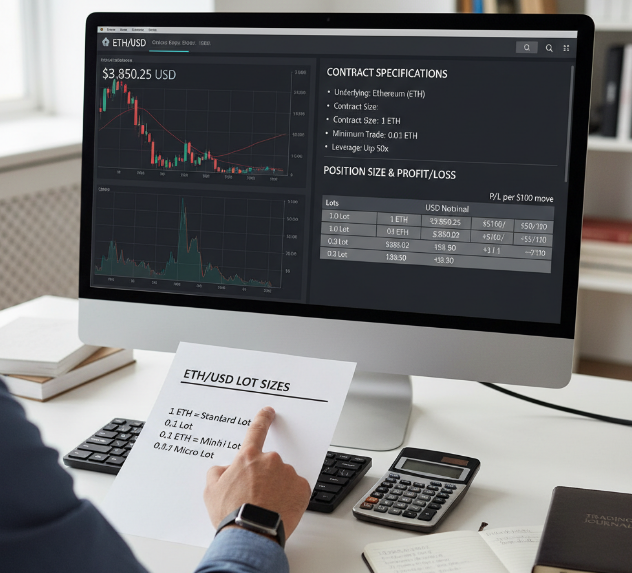
Spot Crypto Contract Size and Pip Value
In the Spot market, the Contract size equals the actual ETH you purchase. No mystery there. TheUnit of trade directly reflects blockchain ownership if you’re buying real coins.
For CFD trading, pip math matters. A Pip valuedepends on the Price increment set by the broker. Many platforms quote ETH/USD to two decimal places.
Below is a simplified numerical illustration:
| ETH/USD Price | Contract Size (ETH) | Price Move ($) | Profit/Loss ($) |
|---|---|---|---|
| 3,000 | 1.0 | +10 | +10 |
| 3,000 | 0.5 | +10 | +5 |
| 3,000 | 2.0 | -25 | -50 |
Key drivers inside the Crypto contract math:
Market value of ETH
Chosen Position sizing
Minimum Price increment
When searching “ETH USD lot size” or “Ethereum USD contract size,” remember that lot size multiplies every tick. That’s why traders usingEasyCashBackFx often compare spreads and rebates before deciding how large their ETH USD lot size should be.
How Spread and Volatility Impact Lot Size
The Market spread and Volatility shape real risk. Tight spread, calm chart — easier to scale up. Wide spread, wild candles — better to size down.
Here’s how many traders think about it:
✔ Higher Volatility → smaller Lot size
✔ Wider Transaction costs → reduced Risk exposure
✔ Strong Price action trend → align with clearTrading strategy
Under fast Market dynamics, Ethereum can swing 3–5% in a day. That’s no joke. A 1 ETH USD lot size during a $150 move equals $150 change in equity.
Smart flow often looks like this:
Check current spread.
Review daily range and volatility data.
Adjust lot size to match acceptable drawdown.
In short, ETH, USD, and lot size work together as one risk engine. Control the size, and you control the heat. That’s the real game behind every ETH USD lot size decision.
Types Of ETH USD Lot Size
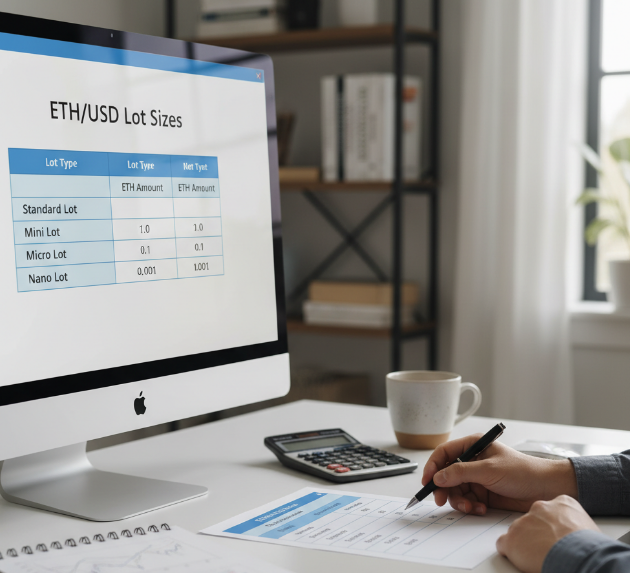
Getting clear on ETH USD lot size is how you avoid overtrading or going too small to matter. When trading ETH USD, lot size defines your trading volume, your risk, and your overall comfort level in this fast-moving cryptocurrency market.
Standard Lot (1 ETH)
Core definition of ETH USD lot size at full scale:
Acts as the base unit in mosttrading platforms
Represents full exposure to the asset
1 ETH contract
In practical market terms:
Higher margin required
Strong price sensitivity per tick
| Lot Type | ETH Amount | Margin Impact (Approx.) | Volatility Exposure | Capital Level |
|---|---|---|---|---|
| Standard | 1.0 ETH | High | High | Large |
| Mini | 0.1 ETH | Medium | Medium | Moderate |
| Micro | 0.01 ETH | Low | Low | Small |
| Nano | 0.001 ETH | Very Low | Minimal | Very Small |
| Custom | Variable | Flexible | Variable | Flexible |
For traders using EasyCashBackFx, tracking ETH USD lot size at this level suits biggercontract strategies and structured capital plans.
Mini Lot (0.1 ETH)
Mini means fractional but still meaningful.
0.1 ETH equals controlled trading volume.
Suitable for:
Active cryptocurrency traders
Medium-sized market exposure
Benefits:
Balanced risk
Manageable margin
When people talk about ETH USD trading size that feels “just right,” this is usually it.
Micro Lot (0.01 ETH)
Fractional unit inside the broader contract
system:
Used to test execution
Monitor spread behavior
Reduce sudden asset swings impact
0.01 ETH
Ideal scenarios:
New traders learning ETH USD lot size dynamics
Strategy backtesting in live market conditions
ETH USD lot size at micro scale keeps risk tight while staying real.
Nano Lot (0.001 ETH)
Small, sharp, precise.
0.001 ETH inside the full
trading volume
ladder:
Micro-adjust entries
Control downside exposure
Fine-tune algorithmic cryptocurrency setups
For anyone dialing in ETH USD lot size with surgical control, nano positioning makes sense. It turns the broad ETH USD lot size concept into something flexible, practical, and easy to scale up when confidence grows.
5 Steps To Calculate Lot Size
Getting ETH USD lot size right isn’t guesswork. It’s about balancing risk, margin, volatility, and real account numbers. If you trade ETH/USD, or calculate ETH lot size often, this guide keeps things practical and straight to the point.
Step 1: Evaluate Margin and Leverage Requirements
When calculating ETH USD lot size, start with yourMargin framework.
Review:
Account equity
Available Trading capital
Broker requirements
Then break it down:
Identify your usable Collateral.
Check maximum allowed Leverage.
Measure total Risk exposure after position entry.
Under high leverage, margin looks small. But liquidation risk grows fast if ETH moves 2–3% against you.
Inside your trading plan:
Equity → defines ceiling.
Margin ratio → defines flexibility.
Exposure → defines survival.
Before increasing ETH lot size, confirm your margin buffer can handle sudden price spikes in ETH USD.
Step 2: Determine Position Sizing via Capital Allocation
Your Position sizing model drives long-term survival.
Most traders cap risk at 1–3% of Account balance per trade. That keeps Portfolio management clean even after a losing streak.
For ETH USD lot size decisions:
Choose a fixed Risk percentage.
Multiply by total Investment capital.
That number becomes allowed loss.
Quick example:
Account: $10,000
Risk: 2%
Max loss: $200
That $200 defines your Trade size limit. From here, you adjust ETH lot size based on stop distance.
On platforms like EasyCashBackFx, tracking allocation alongside rebates keeps your effective cost lower while maintaining disciplined ETH USD lot size planning.
Step 3: Factor in Liquidity and Volatility Metrics
ETH/USD reacts sharply during news hours. So yourLiquidity check matters.
Break analysis into two layers:
Market structure
Market depth
Trading volume
Bid-ask spread
Price behavior
Volatility
Price fluctuations
Expected Slippage
When liquidity drops, large ETH lot size orders widen spreads. That directly affects entry price.
Keep an eye on:
Tight spread → safer execution.
Thin depth → reduce lot exposure.
High volatility → smaller ETH USD lot size.
Your ETH contract size should match real Market conditions, not just confidence levels.
Step 4: Convert Risk Per Trade into ETH Contract Size
This is where math locks in your ETH USD lot size.
Start with your defined Risk per trade and stop loss distance.
Formula logic:
Define dollar Trade risk.
Measure stop distance in USD.
Divide risk by stop distance.
Result = Contract size (ETH units).
Example reference table:
| Account Size | Risk % | Stop Distance ($) | ETH Contract Size |
|---|---|---|---|
| $5,000 | 2% | 100 | 1.0 ETH |
| $10,000 | 2% | 200 | 1.0 ETH |
| $10,000 | 1% | 100 | 1.0 ETH |
Each row reflects alignment between Position value,Unit size, and acceptable loss.
When calculating ETH USD lot size repeatedly, consistency matters more than aggression.
EasyCashBackFx users often integrate this formula into spreadsheets to auto-adjust ETH lot size as volatility shifts.
Step 5: Apply Stop Loss and VaR for Risk Management
No ETH USD lot size calculation is complete without protection.
Your control system includes:
Stop loss placement
Portfolio-level VaR (Value at Risk)
Defined Loss limit
Short breakdown:
Stop loss → caps single-trade damage.
VaR → estimates portfolio downside.
Risk cap → prevents emotional scaling.
If your projected Drawdown exceeds comfort level, reduce Contract size immediately.
A smart Exit strategy keeps Position protection active even in fast markets.
Many traders using EasyCashBackFxfine-tune their ETH USD lot size with cashback rebates factored into net risk, slightly improving long-term expectancy.
In the end, calculating ETH USD lot size isn’t hype. It’s math, discipline, and sticking to your Risk management rules every single trade.
Day Trading: Ideal ETH USD Lot Size
Day trading ETH USD can feel wild, especially when you’re figuring out the right ETH USD lot size. Get it wrong and drawdown hurts. Get it right and your ETH, USD, and lot size balance starts working for you, not against you.

Scalping with Micro Lots to Minimize Drawdown
When setting an ETH USD lot size for scalping, focus on tight risk management and smart position sizing.
Core logic
Quick entries and exits fit true short-term trading.
0.01–0.05 ETH per trade reduces capital shock during sharpvolatility.
Keeps capital preservation intact during hightrade frequency bursts.
Micro exposure
Controlled rotation
Practical setup
Reduce ETH USD lot size further
Accept smaller wins, avoid deep drawdown
Smaller ETH lot size
Strict 0.5–1% risk per trade
Account under $5,000
Fast market hours
Small bites. Fast exits. That’s the vibe.
Leveraging Market Depth for 0.1 ETH Trades
A 0.1 ETH trade needs awareness of market depth and the live order book.
Reading liquidity
Sudden imbalance signals short-term price action
Strong liquidity tightens the bid-ask spread
Cleaner execution
Check stacked bids and offers
Watch shifting order flow
Entry refinement
0.1 ETH becomes efficient
Scale down ETH USD lot size
If depth is thin
If depth is heavy
For active traders using EasyCashBackFx, monitoring ETH USD lot size against real-time depth helps reduce slippage while keeping USD exposure under control.
Quick Execution Strategies Using Algorithmic Orders
Speed matters in algorithmic trading. A delayed click ruins a solid ETH USD lot size plan.
Use API-based automation for faster routing.
Select precise order types (limit, IOC).
Minimize latency through stable VPS hosting.
Let disciplined trading bots handle repeat setups.
Here’s a quick comparison for ETH USD lot size impact:
| Lot Size (ETH) | Avg Spread (USD) | Est. Slippage (USD) | Margin Used (%) |
|---|---|---|---|
| 0.01 | 0.80 | 0.10 | 1.2 |
| 0.05 | 0.85 | 0.25 | 5.8 |
| 0.10 | 0.90 | 0.40 | 11.5 |
| 0.25 | 1.10 | 0.95 | 28.0 |
| 0.50 | 1.40 | 1.80 | 55.0 |
Higher execution speed reduces slippage impact on larger ETH lot size trades. Many traders fine-tune ETH USD lot size through platforms like EasyCashBackFx, where cost control directly improves net results.
Margin Calls Crushing You? Adjust Lot Size
Trading ETH USD lot size without thinking about margin is how accounts get wrecked. When ETH,USD, and lot size move together, pressure builds fast. Here’s how to stay chill and in control.
Lower Contract Size to Reduce Risk Exposure
Reducing your contract size is straight-up smart risk management when tradingETH USD lot size.
Start with your capital
Check available margin
Measure current exposure
Review each position
Large ETH lot size increases drawdown speed
Smaller size softens volatility shocks
For active trading accounts:
Cut your Ethereum lot size in USD during high volatility.
Recalculate required margin before opening a newcontract.
Keep total risk exposure under a fixed percentage of account balance.
A smaller ETH USD lot size doesn’t limit opportunity; it protects your capital so you can trade tomorrow.
Implement Stop Loss and Hedging Strategies
Smart risk management blends stop loss and hedging strategy.
Set a tight stop loss below keymarket levels.
Use partial hedging when volatility spikes.
Define acceptable risk per trade.
Place protective stop loss immediately.
Add an offsetting position if momentum flips hard.
According to CME Group’s 2025 crypto derivatives outlook:
“Digital asset volatility remains structurally elevated compared to traditional FX pairs.”
That’s why pairing stop protection with controlled ETH USD lot size keeps your downside in check. Platforms likeEasyCashBackFxeven help traders optimize costs while managing ETH USD lot size efficiently.
Control Leverage on ECN Platforms to Avoid Liquidation
On an ECN platform, high leverageplus oversized ETH USD lot size equals fastliquidation.
Review account equity daily
Monitor used margin
Adjust trading volume
Reduce leverage during news events
Lower Ethereum lot size in USD
Keep overall risk tight
Controlling leverage isn’t boring—it’s survival.EasyCashBackFxsupports disciplined trading setups so your ETH USD lot size works for you, not against you.
References
[OANDA ETH/USD Instrument Specification - [https://www.oanda.com/eu-en/trading/cryptocurrency-cfd/ethusd](https://www.oanda.com/eu-en/trading/cryptocurrency-cfd/ethusd?utm_source=chatgpt.com)]
[Kraken Trading Glossary - [https://support.kraken.com/articles/115000364388-trading-glossary](https://support.kraken.com/articles/115000364388-trading-glossary?utm_source=chatgpt.com)]
[CME Ether Overview - [https://www.cmegroup.com/markets/cryptocurrencies/ether/ether.html](https://www.cmegroup.com/markets/cryptocurrencies/ether/ether.html?utm_source=chatgpt.com)]
[CME Micro Ether Futures Contract Specs - [https://www.cmegroup.com/markets/cryptocurrencies/ether/micro-ether.contractSpecs.html](https://www.cmegroup.com/markets/cryptocurrencies/ether/micro-ether.contractSpecs.html?utm_source=chatgpt.com)]
[Coinbase Help: Understanding Slippage and Spread - [https://help.coinbase.com/en/coinbase/trading-and-funding/buying-selling-or-converting-crypto/understanding-slippage-and-spread](https://help.coinbase.com/en/coinbase/trading-and-funding/buying-selling-or-converting-crypto/understanding-slippage-and-spread?utm_source=chatgpt.com)]
[CME Group January 2026 Volume Record - [https://www.cmegroup.com/media-room/press-releases/2026/2/03/cme_group_januaryvolumesetsnewrecordof296millioncontractsup15yea.html](https://www.cmegroup.com/media-room/press-releases/2026/2/03/cme_group_januaryvolumesetsnewrecordof296millioncontractsup15yea.html?utm_source=chatgpt.com)]
FAQ
What defines the right ETH USD lot size for institutional trading?
In institutional trading of the ETH/USD crypto-fiat pair, the right lot size is usually shaped by three main factors: capital allocation set by the fund manager, margin and leverage terms offered by a prime broker or ECN venue, and market depth and liquidity inside the order book.
During periods of high Ethereum volatility, using a large standard lot can significantly increase drawdown and Value at Risk (VaR). That is why many hedge funds adjust position sizing around order blocks and whale activity to keep overall risk exposure aligned with mandate limits.
How is a standard ETH/USD contract size structured across trading platforms?
On most trading platforms, a Standard Lot = 1 Ethereum, a Mini Lot = 0.1 ETH, and a Micro Lot = 0.01 ETH.
Each contract size represents direct exposure to the US dollar through spot crypto or derivative structures. In OTC or STP environments, execution quality and spread stability often matter more than size alone, especially when handling block trade activity.
Why does volatility force traders to adjust ETH USD lot size?
When cryptocurrency markets react to news events or sudden shifts in market sentiment, spreads tend to widen and liquidity often becomes thinner. This changes the risk profile of every trade.
Larger lots can amplify pip value swings, while smaller lots help stabilize position sizing and reduce sudden margin stress. For proprietary trading firms and institutional investors using algorithmic execution through API connectivity, dynamic sizing is essential for avoiding abrupt stop loss cascades.
How can traders calculate precise position sizing in ETH/USD?
Accurate position sizing combines risk mathematics with market behavior. Traders usually begin by defining the amount they are willing to risk in US dollar terms, then match that figure to the stop loss distance based on technical analysis or on-chain data.
After that, the position is translated into Ethereum units that remain acceptable within margin limits and available liquidity.
| Component | Practical Focus |
|---|---|
| Risk per Trade | % of capital, controlled drawdown |
| Stop Loss Distance | Volatility + order book structure |
| Final Lot Size | Balanced risk exposure vs liquidity |
Behind every ETH USD lot size decision stands a human choice: protect capital or press advantage in a fast-moving digital asset market.