

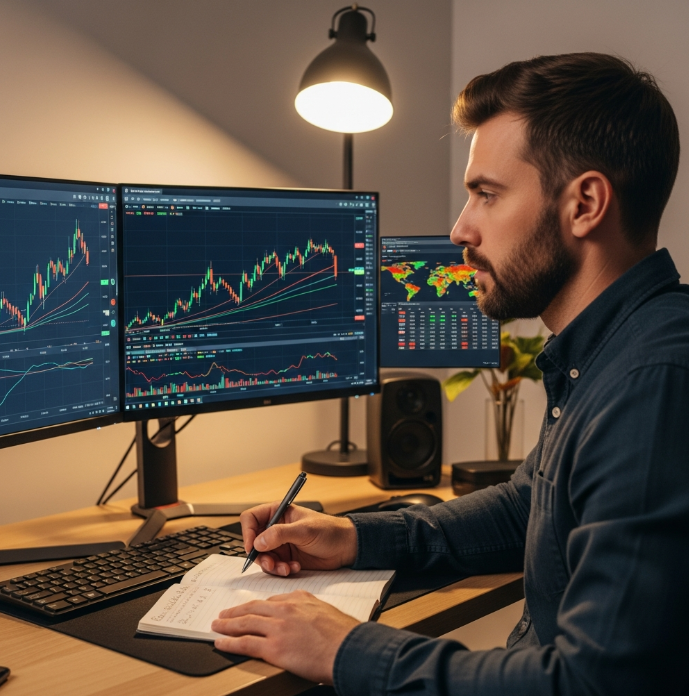
Some folks swear forex is just Vegas with better lighting: spin the wheel, pick a pair, hope for the best. That’s one of those stubborn forex trading myths that refuses to die — and honestly, it’s costing traders real money.
Forex isn’t luck in a fancy wrapper; it’s strategy wearing sneakers. You mess around without a plan, risk rules, or understanding what moves currency pairs? Sure, then it starts to look like gambling. But build a system, respect risk, track macro data, and use tools like MetaTrader 4 — now you’re trading.
This guide breaks down the truth vs. the myth around “Forex is gambling,” so you can:
Stop treating the market like a casino
Start thinking like a risk manager
Use data and structure instead of vibes
Essential Insights: Key Facts Every Trader Should Know
Understanding Currency Pairs
Currency pairs, such as EUR/USD, reflect the value of one currency against another, crucial in making informed trading decisions.
Economic Indicators' Role
Key indicators like GDP growth rate and inflation rate serve as the backbone for strategic trading decisions, not random speculation.
Risk Management is Key
Setting stop-loss orders, using proper position sizing, and avoiding over-leverage are essential to avoid emotional and reckless trading.
Technical Analysis Necessity
Using indicators such as Moving Averages, RSI (Relative Strength Index), and MACD helps traders identify entry and exit points based on historical price data.
The Spectrum of Trading Strategies
Understanding different approaches, such as Day Trading and Position Trading, allows traders to select a strategy aligned with their goals and risk tolerance.
Is Forex Trading Gambling? The Core Question
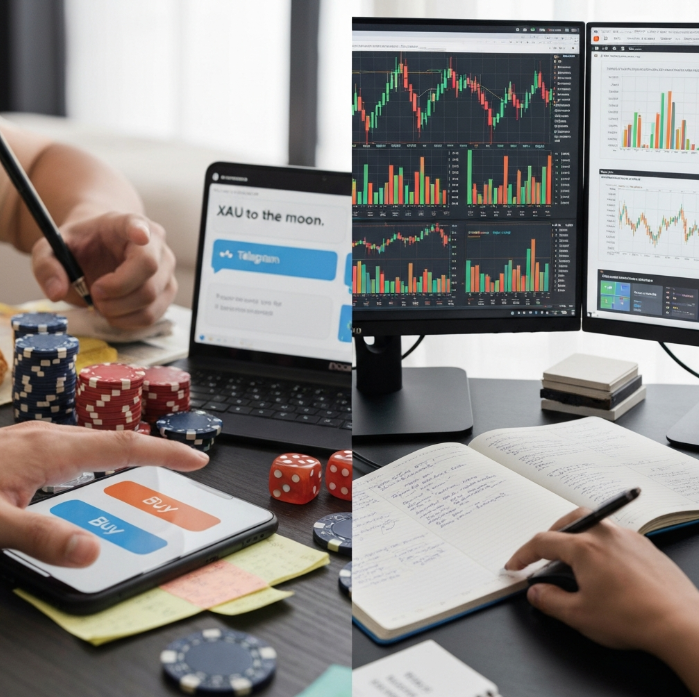
Let’s be blunt: forex can feel like gambling if you treat it like a game — clicking buy and sell because a candle looks “bullish” on Instagram or because some Telegram group said “XAU to the moon.”
But that doesn’t mean forex is gambling by design.
In reality, forex is a financial market where governments, banks, corporations, funds, and retail traders exchange currencies for trade, investment, and speculation.
What separates a trader from a gambler isn’t the market — it’s the mindset and the method:
A gambler relies on luck, emotion, and impulse.
A trader relies on data, probability, and risk management.
So, the real question isn’t “Is forex trading gambling?”
It’s: “Are you trading like a gambler or like a professional?”
Understanding Forex Trading: Myths vs. Reality
Forex trading revolves around currency pairs, quoted as something like EUR/USD = 1.0850, meaning 1 euro is worth 1.0850 US dollars.
These prices move based on real-world forces:
Interest rate decisions
GDP growth and recession signals
Inflation and central bank policy
Employment data (like NFP in the US)
Geopolitical events and risk sentiment
According to the BIS Triennial Survey (2022), over $7.5 trillion is traded daily in forex markets. That’s not a roulette table; that’s the plumbing of the global economy.
When big players hedge exports, rebalance reserves, or shift portfolios, they’re not “rolling dice”; they’re managing macro risk. Retail traders simply plug into the same price stream — but how they behave determines whether what they’re doing looks more like business or bets.
Key Differences Between Forex Trading and Gambling
People love to say “Forex is just like the casino,” but the mechanics are completely different when done correctly:
| Aspect | Gambling (e.g., roulette, slots) | Structured Forex Trading |
|---|---|---|
| Edge | Fixed against you (house edge) | You can build a positive expectancy via strategy, risk-reward, and probability. |
| Information | Outcomes are random and independent | Price reacts to economic data, sentiment, liquidity, and macro trends you can study. |
| Control | You can’t control odds or payouts | You can control risk per trade, position size, entries, exits, and when not to trade. |
| Capital Behavior | Designed to separate you from money over time | Capital can grow over time if you respect risk and manage losses. |
| Time Horizon | Short, impulsive, entertainment-driven | Long-term, systematic, process-driven with journaling and review. |
The problem isn’t forex itself — it’s that many retail traders approach forex with a gambler’s behavior:
All-in positions on one trade
Revenge trading after a loss
Over-leveraging small accounts
Blindly copying “signals” without context
If that’s your approach, then yes — you’re not really “trading.” You’re just gambling with extra steps.
How Professional Traders Treat Forex (Not Like a Casino)
Professional traders — whether at funds, prop firms, or trading seriously from home — don’t see the market as a slot machine. They treat it like:
A business with capital, risk, and return
A probability game where no single trade matters
A craft they refine through data and feedback
Here’s how that looks in practice:
1. They Start with a Written Trading Plan
A serious trader doesn’t just “open MT4 and vibe.” They operate from a written trading plan that covers:
Which pairs they trade (e.g., EUR/USD, XAU/USD, GBP/JPY)
What timeframes they use
Exact entry criteria (patterns, levels, indicators)
Stop-loss and take-profit rules
Maximum risk per trade and per day
That structure is the exact opposite of gambling.
2. They Respect Risk and Position Sizing
Risk management is where the “forex vs gambling” argument is literally won or lost.
Professional traders:
Rarely risk more than 0.5–2% of their account on a single trade
Use stop-losses consistently
Avoid stacking correlated positions (e.g., being long EUR/USD, GBP/USD, and AUD/USD all at once)
Think in terms of risk per idea, not just per trade
A gambler thinks, “If this hits, I double my account.”
A trader thinks, “If this stops out, I still live to trade tomorrow.”
3. They Follow Data, Not Vibes
Casinos don’t care about economic releases. Traders do.
Smart forex traders monitor:
GDP data and growth trends
Interest rate expectations and central bank meetings
Inflation reports (CPI, PCE, etc.)
Employment reports like NFP and jobless claims
Risk sentiment (equity markets, bond yields, VIX, etc.)
Research from institutions like the IMF and from independent FX analysts shows that countries with stronger, more stable GDP growth often see their currencies appreciate or hold value better over time — that’s not coincidence, it’s fundamental cause and effect.
This is why serious traders journal economic events, track correlations, and build strategies around fundamentals instead of just “this candle looks big.”
4. They Use Technical Analysis with a Purpose
Technical analysis isn’t mystical lines and “guru” patterns — it’s a structured way to read crowd behavior through price.
Common tools include:
Moving Averages (trend and dynamic support/resistance)
RSI (overbought/oversold conditions, divergence)
MACD (trend and momentum shifts)
Support & Resistance zones
Chart Patterns (flags, wedges, double tops/bottoms, etc.)
A gambler uses indicators randomly.
A trader uses them in a tested, rule-based system with defined entry and exit criteria.
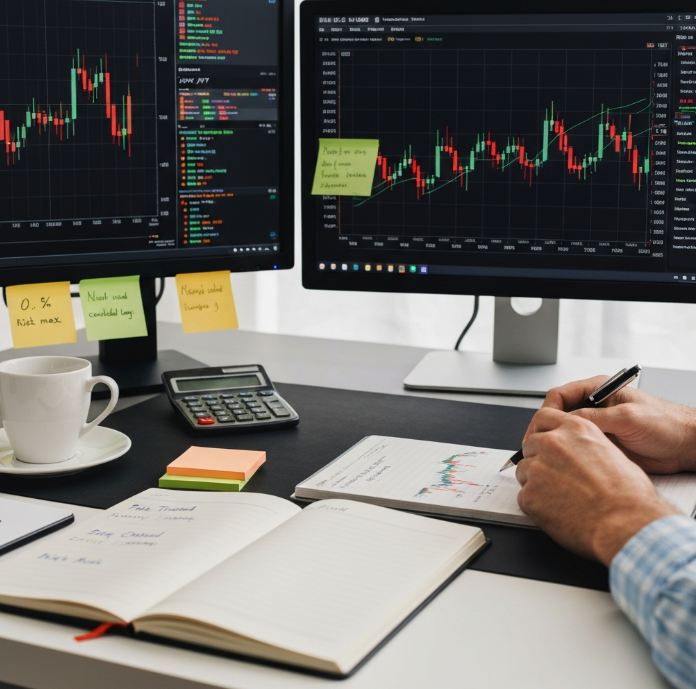
5. They Journal and Review
A casino visitor remembers the wins and forgets the losses. A trader does the opposite: they spreadsheet the pain.
Professional traders:
Record screenshots of setups
Tag trades by strategy, session, and conditions
Review win-rate, average R, and drawdown
Remove or refine strategies that underperform
That continuous feedback loop is what turns a random clicker into a serious operator.
Why Forex Feels Like Gambling for Many Retail Traders
If forex feels like gambling to you right now, there’s probably a reason. Most new traders:
Start with undercapitalized accounts ($50–$300)
Use extreme leverage (1:500, 1:1000)
Open trades based on YouTube, TikTok, or paid signals
Don’t track their trades or risk per position
That combination — small capital, high leverage, emotional entry — produces a chart that looks exactly like a casino player’s chip stack: random spikes, then a slow bleed to zero.
Add in:
Overtrading during news events
Chasing losses after a bad day
Constantly switching strategies
…and you’ve built a psychological casino in your own head.
When Forex Becomes Gambling (Red Flags)
Forex crosses the line into gambling when:
You don’t have a written trading plan
You can’t define your edge in one or two sentences
You don’t know your average risk per trade
You’re trading to feel something (excitement, boredom, ego)
You change lot size randomly based on how you “feel”
If any of those sound like you, it’s not the broker, the market, or “manipulation.”
You’re just playing a game you haven’t read the rules for yet.
When Forex Is a Structured, Strategic Business
On the other hand, forex is absolutely not gambling when:
You use a written trading plan with backtested rules
You risk a fixed percentage per trade
You accept losses as a cost of doing business
You track your performance and continuously optimize
You choose strategies that fit your schedule and personality
For example:
A day trader who only trades London session breakouts on EUR/USD and GBP/USD with a 1:2 risk-reward ratio, risking 1% per trade.
A swing trader who trades daily timeframe pullbacks in major trends, holding positions for days or weeks with tight risk control.
Both may lose on individual trades. But over 50, 100, or 500 trades, their process gives them a fighting chance. That’s not gambling — that’s a business model.
Key Trading Strategies: Day Trading vs. Position Trading
One of the biggest mindset shifts from “gambling” to “trading” is understanding strategies instead of just “setups.”
Day Trading
Day trading involves opening and closing trades within the same day, often within specific sessions like London or New York.
Typical characteristics:
High trade frequency
Lower timeframes (M1–M30)
Tight stops and quick profit targets
Higher emotional pressure
Day trading can easily become gambling if you:
Keep clicking in and out of trades with no rules
Try to “make back” daily losses
Let PnL dictate your mood and decisions
But with discipline, day trading can be a structured edge:
Focusing on one or two pairs
Trading only during high-liquidity hours
Using clearly defined setups (breakouts, pullbacks, mean reversion)
Position Trading
Position trading involves holding trades for weeks or even months, based primarily on macro and fundamental trends.
Typical characteristics:
Low trade frequency
Higher timeframes (H4, Daily, Weekly)
Reliance on macroeconomic themes (e.g., rate cycles, growth trends, risk-on/risk-off)
Wider stops and larger long-term targets
Position traders often rely heavily on:
Long-term interest rate expectations
Central bank policy cycles
GDP momentum and inflation trends
Sovereign risk, credit spreads, and capital flows
Whether you choose day trading or position trading, the key is consistency. A random mix of both, with no rules? That’s when it slides back toward gambling.
The Role of Risk Management: The Real Line Between Trading and Gambling
Risk management is where the gambling myth truly dies.
Here’s the uncomfortable truth: even good traders have strings of losing trades. What keeps them in the game is how they size risk and control damage.
Solid risk management includes:
Using stop-losses on every trade
Avoiding risking more than 1–2% of capital per position
Limiting total daily or weekly drawdown (e.g., stop trading after -3% in a day)
Avoiding correlated exposure (e.g., being long multiple JPY crosses at once)
Look at it this way:
A gambler keeps betting bigger after every loss.
A trader keeps risk constant and size logical relative to equity.
That’s why professional traders can have losing months and still survive. Gambler-style traders usually blow up at the first real drawdown.
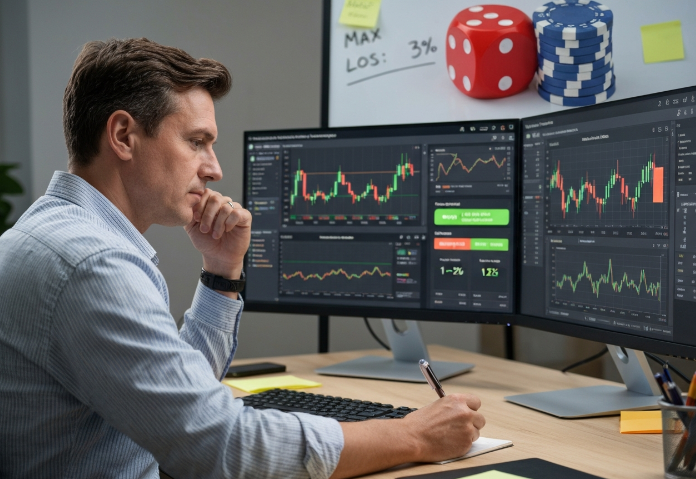
The Role of Psychology: Why Your Brain Wants Forex to Feel Like Gambling
Human brains are not built for probability. We love:
Fast rewards
High dopamine
“All-in” moments
Forex offers all of that — flashing candles, floating PnL, instant feedback. It’s incredibly easy for trading to become a dopamine machine instead of a disciplined practice.
Trading starts to look like gambling when:
You check your phone every 30 seconds
You move stop-losses because “it’ll come back”
You feel physical stress watching a trade
Your mood is tied to every pip
The solution?
Pre-plan trades (entry, stop, target)
Use alerts instead of staring at charts
Size risk so a loss doesn’t hurt emotionally
Take breaks away from screens
In other words: treat trading like a job, not a slot machine.
Bonus: Evidence-Based View – What the Data Actually Says
Let’s move beyond opinion and look at what larger-scale data and research suggest about trading, risk, and outcomes:
| Source | Key Takeaway | What It Means for “Is Forex Gambling?” |
|---|---|---|
| Bank for International Settlements (BIS) 2022 | Daily FX turnover reached around $7.5 trillion, driven largely by institutions, hedging, and capital flows. | The market exists primarily for global finance and trade, not as a casino game. |
| IMF & World Bank research | Stronger, more stable GDP growth tends to support currency performance over time. | Currency trends are tied to real economic fundamentals, not random outcomes. |
| CFTC / ESMA retail trading data | A high percentage of retail CFD/forex traders lose money, often due to over-leverage and poor risk management. | The problem isn’t the market; it’s undisciplined behavior that resembles gambling. |
| Academic & quant studies on technical strategies (e.g. arXiv) | Many single-indicator strategies underperform, but combining technical tools with sound risk management can improve consistency. | Trading outcomes depend heavily on system design and discipline, not luck alone. |
None of this proves that “forex = guaranteed profit” (it’s not). What it does show is that:
The market is a real economic mechanism, not a slot machine.
The behavior of traders is what makes it look like gambling — or like a serious business.
Practical Checklist: Are You Trading or Gambling?
Use this checklist to get brutally honest with yourself. If you answer “No” to most of these, you’re probably closer to gambling than trading:
Do you have a written trading plan?
Do you know your exact entry, exit, and invalidation rules?
Do you risk a fixed percentage (or amount) per trade?
Do you track your trades in a journal or spreadsheet?
Do you avoid trading when emotionally charged (angry, stressed, euphoric)?
Do you treat your trading capital as business capital, not “extra money to play with”?
If you want to move away from “gambling mode,” start by fixing the process, not chasing the perfect setup.
Final Verdict: Is Forex Trading Gambling?
Here’s the truth:
Forex can be gambling when you trade without a plan, ignore risk, chase signals, and let emotions run the show.
Forex is not gambling when you treat it like a professional does: with structure, data, risk management, and long-term thinking.
The market doesn’t care whether you win or lose. It doesn’t know you exist.
Which means the verdict isn’t really about forex at all.
It’s about you.
Are you sitting at a casino table — or building a trading business?
The answer will always come from your process, not your opinion.
References
BIS Triennial Central Bank Survey 2022 – Foreign exchange turnover – https://www.bis.org/statistics/rpfx22.htm
New retail investors in France: Attitudes, knowledge and behaviours (OECD, 2023) – https://www.oecd.org/content/dam/oecd/en/publications/reports/2023/10/new-retail-investors-in-france_9aecd005/2cd2565d-en.pdf
How GDP Can Influence Currency Trades (Investopedia) – https://www.investopedia.com/articles/forex/11/trading-gdp-like-a-currency-trader.asp
How does GDP affect Forex trading? (Blueberry Markets) – https://blueberrymarkets.com/market-analysis/explained/how-does-gdp-affect-forex-trading
World Economic Outlook (IMF) – https://www.imf.org/en/publications/weo
Why do most retail traders fail and what can I do to improve my chances of success? (FXStreet) – https://www.fxstreet.com/education/why-do-most-retail-traders-fail-and-what-can-i-do-to-improve-my-chances-of-success-202503311406
A comparative study of the MACD-based trading strategies: evidence from the US stock market (arXiv) – https://arxiv.org/abs/2206.12282
Relative Strength Index (RSI) Definition (Investopedia) – https://www.investopedia.com/terms/r/rsi.asp
FAQ
Why do new traders often think forex is all luck and guessing?
Many beginners believe trading EUR/USD or GBP/JPY runs purely on chance; yet, disciplined use of Moving Averages, RSI, and MACD Oscillator exposes repeating market rhythms more than randomness ever could.
Small revelations—Interest Rate Decisions from central banks or Inflation Rate adjustments—show patterns much like predictable beats rather than chaotic tosses of dice.
Summary: Luck ends where observation begins; technical clarity replaces myth with measurable confidence.
Is huge capital required to survive in the forex world?
Short description + Multi-column structure guiding perspective
| Common Thought | Real Insight |
|---|---|
| Only big accounts can profit | Careful Position Sizing allows small trades in AUD/USD without draining funds |
| Expensive equipment matters most | Even with MetaTrader 4 or cTrader Platform, discipline outweighs tool price |
| Wide margins guarantee success | Smart Stop Loss Orders guard against sharp USD/CHF swings better than oversized bets |
Bravery lies not in volume but precision—the trader mastering Risk Reward Ratio wins consistency over spectacle.
Does chart reading truly remove speculation?
☑ Symbols carve emotion into strategy: a Head and Shoulders warns reversal, while Rising Wedge hints compression before breakout.
☑ Bollinger Bands whisper volatility tightening; Fibonacci Retracement paints key balance lines for trend followers using Swing Trading technique across NZD/USD moves.
→ Tension builds as traders decode these visual signals—numbers telling stories no rumor can match.
How does smart risk management silence fear during losses?
➤ Day Trading may tempt reactionary acts after CPI reports sway prices wildly; yet true composure rests in preset protection: Stop Loss Orders close wounds early while Take Profit Levels mark victory points beforehand.
➤ Hedging Techniques spread exposure—smoothing uncertainty when GBP/JPY surges irrationally overnight under sudden GDP Growth Rate news flow.
⮕ In essence: every controlled exit preserves strength for tomorrow’s calculated entry; faith shifts from hope to structured defense built inside each trade plan on TradingView Charts or NinjaTrader Platform.