


You know what’s wild? A lot of folks dive into forex trading in India thinking it’s all Wall Street swagger and fast cash. But here’s the kicker—unless you’re riding on RBI-approved rails, you're basically playing poker at a cop convention. The rules aren’t just red tape—they’re landmines. Every trade outside those INR-based pairs could cost you more than a bad bet on GameStop in 2021.
Most people don’t trip up because they’re reckless—it’s ‘cause no one ever spelled out where the legal line actually is. So if your head's spinning with terms like FEMA, SEBI, or wondering if MetaTrader 5 is even allowed here…buckle up. We’re about to clear the fog with facts that matter—and keep your trades outta trouble.
Is Forex Trading Legal in India? The Basics Explained
Quick heads-up: this one’s all about how forex trading in India works, the tools you’ll need, and how to stay smart with your trades.
India doesn’t ban forex outright—but it does lock it inside a tight legal framework. Under the Foreign Exchange Management Act (FEMA), the RBI and SEBI control what you can trade, where, and with whom. In practice, that means:
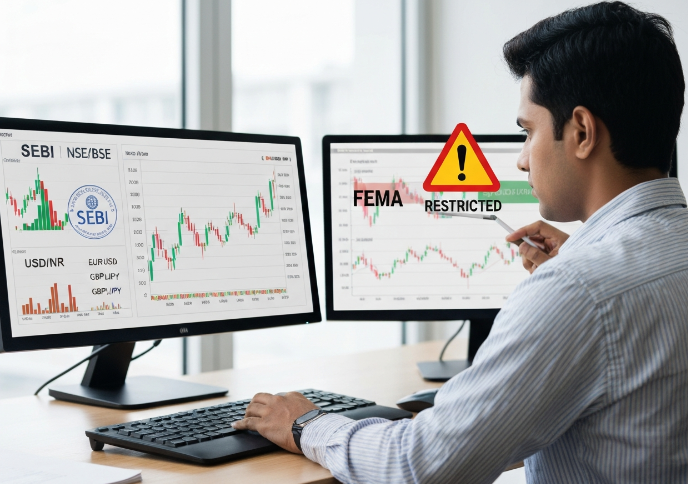
You can legally trade only certain INR-based currency derivatives (like USD/INR, EUR/INR, GBP/INR, JPY/INR) and a few SEBI-approved cross-currency pairs on Indian exchanges such as NSE and BSE.
You must use SEBI-registered brokers and recognized exchanges—no offshore “high-leverage” apps.
Anything beyond that—like trading EUR/USD or GBP/JPY on some slick overseas app—drifts into “illegal under FEMA” territory.
Understanding Currency Pairs: EUR/USD, GBP/INR, and Beyond
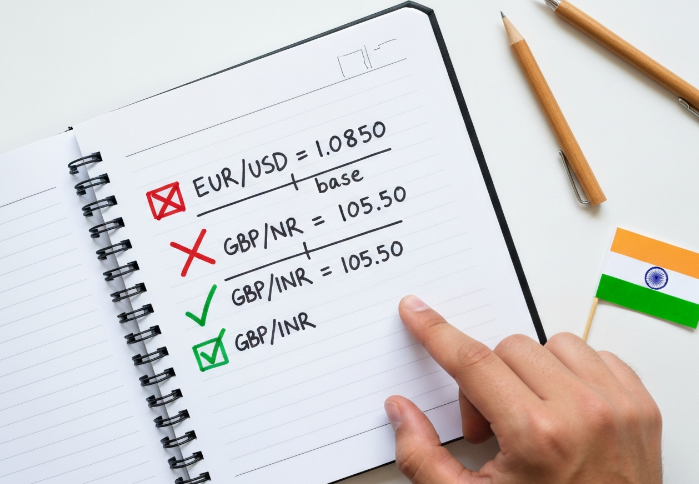
Currency pair basics start with two parts—the base currency (first) and the quote currency (second). So in EUR/USD, you’re seeing how many U.S. dollars it takes to buy 1 euro.
When you see EUR/USD = 1.0850, that means 1 euro costs 1.0850 dollars.
For GBP/INR, the pound is the base, the rupee is the quote—so you’re effectively betting on the rupee strengthening or weakening against the British pound.
In global markets, traders jump between majors like EUR/USD, GBP/USD, or USD/JPY all the time. But here’s the India-specific twist:
Indian traders can legally trade only certain pairs involving INR like USD/INR, EUR/INR, GBP/INR, and JPY/INR on regulated exchanges.
Major pairs like EUR/USD or cross pairs such as EUR/JPY aren’t allowed for retail trading under Indian regulations unless accessed as SEBI-approved exchange-traded derivatives via Indian brokers.
? Volatility matters—pairs like EUR/USD are super liquid and move a lot during London and New York sessions, making them attractive globally but off-limits for direct spot trading in India. If you’re in India, sticking to INR-linked and SEBI-approved contracts keeps you both legal and safer from surprise knocks on the door.
Overview of Trading Platforms: MetaTrader 4 vs. MetaTrader 5
Let’s talk tools.
MetaTrader 4 (MT4) has been the OG platform for forex traders for years:
Simple interface
Massive library of indicators and EAs (trading robots)
Lightweight and friendly for beginners
MetaTrader 5 (MT5) is the newer, upgraded version:
Supports more asset classes beyond forex including stocks and commodities
More order types and advanced tools
Better backtesting and multi-threaded performance
According to industry intelligence reports from Finance Magnates, MT5 has been steadily overtaking MT4 in global trading volume since 2025, as brokers push multi-asset offerings and tighter integration.
In India, both MetaTrader 4 and MetaTrader 5 can be part of a legal setup only if:
Your account is with a SEBI-registered broker
You trade INR-based or SEBI-approved exchange-traded currency derivatives
Orders are routed through recognized Indian exchanges
If you’re firing trades from MT4/MT5 into offshore brokers offering 1:500 leverage on EUR/USD while sitting in Mumbai—that’s a FEMA problem, not a “just testing my strategy” moment.
Most of the time, the platforms themselves are free via your chosen broker, but always pick one that fits your style—not just what influencers hype.
.png "MT4 vs. MT5 Platforms (Trading Setup).png")
Key Trading Strategies for Beginners in India
Let’s break it down into three go-to moves when starting out:
Day Trading – Quick in-and-out trades within a single day using intraday trends on pairs like USD/INR futures.
Swing Trading – Holding positions for several days to capture medium-term moves, often based on price patterns and support/resistance.
Trend Following – Riding longer-term market trends instead of predicting tops and bottoms—often built into broader forex trading strategy frameworks.
And hey—don’t forget risk control! Set your stop-losses early, don’t risk more than a small percentage of your account on any one trade, and avoid revenge trading no matter what the chart says.
Even if you're just dipping your toes into forex trading from India, these strategies help keep things grounded while you learn the ropes step-by-step.
5 Key Regulations for Forex Trading in India
Getting into forex trading in India? You’ll want to know these rules before making your first move.
SEBI and Its Role in Regulating Forex Markets
SEBI (Securities and Exchange Board of India) is the market watchdog keeping an eye on brokers, exchanges, and how instruments are offered to retail traders. In simple terms:
It ensures brokers offering forex derivatives are properly registered.
It defines which contracts (like USD/INR futures) can be listed on exchanges such as NSE, BSE, and MSE.
It sets rules for leverage, margin, and risk disclosure.
Under SEBI and RBI’s combined framework:
Only currency derivatives listed on recognized Indian exchanges and involving approved currency pairs are allowed for residents.
Trading via international platforms that bypass Indian exchanges is considered a violation of FEMA and can invite penalties.
Platforms and cashback services that integrate with regulated brokers—for example rebate programs like EasyCashbackFX that focus on forex cashback—keep your trading aligned with this framework while helping lower your overall costs per trade.

The Importance of Risk Management: Leverage and Margin
Legal trading doesn’t mean safe trading. Leverage cuts both ways.
Here’s a quick look at how margin and risk usually shake out:
| Risk Factor | Margin Level (%) | Risk View | Notes |
|---|---|---|---|
| Healthy account | Above 100% | Safer buffer | You can withstand normal volatility. |
| Warning zone | 50–100% | Elevated risk | Need to reduce position size or hedge. |
| Danger zone | Below 50% | Liquidation risk | Broker can start closing your trades. |
If your account is always flirting with danger zones, you’re playing with fire—and not in a good way. Managing capital isn’t boring; it’s survival.
Types of Orders You Can Implement
Different order types can help automate discipline:
Market Order – Executes instantly at current market price; good for fast-moving setups.
Limit Order – Sets a better entry price to avoid chasing the market.
Stop-Loss Order – Automatically closes your trade at a pre-defined loss level.
Take-Profit Order – Locks in gains once your target is reached.
Putting it together:
Want protection? Use a stop-loss order, which shuts down losing trades automatically.
Lock in gains with take-profit orders, so wins don’t turn into losses.
Don’t over-leverage just because your broker allows it—SEBI’s caps exist for a reason.
Legal Standing of Popular Forex Platforms: cTrader vs. TradingView
Trading tools like cTrader, MetaTrader, or even browser-based WebTraders look flashy—but legality in India doesn’t depend on the app’s color scheme. It’s about:
Where your trades are routed
Whether the broker is SEBI-registered
Whether instruments are listed on recognized Indian exchanges
Regulators and major broker guides consistently stress that residents must trade only through authorized dealers and SEBI-registered brokers in permitted currency derivatives; using offshore platforms for leveraged forex falls outside this framework.
So yeah—before you fall in love with a new platform UI, remember: legality isn't about brand names; it’s about routing your orders through brokers that are actually allowed to operate under Indian law. EasyCashbackFX keeps things transparent while rewarding smart trading moves across supported platforms that play by Indian rules.
Legal Consequences of Illegal Forex Trading
Getting into forex trading in India without knowing the law is like driving blindfolded on a highway—you might be fine for a bit, but one wrong move and you’re in a wreck.
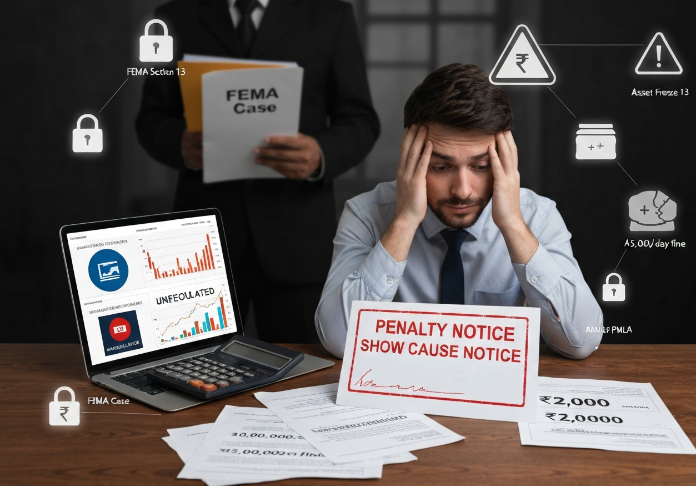
Here’s what breaking FEMA provisions and RBI guidelines could really cost you:
? Monetary penalties – Under FEMA Section 13, penalties can go up to three times the amount involved, or up to ₹2,00,000 if the amount isn’t quantifiable, plus a further penalty that may extend to ₹5,000 per day if the violation continues.
? Asset and account action – The Enforcement Directorate (ED) can investigate, attach funds, or freeze assets in serious or repeated violations, especially when money laundering or fraud is suspected.
? Regulatory scrutiny – Using unregulated brokers or betting on non-INR pairs through offshore apps puts you squarely on the wrong side of FEMA and can lead to show-cause notices, hearings, and long compliance headaches.
Below is a simplified look at how penalties can stack up:
| Offense Type | Penalty Amount (FEMA Section 13) | Daily Fine Rate (Continuing Offence) | Jail Term Potential* |
|---|---|---|---|
| General FEMA contravention (e.g., unauthorized forex) | Up to 3× the amount involved, or up to ₹2,00,000 | Up to ₹5,000 per day | Civil under FEMA; typically monetary, but non-compliance can escalate scrutiny. |
| Serious/repeated violations with fraud or laundering | Penalties plus possible confiscation of assets/funds | Case-specific | In extreme cases, related laws (like PMLA) can involve up to 7 years or more |
*Imprisonment comes from related criminal laws (like the Prevention of Money Laundering Act), not from routine FEMA contraventions alone—but illegal forex can be the trigger that drags you into that mess.
Trying your luck outside legal boundaries may seem tempting—but don’t let ignorance turn into regret.
How Compliance Avoids Legal Issues in Forex Trading
Want peace of mind while trading? Stick with what's legit. Follow these principles and you’ll dramatically reduce your risk:
✔️ Trade only via authorized channels, like SEBI-recognized brokers.
✔️ Stick to INR-based currency derivatives and SEBI-approved cross-currency contracts; anything else is off-limits under current rules.
✔️ Avoid offshore apps promising crazy leverage or guaranteed monthly returns—recent fraud cases in India show how often these blow up on unsuspecting traders.
✔️ Keep proper records of deposits, withdrawals, and contract notes from your broker—these become your first line of defence if questions ever come up.
By staying on approved paths, you’re not just avoiding fines—you’re actively protecting your capital and reputation. Cashback services like EasyCashbackFX that partner only with regulated brokers let you earn forex rebates on every compliant trade, stacking savings on top of legal safety.
So yeah—when it comes to legal trading? Play it safe, play it smart.
References
Is Forex Trading Legal in India? Rules, Restrictions, and What’s Allowed – https://www.5paisa.com/blog/is-forex-trading-legal-in-india-rules-restrictions-and-what-allowed
Is Forex Trading Legal in India? All You Need to Know About Legalities and Penalties – https://upstox.com/learning-center/online-trading/is-forex-trading-legal-in-india-all-you-need-to-know-about-legalities-and-penalties/article-1479/
RBI – FAQs on Forex Derivatives for Residents – https://www.rbi.org.in/commonman/english/scripts/FAQs.aspx?Id=3347
FEMA Section 13 – Penalties for Contravention (summarised) – https://www.taxtmi.com/article/detailed?id=6656
Compounding of Contraventions under FEMA – https://carajput.com/blog/corporate-and-professional-update-nov-1-2016/
RBI Foreign Exchange Guidelines: Key Penalties and Risks – https://razorpay.com/blog/rbi-foreign-exchange-guidelines/
What Is the Punishment for Forex Trading in India – https://www.motilaloswal.com/learning-centre/2022/5/what-is-the-punishment-for-forex-trading-in-india
Foreign Exchange Management Act, 1999 (Overview) – https://en.wikipedia.org/wiki/Foreign_Exchange_Management_Act
FAQ
What currency pairs are legal for forex trading in India?
Trading law here is strict: only INR-based combinations like GBP/INR, USD/INR, EUR/INR, JPY/INR breathe freely on SEBI-approved floors. If you wander toward EUR/USD or AUD/USD without RBI-sanctioned channels, you’re stepping into risky territory.
Is MetaTrader 4 or MetaTrader 5 safe to use locally?
MT4 and MT5 feel right at home provided they connect through a SEBI-registered broker who offers permitted INR trades. This keeps your chart whisperings—be it RSI flashes or Moving Average slopes—for legal ears only.
Which order types should new Indian traders grasp first?
Like tools in an artist’s box:
Market Order: quick brushstroke at the live price—USD/CAD included if globally accessed via compliant path.
Limit Order: patient stroke waiting for its perfect shade of value.
Stop Loss Order: protective frame against sudden shocks such as a Double Top collapse on GBP/INR charts.
Are trend-following strategies effective within India's limits?
Watching Moving Averages cross is like tracking tides—the pull steady over time across liquid INR-linked markets. Pair that with Fibonacci Retracement lines and you can ride waves without losing sight of shoreline support levels.
How important is risk management when starting forex trading here?
It’s the heartbeat of survival—Position Sizing sets rhythm; Risk Reward Ratio decides dance length; Margin control prevents exhaustion mid-step; Capital Preservation ensures you return tomorrow to meet fresh Head and Shoulders setups with calm eyes instead of trembling hands.