
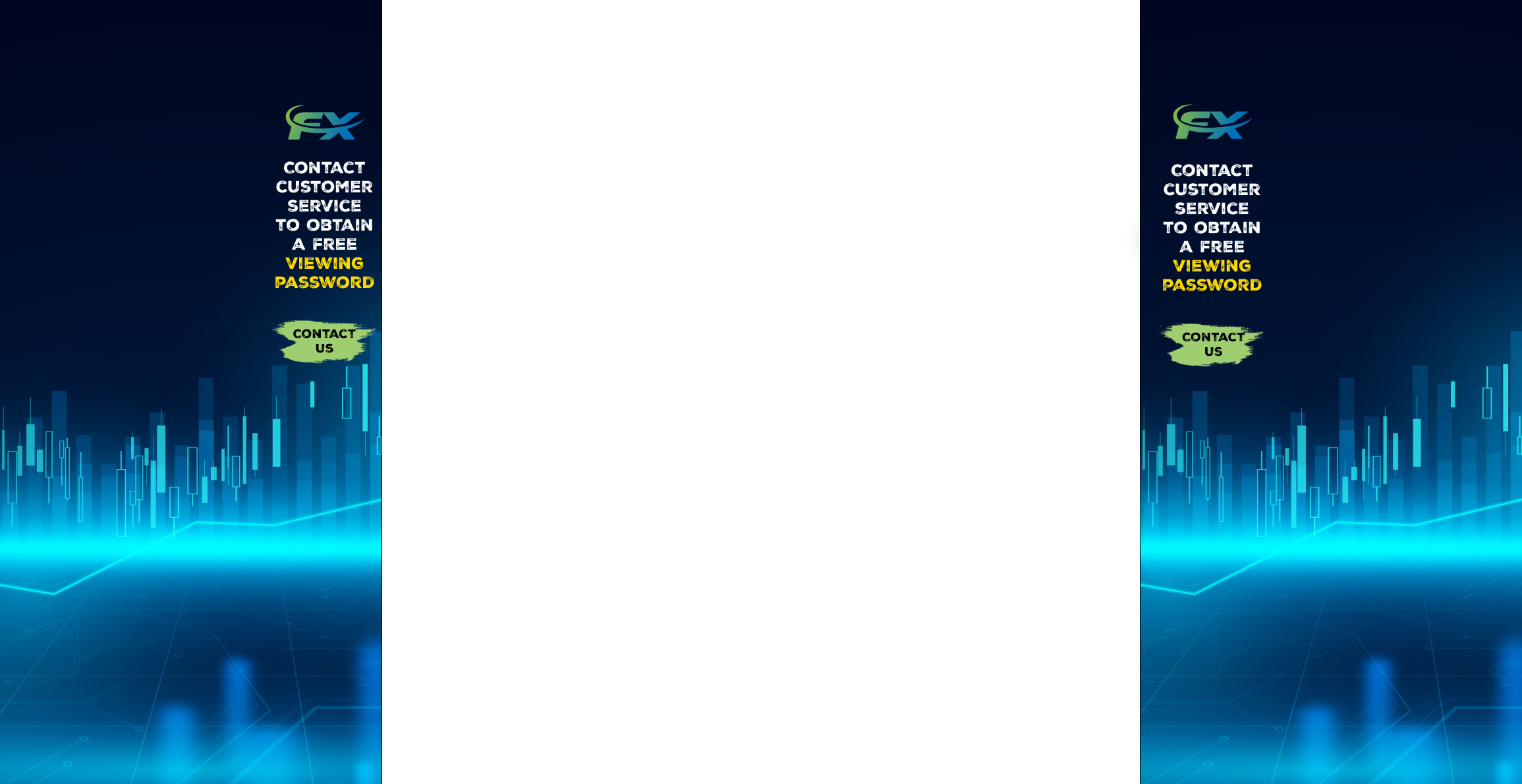

You ever watch someone win big in forex and think, “What sorcery is this?” Buckle up. If you’re trading on iq option forex and still guessing what a pip actually means for your wallet, friend—you might be bleeding profits without even knowing it. Pips aren’t just numbers; they’re the heartbeat of your trade, telling you exactly how much you're making—or losing—per tick.
One misstep in pip math, and poof—there goes your weekend getaway fund. We’ve seen traders crash hard by misjudging position size or skipping stop-loss setups entirely. But truth is? Calculating pip profit isn’t rocket science… when you know where to look.
If this still feels fuzzy, spending a little time with structured forex education will make everything below click much faster.
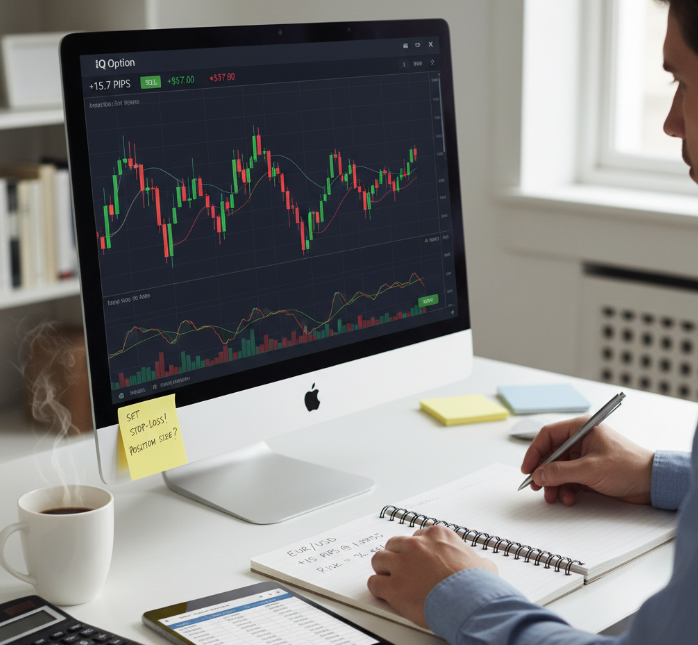
Quick Insights for IQ Option Forex Traders
→ Understanding Pips: Pips represent the smallest price movement in forex trading, impacting trade profits and losses significantly.
→ Calculating Pip Profit: Use the formula: Lot size x Pip value x Pip movement (in pips) for accurate profit calculations on currency pairs like USD/CHF.
→ Risk Management: Properly assess position sizing and understand risk-reward ratios to avoid common pitfalls in pip profit calculations.
→ Trading Strategies: Choose between strategies like scalping or day trading, depending on your trading goals and time availability on IQ Option.
→ Utilizing Technical Indicators: Indicators such as Moving Averages and RSI help refine your pip-based trading decisions and contribute to effective profit calculations.
What Is a Pip and How Does It Work?
Understanding what a pip is might seem small-time, but it’s the cornerstone of every forex move you make. If you don’t know how much each pip is worth in cash, you’re basically driving blind at 120 km/h with the headlights off.
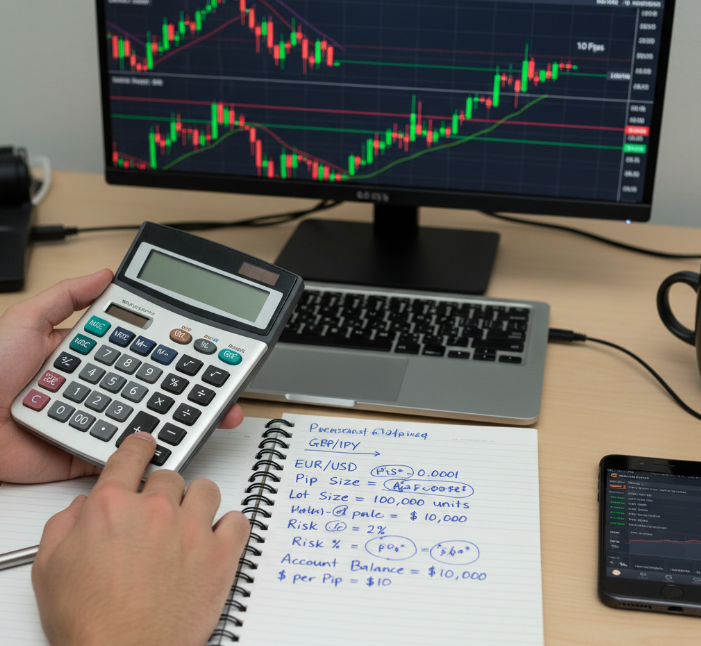
Understanding Pip Values in EUR/USD and GBP/JPY
Pip values can feel like a mystery until you see how they shift with each currency pair. Here’s how it plays out:
EUR/USD usually has four decimal places, so one pip equals 0.0001.
GBP/JPY, as a JPY pair, often quotes to two decimal places, so one pip equals 0.01.
The size of the trade influences the actual pip value—for a standard lot, that’s around $10 per pip on EUR/USD.
Mini and micro lots drop the pip value, letting you manage risk more precisely.
| Pair | Typical Quote Format | Pip Size | Value per Pip (Standard Lot) |
|---|---|---|---|
| EUR/USD | 1.1050 | 0.0001 | ≈ $10 |
| GBP/JPY | 186.40 | 0.01 | ≈ $9 (varies with rate) |
| USD/CHF | 0.9050 | 0.0001 | ≈ $10 (when CHF ≈ 1 USD) |
| AUD/USD | 0.6700 | 0.0001 | ≈ $10 |
The exact value can shift slightly depending on live prices, but knowing these approximations gives you instant clarity when setting up trades.
The Role of Pips in Forex Trading Strategies
Pips are the universal “scoreboard” of forex trading strategies:
Scalpers hunt for 3–10 pips at a time but rely on high frequency and razor-thin spreads.
Day traders look for 20–50 pip intraday swings, often pairing technical patterns with news spikes.
Swing traders might chase 100+ pips over days, layering technical zones with macro themes.
According to the Bank for International Settlements, global OTC forex markets saw around $7.5 trillion traded per day in April 2022—proof that even moves of just a few pips can scale into huge gains or losses when volume is that massive.
So whether you're testing waters with iq option forex or scaling up a serious account, understanding how pip moves align with your strategy is non-negotiable.
Why Pips Matter: Impact on Risk Management
Let’s say you’re trading with a $5,000 account:
You risk 2% per trade → that’s $100.
Your stop loss is 20 pips away from entry.
That means you can afford $5 per pip risk.
So your position size must be chosen so that each pip = $5. Panic-clicking lot sizes without this math? That’s how accounts disappear.
Pips link your trade idea to real dollar risk. They connect your chart lines, stop losses, and take profit levels back to your actual account balance—so you’re not blindsided when a “tiny” move becomes a big loss.
Basic Formula for Calculating Pip Profit
Quick math meets smart trading here—this is where you figure out how to turn tiny pip moves into real cash on the charts, using the same kind of forex trading calculation you’ll lean on no matter which broker or platform you use.
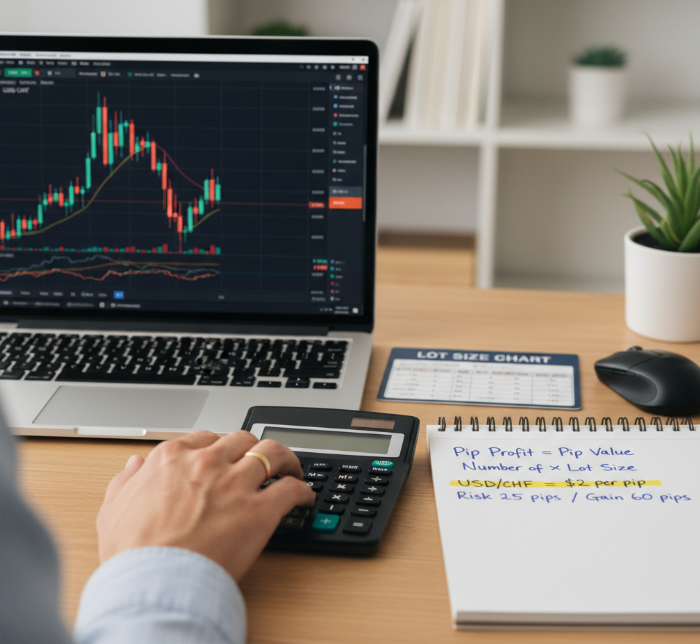
Formula Breakdown: What You Need to Know About USD/CHF
Let’s break it down using the USD/CHF currency pair, which often trips traders up due to its pricing and how pip value is derived.
Pip Profit = Pip Value × Number of Pips Gained (or Lost) × Lot Size
For USD-quoted pairs, pip math is simpler, but USD/CHF adds a twist because the quote currency is CHF, not USD.
A standard lot equals 100,000 units of the base currency, so one pip is usually close to $10 per pip—unless you’re trading micro or mini lots, of course.
To calculate profit: multiply your lot size by the pip value and then by the number of pips gained or lost during the trade.
If you’d rather avoid manual math, you can cross-check these numbers with a forex pip calculator or a forex profit calculator before placing the order.
On platforms like IQ Option, this calculation happens in the background—but knowing the math helps you avoid dumb mistakes when setting up trades manually.
Influential Factors: Position Sizing and Risk Reward Ratio
Your pip profit per trade doesn’t just depend on how far price moves—it’s also tied to:
Position size: Bigger lots mean bigger pip value, which amplifies both wins and losses.
Risk-reward ratio: A 1:3 setup (risking 20 pips to target 60 pips) can make you profitable even if you’re wrong more often than you’re right.
Account size: A $500 account cannot handle the same pip value per trade as a $10,000 account.
Smart traders reverse-engineer this:
Decide how much they’re willing to lose (e.g., $50).
Decide a reasonable stop loss in pips (e.g., 25 pips).
Calculate allowable pip value ($50 ÷ 25 = $2 per pip).
Adjust lot size until each pip ≈ $2.
This way, every pip is pre-planned, not guessed.
How to Use IQ Option Forex for Profit Calculations
IQ Option gives you clean visuals and straightforward P&L displays—but only if you know where to look and what the numbers are actually saying.
Accessing Profit Calculations on IQ Option: Step-by-Step
Here’s a quick path to seeing pip-driven profit numbers in real time:
Open the IQ Option platform and switch to the Forex section.
Select your currency pair (e.g., EUR/USD, GBP/JPY, USD/CHF).
Set your investment amount and multiplier (akin to leverage).
Place your Buy or Sell order.
Watch the live profit/loss panel—this reflects your open P&L as price moves in pips.
Use the chart’s price scale to estimate how many pips away your stop loss or manual exit might be.
While IQ Option shows profit in currency terms, mapping that back to pips and lot-equivalents gives you a deeper understanding of whether a setup is worth the risk.
Navigating MetaTrader 4 for Enhanced Calculation Accuracy
If you're serious about precision, syncing MetaTrader 4 (MT4) with your IQ Option account is a no-brainer.
You can:
Use MT4 to analyze charts with pro-level tools.
Measure pip distances between support, resistance, and trendlines.
Backtest strategies using historical price data.
Track exact pip movement before committing on IQ Option.
MT4’s advanced chart tools (like crosshairs and measurement tools) help you see if a 30-pip stop with a 15-pip target is just bad math before you ever click “Buy.”
Using Technical Indicators: Impact of Moving Average and RSI
Indicators can turn chaotic charts into structured decision zones.
Moving Averages (MA):
Help you see overall trend direction.
Can act as dynamic support or resistance.
Smooth out noise, allowing you to set pip targets aligned with trend flow.
Relative Strength Index (RSI):
Shows overbought/oversold conditions.
Helps filter out bad entries when the market’s already stretched.
Combines well with MA crossovers to catch high-probability moves.
Education resources from brokers and analysts such as FXCM's guide to the Relative Strength Index (RSI) show that combining Moving Averages with RSI can help traders filter noise and improve trade timing, especially in trending markets.
Together, MA + RSI let you time entries so that your pip targets fit both momentum and structure instead of wishful thinking.
Exploring Trading Strategies: Scalping vs. Day Trading on IQ Option
Picking between these two strategies depends on how fast you want results—and how much screen time you're willing to commit.
Scalping:
Super short-term trades lasting seconds or minutes.
Targets are tiny—often 5–10 pips.
Requires tight spreads and fast execution.
Demands constant monitoring.
Relies heavily on market volatility spikes.
Day Trading:
Trades last from minutes up to several hours.
Targets range from 20–60 pips.
Less screen-intensive than scalping, but still active.
Better suited for analyzing trends using indicators like MA & RSI.
Both strategies can work well within the structure of iq option forex, especially if you match them with solid risk control techniques like stop-losses and position sizing.
Whether you're chasing pips quickly or playing out longer intraday swings, testing both styles in demo mode can really pay off before risking real capital.
Whichever path you choose, treat it as a structured forex trading strategy with clear rules for entries, exits, and risk.
Calculating Forex Pip Profit: 3 Easy Steps
Now let’s get practical and walk through this with a pair many traders love: AUD/USD.
Step 1: Select Your Currency Pair - Focus on AUD/USD
Choosing a currency pair isn't just about picking favorites—it’s about volatility, spread, and how cleanly it trends.
AUD/USD is popular because:
It reacts clearly to commodity prices and Chinese data.
It tends to respect technical levels reasonably well.
Spreads are often tight, making pip targeting more efficient.
Stick with one or two familiar pairs at first; it makes it easier to spot opportunities without overcomplicating things.
Step 2: Determine Entry and Exit Points Using Fibonacci Retracement
Pinpointing where to jump in or bail out can make or break your pip profit. Fibonacci Retracement helps with that.
You might:
Identify a recent swing high and swing low.
Plot Fibonacci levels (e.g., 38.2%, 50%, 61.8%).
Wait for price to pull back to a Fib level that aligns with other clues—trendlines, MA, or support/resistance.
Use that confluence as your entry point and a nearby structure break as your stop loss.
This way, your pip target isn’t random—it’s based on areas where traders historically step in or out.
Step 3: Employing Take Profit and Stop Loss Effects
Don’t ride blind—use a combo of Take Profit and Stop Loss orders to lock in pip targets.
For example:
Entry: 0.6700 (AUD/USD long).
Stop Loss: 0.6680 (20 pips risk).
Take Profit: 0.6740 (40 pips reward).
Risk-reward ratio: 1:2. You’re risking 20 pips to potentially gain 40. Repeat this kind of logic over dozens of trades and your pip math starts leaning in your favor—even if you’re not right every time.
Calculate Pip Profit in Different Market Conditions
Different market moods call for different pip math strategies—because not all conditions are created equal.
| Market Type | Pip Targets | Spread Sensitivity | Ideal Strategy Type |
|---|---|---|---|
| Ranging | Small (5–15) | High | Scalping |
| Trending | Medium (20–50) | Moderate | Day trading / Swing |
| Breakout | Large (50–100+) | Moderate/High | News or breakout plays |
| Stable | Tight | Moderate | Swing trading setups |
In volatile markets, pip values can spike fast—great for quick profits but brutal if stops are too tight or you’re over-leveraged. Calm markets reward patience but punish greed if targets are unrealistic.
Real-Life Examples: Profiting Through Economic Indicators
Here’s where real-world events meet profit potential—and yes, it gets exciting fast. Keeping an eye on an economic calendar means you’re never surprised when news is about to shake your pip calculations.
When Australia hikes interest rates unexpectedly? The AUD usually strengthens. When the US drops a blockbuster jobs report? The USD often surges or tanks, depending on the surprise. Layering these fundamental cues over technicals like Fibonacci zones is where pip math gets powerful.
Short bursts:
A strong US Non-Farm Payroll (NFP) report? Watch USD strength push AUD/USD lower.
Weak Australian CPI figures? Expect bearish pressure on AUD.
Central bank commentary? Can shift sentiment within minutes—stay alert!
Market commentary frequently notes that interest rate decisions and broader monetary policy are among the primary drivers of intraday pip movement across major currency pairs—a reminder to track fundamentals alongside your technical setups.
Combine that insight with smart chart reading on IQ Option, and you’ve got yourself a potent mix of fundamentals + technicals working together.
Common Mistakes in Pip Profit Calculations
Sloppy pip math can wreck your trade setup faster than you’d think—especially with patterns and hedging.

The Importance of Accurate Measurements in Falling Wedge Patterns
When working with a Falling Wedge, eyeballing isn't good enough—you need precision like a sniper, not a shotgun blast.
Misplacing the lower or upper trendline distorts your breakout projection.
Incorrect pip range calculation between wedge points leads to false expectations.
Ignoring volatility near breakout zones creates misleading risk-to-reward ratios.
To avoid blowing your pip count:
Use consistent timeframes when identifying the wedge.
Check multiple touches on each trendline—don’t force the pattern.
Measure from the widest part of the wedge for target setting.
Traders using platforms like iq, option, and forex setups often underestimate how much pattern recognition and clean trendline drawing matter big time. Getting the wedge height wrong by even 10–15 pips can be the difference between a planned profit and a stop-out.
Avoiding Pitfalls: Common Errors with Hedging Strategies
Hedging seems smart—until it’s not. Many traders try to outsmart market swings but end up outsmarting themselves instead.
One major blunder? Overcompensating risk by placing too many offsetting trades. That’s not hedging—it’s over-hedging, and it's just as dangerous as missing your stop-loss.
Another trap is under-hedging—you hedge too little, thinking you’re safe, but your primary exposure is still massive. That creates account-busting drains if price action spikes hard against you.
Also, don’t forget that platforms like iq option forex may limit certain hedge structures or increase margin requirements—especially during high-volatility events like NFP or CPI releases.
Understanding how each hedge impacts your net exposure is key to clear pip profit calculation and effective long-term risk management.
If you're serious about tightening up those hedges without choking your account, EasyCashbackFX offers forex tools online and forex cashback that help you keep every pip accountable while reducing trading costs over time.
References
Babypips – Pips and Pipettes Explained - https://www.babypips.com/learn/forex/pips-and-pipettes
Babypips – How to Use Fibonacci Retracements - https://www.babypips.com/learn/forex/fibonacci-retracement
Bank for International Settlements – Triennial Central Bank Survey: Foreign exchange turnover in April 2022 - https://www.bis.org/statistics/rpfx22_fx.htm
FXCM – Relative Strength Index (RSI) Indicator Guide - https://www.fxcm.com/markets/insights/relative-strength-index-rsi/
Myfxbook – Forex Pip Calculator - https://www.myfxbook.com/forex-calculators/pip-calculator
OANDA – How Interest Rates Affect Currency Pairs - https://www.oanda.com/us-en/trade-tap-blog/asset-classes/forex/how-interest-rates-affect-currency-pairs/
FAQs about Iq Option Forex
What is a pip and why does it matter in forex trading?
A pip reflects the tiniest heartbeat of change in pairs like EUR/USD or GBP/JPY.
Even small shifts can tip trades toward triumph or defeat.
Watching pips closely helps you set Stop Loss and Take Profit with surgical precision.
How do I calculate pip profit for USD/CHF trades?
Pick your lot size on the IQ Option chart view — imagine holding just enough, not too much.
Multiply by the pip value, then link it to price movement’s rhythm against USD/CHF action lines.
See your potential gain rise or shrink in cTrader or MetaTrader 4 right before your eyes.
How can iq option forex sharpen profit calculations?
Select EUR/USD or AUD/USD; open tools woven into IQ Option's own interface:
| Feature | Application | Benefit |
|---|---|---|
| Built-in Calculator | Auto computes pips per move | Instant clarity |
| MT4 Integration | Sync live quotes & MACD readings | No guesswork |
| RSI Overlay Charts | Track sentiment swings fast | Better entries/exits |
Why is position sizing crucial when aiming for steady gains?
By adjusting Position Sizing, traders keep risk thoughtful rather than reckless:
Small lots reduce exposure during high Unemployment Rate updates on USD/CAD moves.
Balanced Risk Reward Ratio keeps ambition alive but damage contained if GBP/JPY turns sour.
What steps can make Fibonacci Retracement shine in an AUD/USD swing trade?
Gently draw retracement lines across recent highs and lows; notice how prices breathe between them:
◦ Spot entry near 61.8% as Moving Average cradles price action during Swing Trading phases.
◦ Plant your Take Profit where confidence peaks before GDP Growth announcements stir volatility.
Are mistakes common when measuring pips within Falling Wedge patterns?
Misjudged height leads to false hope:
★ Pair Bollinger Bands with wedge outlines to confirm shrinking volatility lanes on EUR/USD charts inside WebTrader visuals.
★ Wait for clear breakouts before Scalping that moment—you’ll feel the difference when momentum roars back to life.